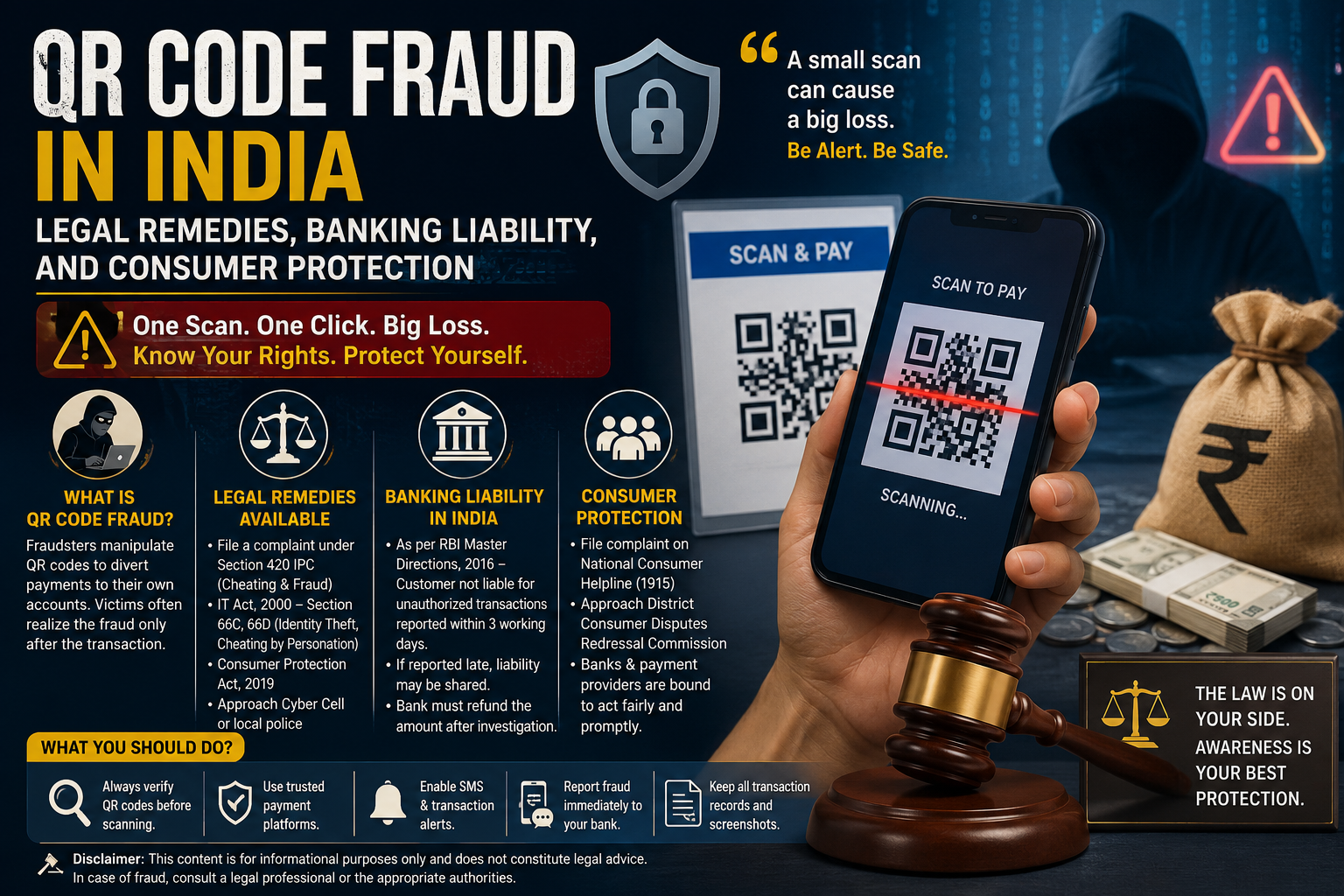
📌 Introduction
India has witnessed an unprecedented digital payment revolution over the past decade. The widespread adoption of UPI (Unified Payments Interface), QR code-based payments, mobile banking, digital wallets, and contactless transactions has transformed the way people transfer money. Today, purchasing groceries, paying utility bills, booking cabs, and even making small roadside payments often involves scanning a QR code.
While these technological advancements have made financial transactions faster and more convenient, they have also created new opportunities for cybercriminals. One of the fastest-growing forms of financial cybercrime in India is QR Code Fraud.
Fraudsters exploit the lack of public awareness, social engineering techniques, fake payment requests, counterfeit QR codes, and phishing tactics to deceive individuals into transferring money voluntarily. In many cases, victims mistakenly believe that scanning a QR code will receive money, whereas the transaction actually authorizes a payment from their own bank account.
QR code fraud has affected students, senior citizens, online buyers and sellers, small businesses, shopkeepers, professionals, and even experienced digital payment users. Such frauds often raise important legal questions:
⚖️ Is the bank liable for the loss?
⚖️ Can the victim recover the money?
⚖️ What are the legal remedies available?
⚖️ Which laws govern QR code fraud in India?
⚖️ Can compensation be claimed?
⚖️ What role do RBI guidelines play?
⚖️ What evidence should be preserved after a fraud?
This comprehensive guide answers these questions through an analysis of the applicable legal framework, banking regulations, consumer protection mechanisms, and practical remedies available under Indian law.
📱 What is QR Code Fraud?
A QR (Quick Response) Code is a machine-readable two-dimensional barcode that stores information such as payment details, website links, merchant information, or account identifiers.
In legitimate digital payments, QR codes simplify transactions by allowing users to scan a code instead of manually entering bank details.
QR Code Fraud occurs when criminals misuse QR codes or deceive users into making unauthorized payments, disclosing sensitive financial information, or accessing fraudulent websites.
Unlike traditional hacking, QR code fraud often relies more on psychological manipulation (social engineering) than on technical expertise.
⚠️ Understanding the Biggest Myth
One of the most common misconceptions exploited by fraudsters is:
Scanning a QR code never automatically credits money into your account.
In most UPI applications:
✅ Sending money generally requires scanning a QR code and authorizing the transaction.
✅ Receiving money usually does not require scanning a QR code.
Fraudsters exploit this misunderstanding by claiming:
“Scan this QR code to receive payment.”
“Scan to get your refund.”
“Scan to claim cashback.”
“Scan to verify your account.”
Once the victim scans the code and authorizes the transaction using the UPI PIN, money is transferred from the victim's account instead of being received.
🔍 How QR Code Payments Work
A standard QR payment generally follows these steps:
The payer opens a UPI application.
The QR code is scanned.
Merchant/payment details appear.
The payer enters the payment amount (if required).
The payer verifies the details.
The payer enters the UPI PIN.
The payment is processed.
This process is secure only if the QR code belongs to a genuine and trusted recipient.
Problems arise when criminals replace or manipulate the QR code or trick users into scanning fraudulent codes.
🚨 Common Types of QR Code Frauds
1. Fake Payment Collection Scam
This is the most common fraud.
Example:
A seller lists a product online.
A fraudster pretends to be a buyer and says:
“I'll pay immediately. Please scan this QR code to receive payment.”
The seller scans the code, enters the UPI PIN, and unknowingly transfers money to the fraudster.
2. Fake Merchant QR Code
Criminals paste counterfeit QR code stickers over genuine merchant QR codes.
Customers believe they are paying the shopkeeper, but the payment is actually credited to the fraudster's account.
Many shopkeepers discover this fraud only after reconciling their daily sales.
3. Refund Scam
Victims receive calls claiming to be from:
Banks
Amazon
Flipkart
Government departments
Courier companies
Electricity providers
They are told:
“Scan this QR code to receive your refund.”
Instead, money is debited.
4. Customer Care Scam
Fake customer care executives ask customers to scan QR codes to:
Cancel orders
Process refunds
Update KYC
Resolve account issues
Victims unknowingly authorize payments.
5. Fake Charity QR Codes
During disasters, festivals, or crowdfunding campaigns, fraudsters circulate fake donation QR codes through WhatsApp and social media.
Money intended for genuine charities reaches criminals instead.
6. Fake Government Scheme Scam
Fraudsters misuse the names of government schemes by claiming:
Subsidy released
Scholarship approved
Pension credited
PM scheme benefit sanctioned
Victims are asked to scan QR codes to receive the amount.
Instead, they lose money.
7. Job Offer Scam
Applicants are informed that:
Salary is ready.
Incentive has been approved.
Joining bonus is available.
The applicant scans the QR code and loses money.
8. Rental Scam
Property seekers are told to scan QR codes to:
Confirm booking
Block the property
Receive refundable deposits
The fraudster disappears after receiving the money.
🎯 Why QR Code Frauds Are Increasing in India
Several factors contribute to the rise of QR code fraud:
📱 Rapid growth of UPI transactions.
🌐 Increased dependence on digital payments.
📈 Low digital literacy among first-time users.
🎭 Sophisticated social engineering techniques.
📞 Easy impersonation through fake customer care calls.
💬 Heavy reliance on WhatsApp and social media.
💸 Faster transactions, leaving little time for verification.
As digital payment adoption expands, cybercriminals continue to develop new methods to exploit unsuspecting users.
👥 Who Is Most Vulnerable?
Although anyone can become a victim, certain groups are particularly targeted:
👴 Senior citizens
🎓 Students
🛍️ Online sellers
🛒 Small shopkeepers
🏪 Small business owners
🚕 Cab drivers
🏠 Property owners
💼 Freelancers
📦 OLX and Facebook Marketplace users
📱 First-time UPI users
⚖️ Real-Life Examples
Example 1
A person sells a mobile phone online for ₹15,000.
The "buyer" sends a QR code saying:
“Scan this to receive payment.”
The seller scans it, enters the UPI PIN, and ₹15,000 is debited.
Example 2
A restaurant's genuine QR code is replaced with a fake sticker.
Customers continue making payments, believing they are paying the restaurant.
At the end of the day, the restaurant receives no payment because all transactions went to the fraudster's account.
Example 3
A fake electricity department executive threatens disconnection unless a QR code is scanned to "update" the account. The victim scans it and authorizes a payment.
📜 Legal Framework Governing QR Code Fraud in India
QR code fraud is not governed by a single law. Instead, several statutes operate together to address different aspects of the offence.
1. Bharatiya Nyaya Sanhita, 2023 (BNS)
Depending on the facts of the case, QR code fraud may involve offences such as:
Cheating
Cheating by personation
Forgery (where fake QR codes or documents are used)
Criminal breach of trust (in appropriate circumstances)
The exact provisions depend on how the fraud was committed.
2. Information Technology Act, 2000
The IT Act applies where the fraud involves:
Computer systems
Electronic records
Digital communication
Online impersonation
Unauthorized access
Cyber offences
It complements the provisions of the BNS in cybercrime investigations.
3. Consumer Protection Act, 2019
Where there is:
Deficiency in banking service,
Unfair trade practice,
Failure of payment service providers, or
Consumer rights violations,
the Consumer Protection Act may provide remedies, including compensation in appropriate cases.
4. Reserve Bank of India (RBI) Directions
The RBI has issued various directions and circulars concerning:
Digital payment security
Customer protection
Unauthorized electronic banking transactions
Grievance redressal mechanisms
Responsibilities of regulated entities
These directions play a significant role in determining whether a customer, bank, or payment service provider bears liability.
🏦 Banking Liability in QR Code Fraud Cases
One of the first questions victims ask after losing money is:
“Will my bank refund the amount?”
The answer is not always straightforward. Banking liability in QR Code fraud depends on several legal and factual factors, including:
Whether the transaction was authorized or unauthorized.
Whether the customer voluntarily entered the UPI PIN.
Whether the bank followed RBI's security standards.
Whether there was negligence on the part of the customer, the bank, or a third party.
How quickly the fraud was reported.
Thus, every case is decided based on its own facts.
⚖️ Understanding the Concept of Liability
In legal terms, liability means legal responsibility for the financial loss.
In QR Code fraud cases, liability may fall upon:
🏦 The Bank
💳 Payment Service Provider (UPI App/Wallet)
👤 The Customer
🕵️ The Fraudster
🤝 More than one party, depending on the circumstances.
📜 RBI's Customer Protection Framework
The Reserve Bank of India (RBI) has issued guidelines for unauthorized electronic banking transactions, laying down principles for determining liability and customer protection.
The RBI emphasizes that:
Banks must maintain robust security systems.
Customers should promptly report unauthorized transactions.
Each complaint should be assessed on its own facts.
Liability depends on who was at fault.
These guidelines have become an important reference point in disputes involving digital payment fraud.
🏛️ Categories of Liability
1️⃣ When the Bank May Be Liable
The bank may bear responsibility where the loss is attributable to its own failure, such as:
Failure to maintain reasonable security measures.
System vulnerabilities.
Internal negligence.
Failure to comply with RBI directions.
Unauthorized transactions caused by deficiencies in the bank's systems.
In such situations, customers may be entitled to appropriate relief, subject to the applicable legal framework.
2️⃣ When the Customer May Be Liable
A customer may bear responsibility where the loss results primarily from their own actions, for example:
Sharing the UPI PIN.
Revealing OTPs or passwords.
Scanning a fraudulent QR code after ignoring clear warnings.
Voluntarily authorizing a payment without verifying the recipient.
Sharing confidential banking credentials with strangers.
However, merely being a victim of fraud does not automatically mean the customer is legally liable. The specific facts and evidence remain crucial.
3️⃣ Third-Party Fraud
In many QR Code fraud cases:
The bank's systems function correctly.
The customer's account is technically accessed through a valid transaction.
The fraud is committed by an external criminal using deception.
Here, liability becomes more complex and may require examination of:
the fraudster's conduct,
the customer's actions,
the bank's security measures, and
compliance with RBI guidelines.
📱 Liability of UPI Apps and Payment Platforms
Digital payment platforms play a significant role in QR code transactions.
These platforms are generally expected to:
🔒 Maintain secure payment infrastructure.
⚠️ Display fraud warnings.
🛡️ Detect suspicious transactions.
📞 Provide grievance redressal mechanisms.
🤝 Cooperate with investigating agencies.
Where there is a deficiency in service or non-compliance with applicable regulations, legal remedies may also be available against the relevant service provider, depending on the facts.
👤 Consumer Rights in QR Code Fraud Cases
Victims of QR code fraud continue to enjoy important legal protections.
They have the right to:
✅ Report the fraud immediately.
Prompt reporting improves the chances of freezing funds and initiating recovery procedures.
✅ Receive acknowledgment of their complaint.
Banks and regulated entities are generally expected to register and process customer complaints.
✅ Seek grievance redressal.
If dissatisfied with the bank's response, customers may pursue the available grievance mechanisms provided under law and RBI regulations.
✅ Approach Consumer Commissions
Where there is alleged deficiency in banking or payment services, consumers may seek remedies under the Consumer Protection Act, 2019, subject to the facts of the case.
Possible reliefs may include:
Compensation (where legally justified)
Refund (in appropriate circumstances)
Costs
Other suitable directions
⚖️ Duty of the Customer
Consumer rights are accompanied by certain responsibilities.
Customers should:
Never share their UPI PIN.
Never disclose OTPs.
Verify the recipient's name before approving a payment.
Check whether the transaction is a Pay request or a Collect request.
Immediately report suspicious activity.
Failure to take reasonable precautions may affect the determination of liability in some cases.
🚨 Importance of Immediate Reporting
Time is critical in cyber fraud.
Victims should report the incident:
As soon as possible after noticing the fraud.
To the bank or payment service provider.
Through the National Cyber Crime Helpline (1930) or the National Cyber Crime Reporting Portal.
To the local police or cyber police station, where appropriate.
Early reporting increases the possibility of tracing or freezing the funds before they are withdrawn or transferred further.
📂 What Evidence Should You Preserve?
Strong evidence can significantly assist an investigation and any legal proceedings.
Preserve:
📱 Screenshots of the transaction.
📄 Bank statement.
📩 SMS alerts.
📧 Email confirmations.
💬 WhatsApp or chat conversations.
📞 Call recordings (if legally available).
📷 Images of the QR code.
🧾 UPI transaction ID.
⏰ Date and time of the transaction.
Avoid deleting messages or transaction history until the matter is resolved.
⚖️ Can the Bank Refuse Every Refund?
No.
A bank cannot automatically reject every claim simply because the customer entered the UPI PIN.
Each complaint must be assessed on its own facts, including:
Whether there was deception.
Whether adequate security measures existed.
Whether RBI directions were followed.
Whether the bank acted promptly after receiving the complaint.
Whether there was any deficiency in service.
⚖️ Judicial Approach in India
Indian courts have consistently emphasized:
Consumer protection in digital transactions.
Fair investigation of cyber fraud.
Accountability of financial institutions where warranted.
The need to examine each case based on its specific facts and evidence.
There is no universal rule that either the bank or the customer is always liable. Courts evaluate the circumstances of each dispute before determining responsibility.
📌 Practical Checklist for Victims
If you become a victim of QR code fraud:
🚫 Do not make any further payments.
📞 Contact your bank immediately.
📱 Call 1930 without delay.
🌐 File a complaint on the National Cyber Crime Reporting Portal.
📄 Preserve all digital evidence.
👮 Lodge an FIR or cyber crime complaint, where appropriate.
⚖️ If your grievance is not resolved, consider approaching the appropriate consumer forum or other competent authority after obtaining legal advice.
⚖️ Step-by-Step Legal Remedies Available to Victims
Becoming a victim of QR Code fraud does not mean that all legal options are exhausted. Indian law provides multiple remedies through criminal law, banking regulations, consumer protection mechanisms, and cybercrime reporting systems.
The key is acting quickly. The sooner the fraud is reported, the greater the possibility of tracing, freezing, or recovering the funds.
🚨 Step 1: Immediately Inform Your Bank
The first and most important step is to contact your bank or payment service provider as soon as you discover the fraudulent transaction.
Request the bank to:
🚫 Block further unauthorized transactions.
📝 Register your complaint.
📄 Provide a complaint or reference number.
🔍 Initiate an internal investigation.
📤 If possible, place the beneficiary account under scrutiny in accordance with applicable procedures.
Keep a record of every communication with the bank, including emails, SMS messages, complaint numbers, and call details.
☎️ Step 2: Call the National Cyber Crime Helpline – 1930
If you have been cheated through a QR Code payment, immediately call 1930, the National Cyber Crime Helpline.
The helpline is designed to assist victims of financial cyber fraud by facilitating prompt reporting and coordination with relevant stakeholders. Early reporting may increase the chances of freezing the fraudulently transferred funds before they are moved further.
When calling, keep the following information ready:
Name
Mobile number
Bank name
Transaction ID
Amount lost
Date and time of transaction
UPI ID (if available)
Account details of the recipient (if known)
🌐 Step 3: File a Complaint on the National Cyber Crime Reporting Portal
Victims should also submit an online complaint through the Government of India's National Cyber Crime Reporting Portal.
While filing the complaint, upload all available evidence, such as:
Screenshots
Bank statement
Transaction receipt
QR code image (if available)
Chat records
Emails
Call details
The more accurate and complete the information, the easier it becomes for investigating agencies to process the complaint.
👮 Step 4: Lodge an FIR or Cyber Crime Complaint
Depending on the facts and the nature of the offence, the victim may approach:
A local police station, or
A Cyber Crime Police Station.
The complaint should clearly mention:
The sequence of events.
The amount lost.
The method adopted by the fraudster.
The transaction details.
Details of any communication with the accused.
Attach copies of all relevant documents and digital evidence.
📂 Documents Commonly Required
Although requirements may vary, victims should generally keep the following documents ready:
✅ Identity proof
✅ Bank statement
✅ Transaction receipt
✅ UPI Transaction ID
✅ Mobile number used
✅ Screenshot of payment
✅ QR Code image (if available)
✅ Chat history
✅ Complaint acknowledgment from the bank
✅ Cyber complaint acknowledgment
✅ FIR copy (if registered)
🔍 How the Investigation Usually Proceeds
After receiving the complaint, investigating agencies may:
Obtain transaction records.
Trace the beneficiary account.
Collect digital evidence.
Seek information from banks and payment service providers.
Identify linked mobile numbers, devices, or IP-related data, where legally permissible.
Record statements of the complainant and other relevant persons.
The exact process depends on the facts of each case and the applicable legal provisions.
💰 Can the Money Be Recovered?
Recovery depends on several factors, including:
How quickly the fraud was reported.
Whether the funds are still available in the beneficiary account.
Whether the amount has been transferred to multiple accounts.
The progress of the investigation.
Orders passed by the competent authorities.
While recovery is possible in some cases, it cannot be guaranteed in every instance.
🏦 RBI Integrated Ombudsman Scheme
If a customer is dissatisfied with the bank's response—or if the bank fails to respond within the prescribed time—the customer may, where applicable, approach the RBI Integrated Ombudsman.
The Ombudsman examines complaints relating to deficiencies in banking services and may issue appropriate directions in accordance with the governing scheme.
⚖️ Consumer Commission Remedy
If the victim believes there has been:
Deficiency in banking service,
Deficiency by a payment service provider,
Negligence, or
Unfair trade practice,
a complaint may be filed before the appropriate Consumer Commission under the Consumer Protection Act, 2019, subject to maintainability.
Possible reliefs include:
💰 Compensation
💵 Refund (where justified)
📄 Litigation costs
📢 Appropriate directions to the service provider
🧾 Civil Remedies
Apart from criminal proceedings, victims may also have civil remedies depending on the circumstances.
A civil action may be considered where financial loss has resulted from:
Breach of contractual obligations,
Negligence,
Deficiency in service, or
Other legally recognized causes of action.
The appropriate remedy depends on the specific facts of each case.
📱 Importance of Digital Evidence
Digital evidence often plays a decisive role in QR Code fraud cases.
Examples include:
📸 Screenshots
💬 WhatsApp chats
📧 Emails
📱 SMS alerts
🧾 Transaction receipts
📄 Bank statements
📷 Images of the QR code
📞 Call recordings (where lawfully obtained)
📍 Transaction IDs
⏰ Time and date logs
Do not edit, delete, or alter these records, as doing so may affect their evidentiary value.
⚠️ Common Mistakes Made by Victims
Many victims unintentionally weaken their case by:
❌ Waiting several days before reporting the fraud.
❌ Deleting chats or call logs.
❌ Failing to preserve screenshots.
❌ Ignoring transaction IDs.
❌ Sharing incomplete information with the police or bank.
❌ Assuming that reporting only to the bank is sufficient.
Prompt action and proper documentation significantly improve the effectiveness of legal remedies.
🛡️ Role of Banks and Payment Service Providers
Banks and payment service providers are generally expected to:
Maintain secure payment systems.
Provide timely customer support.
Investigate reported frauds.
Cooperate with law enforcement agencies.
Comply with RBI regulations and applicable legal obligations.
Their responsibilities may be examined during dispute resolution, depending on the facts.
📌 Practical Checklist After QR Code Fraud
Immediately after discovering the fraud:
✅ Freeze or secure your bank account if advised.
✅ Change your UPI PIN and banking passwords.
✅ Inform your bank.
✅ Call 1930.
✅ File a complaint on the National Cyber Crime Reporting Portal.
✅ Lodge an FIR or cyber complaint where appropriate.
✅ Preserve all digital evidence.
✅ Follow up regularly with the bank and investigating authorities.
✅ Seek legal advice if the matter remains unresolved.
🛡️ How to Protect Yourself from QR Code Fraud
While legal remedies are available after a fraud occurs, prevention remains the most effective protection. Most QR Code scams rely on deception rather than technical hacking, making awareness the first line of defense.
✅ Safety Tips
1. Never Scan a QR Code to Receive Money
This is the golden rule.
If someone asks you to scan a QR code to receive money, treat it as a red flag. In most UPI transactions, receiving money does not require scanning a QR code or entering your UPI PIN.
2. Verify the Recipient's Name
Before authorizing any payment:
Check the recipient's name displayed in the UPI app.
If the name is unfamiliar or suspicious, do not proceed.
Never rely solely on the sender's claims.
3. Never Share Your UPI PIN or OTP
Banks, RBI, payment apps, and government authorities never ask customers to share:
UPI PIN
OTP
Debit/Credit Card PIN
CVV
Net Banking Password
Anyone asking for these details is likely attempting fraud.
4. Beware of Fake Customer Care Numbers
Many fraudsters advertise fake customer care numbers on search engines or social media.
Always obtain customer support details from:
The official website.
The official mobile application.
Official customer support channels.
5. Inspect Merchant QR Codes
Before making a payment at a shop:
Check whether a sticker has been pasted over the original QR code.
If the QR code appears damaged, replaced, or suspicious, verify it with the merchant.
6. Avoid Clicking Unknown Links
Fraudsters often combine QR code scams with phishing links sent through:
SMS
Telegram
Social media
Never click unknown links or install applications sent by strangers.
7. Keep Banking Apps Updated
Updated applications include:
Security patches
Fraud detection improvements
Bug fixes
Better encryption
Using outdated applications may increase security risks.
8. Enable Banking Alerts
Activate:
SMS alerts
Email notifications
Push notifications
Immediate alerts help detect unauthorized transactions quickly.
9. Report Fraud Immediately
If you suspect fraud:
Contact your bank immediately.
Call 1930.
File a complaint on the National Cyber Crime Reporting Portal.
Preserve all digital evidence.
Prompt action may improve the chances of preventing further loss.
❓ Frequently Asked Questions (FAQs)
Q1. Is scanning a QR code always safe?
No. A QR code itself is not harmful, but scanning a fraudulent QR code may lead to unauthorized payments or phishing websites.
Q2. Can scanning a QR code alone debit money?
Generally, no. A payment usually requires additional authorization, such as confirming the transaction and entering the UPI PIN. However, users should always exercise caution.
Q3. Can I get my money back after QR Code fraud?
Possibly. Recovery depends on factors such as timely reporting, the stage of the investigation, and the specific facts of the case. Recovery cannot be guaranteed.
Q4. Should I report the fraud to my bank first or the police?
Ideally, report it immediately to your bank, call 1930, and file a cybercrime complaint without delay. Where appropriate, lodge an FIR or approach the Cyber Crime Police Station.
Q5. Is QR Code fraud a criminal offence?
Yes. Depending on the facts, QR Code fraud may attract provisions of the Bharatiya Nyaya Sanhita, 2023, the Information Technology Act, 2000, and other applicable laws.
Q6. Is the bank always liable?
No. Liability depends on the facts, including the customer's conduct, the bank's compliance with RBI guidelines, and the circumstances of the fraud.
Q7. Can businesses also become victims?
Yes. Shopkeepers and businesses are often targeted through fake QR code stickers placed over genuine payment codes.
Q8. Can legal action be taken against the fraudster?
Yes. Criminal proceedings may be initiated against the accused in accordance with applicable law.
📌 Key Takeaways
✅ QR Code fraud is one of India's fastest-growing digital payment scams.
✅ Most scams rely on social engineering, not technical hacking.
✅ Never scan a QR code merely to receive money.
✅ Never share your UPI PIN or OTP.
✅ Verify the recipient's identity before authorizing a payment.
✅ Report fraud immediately to your bank and through the appropriate cybercrime channels.
✅ Preserve all digital evidence for investigation and legal proceedings.
✅ Banking liability depends on the facts of each case and applicable RBI guidelines.
✅ Consumer protection remedies may be available where there is a deficiency in service.
✅ Awareness and prompt action remain the best defenses against QR Code fraud.
⚠️ Legal Disclaimer
This article is intended solely for educational and informational purposes and does not constitute legal advice.

Leave a Comment
Your email address and mobile number will not be published. Required fields are marked *