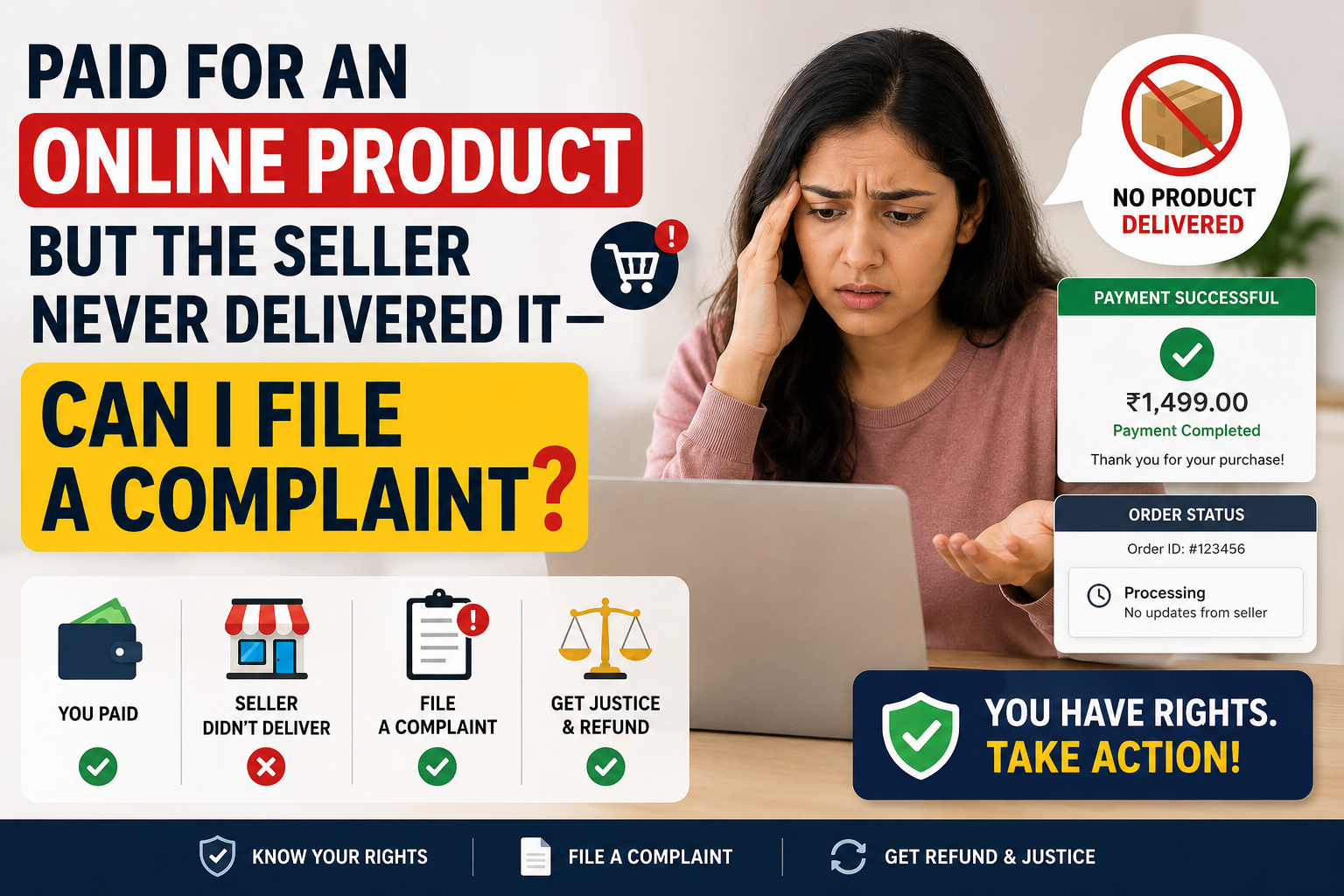
🛒 A Practical Legal Guide for Indian Consumers
Imagine this:
You find a product online. 🛍️
The price looks reasonable. You place the order, make the payment through UPI, debit card, credit card, net banking or another online payment method, and receive an order confirmation.
The seller promises delivery within a few days.
You wait.
Then the promised delivery date passes.
📦 No product.
You contact the seller.
No satisfactory response.
You send messages.
They say, “Your order is being processed.”
You wait again.
Then suddenly:
❌ The seller stops responding.
❌ The tracking information does not work.
❌ The seller refuses to refund your money.
❌ The website becomes unavailable.
❌ Your calls and messages are ignored.
At this point, many consumers think:
«"I have already paid. What can I legally do now?"»
The answer is important:
✅ Yes, in appropriate circumstances, you can take legal action against the seller and/or the concerned e-commerce entity.
A failure to deliver a product after accepting payment may give rise to a consumer grievance and, depending upon the circumstances, may involve issues relating to deficiency, unfair trade practice, breach of the transaction terms, or other legal violations.
The Consumer Protection Act, 2019 provides a framework for protecting consumer rights and seeking redressal. The Consumer Protection (E-Commerce) Rules, 2020 specifically apply to goods and services bought or sold through digital or electronic networks, including different e-commerce models.
This guide explains what a prudent consumer should do—from preserving evidence to approaching the seller, National Consumer Helpline, Consumer Commission, payment provider and, where appropriate, law-enforcement authorities.
🔎 1. First Question: Is This Really a Consumer Dispute?
Before taking legal action, understand the nature of your transaction.
Suppose you purchased:
- 👕 Clothes
- 📱 A mobile phone
- 💻 A laptop
- 🎧 Earphones
- 🪑 Furniture
- 👟 Shoes
- 📚 Books
- 🧴 Cosmetics
- 🏠 Household goods
- 🎁 A gift item
- 💻 Digital products
- 📦 Any other consumer product
You paid the seller, but the product was never delivered.
Generally, this is the type of dispute that can fall within the consumer-protection framework, subject to the facts of the particular transaction.
The Consumer Protection (E-Commerce) Rules, 2020 cover goods and services purchased or sold through digital or electronic networks and apply across e-commerce models.
Therefore, an online transaction is not automatically outside consumer law simply because you purchased the product through a website, application, social-media seller or other digital platform.
⚖️ 2. What Is the Legal Problem When You Pay but Receive Nothing?
The basic problem is simple:
You performed your part of the transaction.
You paid the agreed amount.
But the seller did not perform theirs.
The seller was expected to supply the product according to the transaction terms.
If the seller accepts payment and then fails to deliver without a valid justification, the consumer may have grounds to seek an appropriate remedy.
The precise legal characterization depends upon the facts.
For example:
Situation A — Genuine delay
The seller has actually dispatched the product but a logistics problem has caused delay.
This may be different from:
Situation B — Seller never intended to deliver
The seller accepts payment, repeatedly gives false assurances and eventually disappears.
That situation may raise much more serious concerns.
Situation C — Seller cancels but does not refund
The seller cancels the order but retains the consumer's money.
This can give rise to a refund-related consumer grievance.
Situation D — Seller falsely claims delivery
The seller's system says "delivered" even though the consumer never received the product.
The consumer should immediately preserve evidence and challenge the delivery status.
🛡️ 3. Your Consumer Rights Matter
Consumer protection is not merely about receiving a product.
The Consumer Protection Act, 2019 recognizes important consumer rights, including the right to be informed, right to choose, right to be heard and right to seek redressal.
For an online purchaser, these rights have practical significance.
You should ordinarily be able to know:
💰 What you are paying
📦 What product you are buying
🚚 What delivery terms apply
🔄 What the cancellation/refund policy says
🏪 Who the seller is
📞 How to contact the grievance officer or customer support
🧾 What transaction you actually entered into
An online transaction should not mean that the consumer loses legal protection.
🛒 4. What If I Purchased Through a Marketplace?
This is a very common situation.
Suppose you purchased a product through an online marketplace.
You paid ₹5,000.
The marketplace generated the order.
But the actual product was supplied by a third-party seller.
Now the question arises:
«"Whom should I complain against—the marketplace or the seller?"»
The answer depends upon the structure of the transaction and the conduct of the parties.
The Consumer Protection (E-Commerce) Rules, 2020 distinguish between different e-commerce models and contain duties relating to e-commerce entities and sellers.
Therefore, do not automatically assume that only the individual seller can be approached.
Practical approach:
Keep records showing:
- Name of marketplace
- Name of seller
- Order number
- Product description
- Amount paid
- Payment details
- Delivery promise
- Seller communication
- Complaint ticket
- Refund request
- Marketplace response
Then determine whom the grievance should appropriately be directed against.
📱 5. What If I Bought the Product Through Instagram or WhatsApp?
This situation requires additional caution.
Many small sellers operate through:
🌐 Independent websites
📢 Online advertisements
Suppose an Instagram seller advertises a product.
You contact them through DM.
They provide a UPI ID.
You transfer ₹3,000.
They promise delivery within seven days.
Nothing arrives.
Then they block you.
Can you complain?
Potentially, yes.
But the first challenge is often identifying the person behind the account and proving the transaction.
Therefore, preserve:
📸 Screenshots of the profile
📸 Advertisement
📸 Product listing
📸 Chat messages
📸 Seller's phone number
📸 UPI ID
📸 Bank details
📸 Payment receipt
📸 Order confirmation
📸 Any invoice
📸 Promised delivery date
📸 Refund communication
Do not delete the conversation simply because the seller has stopped responding.
Those digital records may become important evidence.
💰 6. What Evidence Should You Preserve?
This is one of the most important practical steps.
Create an "evidence folder." 📂
Save everything relating to the transaction.
1️⃣ Order confirmation
Take a screenshot showing:
- Order number
- Product
- Price
- Date
- Seller
- Delivery address
- Expected delivery date
2️⃣ Payment proof
Keep:
- UPI transaction receipt
- Bank statement
- Card statement
- Payment gateway receipt
- Transaction ID
- Reference number
3️⃣ Seller communication
Save:
- WhatsApp chats
- Emails
- Instagram messages
- SMS
- Customer-support conversations
4️⃣ Product advertisement
Save the original advertisement or listing if possible.
5️⃣ Delivery promise
If the seller promised:
«"Delivery within 5 days"»
preserve that representation.
6️⃣ Cancellation/refund request
Keep proof showing that you requested cancellation or refund.
7️⃣ Seller's response
If the seller says:
«"Refund will be processed tomorrow"»
save that message.
⚠️ 7. Why Screenshots Are Important
Imagine going to a complaint authority six months later and saying:
«"I ordered something online and the seller never delivered."»
The authority will naturally ask:
Where is the proof?
That is why documentation matters.
A consumer dispute is not merely about telling your story.
You need to demonstrate:
Order → Payment → Promise → Non-delivery → Complaint → Failure/refusal to resolve
Think of this as your evidence chain. 🔗
📞 8. Step One: Contact the Seller
Before immediately escalating the matter, send a clear written complaint to the seller.
Do not rely only on telephone calls.
Why?
Because a written communication creates a record.
🏢 9. Contact the E-Commerce Platform
If you purchased through a marketplace, raise a formal complaint through the platform.
Look for:
🔹 Help Centre
🔹 Customer Support
🔹 Order Complaint
🔹 Refund Request
🔹 Seller Complaint
🔹 Grievance Officer
The Consumer Protection framework provides for grievance mechanisms in e-commerce. Government material regarding the e-commerce framework states that e-commerce entities are required to maintain grievance redressal mechanisms and provide grievance-officer details.
Therefore, do not simply complain through an informal chat if the platform provides a formal grievance mechanism.
📢 10. What Is the National Consumer Helpline?
If the seller/platform does not resolve the matter, one practical next step is the:
🇮🇳 National Consumer Helpline (NCH)
The NCH is operated by the Department of Consumer Affairs and functions as a pre-litigation grievance mechanism.
Consumers can register grievances and submit relevant documents.
The NCH states that grievances can be lodged through its portal, app, UMANG, WhatsApp and telephone channels.
📞 NCH Helpline
1915
The official NCH contact page also lists 1800-11-4000 and provides WhatsApp support at 8800001915.
The helpline operates from 8 AM to 8 PM, except national holidays, according to the official NCH contact information.
🌐 11. How Does NCH Help?
The NCH is not the same thing as a Consumer Commission.
This distinction is important.
NCH provides a pre-litigation grievance redressal mechanism.
According to the NCH's official information, a grievance is registered and a unique docket number is generated. The grievance can then be forwarded to the concerned company, agency, regulator or other relevant stakeholder for resolution.
In simple language:
You can think of the process as:
Consumer → NCH → Company/Seller → Resolution
If the issue is not satisfactorily resolved, the consumer may consider approaching the appropriate Consumer Commission.
🧾 12. What Documents Should You Attach to an NCH Complaint?
Prepare a concise evidence package.
Recommended documents:
✅ Order confirmation
✅ Invoice
✅ Payment receipt
✅ Bank/UPI transaction proof
✅ Screenshots of product listing
✅ Expected delivery date
✅ Communication with seller
✅ Complaint number from platform
✅ Refund request
✅ Seller's response
✅ Screenshots showing non-delivery
Don't upload hundreds of irrelevant screenshots.
Instead, organize the important evidence chronologically.
⚖️ 13. What If NCH Does Not Solve the Problem?
This is where the Consumer Commission becomes important.
The Consumer Protection Act, 2019 provides a formal consumer dispute redressal mechanism.
A consumer may approach the appropriate Consumer Commission for relief, subject to the Act and applicable jurisdictional/procedural requirements.
Government material explains that consumer complaints can be filed by the consumer personally or through an advocate/agent, and online filing facilities have been developed for consumer complaints.
🏛️ 14. Can I File a Consumer Complaint Online?
Yes, online filing facilities are available for consumer complaints.
The Government of India's India Portal describes the e-Daakhil system as an online facility through which consumers and advocates can file consumer complaints along with applicable fees.
The current digital consumer-dispute ecosystem also includes e-Jagriti, which is linked through the National Consumer Helpline's official portal.
This means a consumer does not necessarily have to begin with physically travelling to the seller's city.
💡 15. What Relief Can I Ask For?
Suppose you paid ₹8,000 but received nothing.
What can you ask for?
Depending upon the facts and legal basis of the complaint, possible relief may include:
💰 Refund
You may seek refund of the amount paid.
💸 Compensation
Depending on the circumstances, you may seek appropriate compensation for loss or harm caused by the conduct complained of.
📦 Delivery
If you still want the product and the circumstances justify it, you may seek appropriate relief concerning delivery.
⚖️ Other appropriate directions
A Consumer Commission can grant relief within its statutory powers based on the facts and evidence.
The Consumer Protection framework recognizes the consumer's right to redressal and compensation in appropriate circumstances.
🚨 16. Can I Ask for Compensation for Mental Harassment?
Consumers sometimes say:
«"I suffered mental harassment because the seller ignored me."»
A claim for compensation should not be treated as an automatic fixed amount.
The consumer should explain the actual circumstances and loss/harm relied upon.
For example:
- Significant financial loss
- Repeated unsuccessful attempts to obtain refund
- Unreasonable conduct
- Loss caused by the transaction
- Other provable consequences
The appropriate relief depends on the facts and the decision-making authority.
Practical tip:
Do not write:
«"I want ₹10 lakh because I was mentally harassed."»
without explaining why.
Instead, clearly document:
What happened → What loss occurred → What evidence proves it → What relief is being requested.
🧑⚖️ 17. Do I Need a Lawyer to File the Complaint?
Yes
Consumer complaints can be pursued by consumers themselves, although legal representation may be useful depending on the complexity of the matter.
Government material specifically notes that a consumer may file a complaint personally or through an advocate or agent.
For a straightforward non-delivery dispute involving a small amount, a consumer may choose to first attempt:
Seller → Platform → NCH → Consumer Commission
For complicated disputes, substantial amounts, multiple parties, fraud allegations or difficult legal questions, consulting an advocate may be sensible.
🚔 18. Is Non-Delivery Always a Criminal Offence?
❌ No.
This is an important distinction.
A seller's failure to deliver does not automatically mean that a criminal offence has occurred.
There is a difference between:
Consumer dispute
The seller failed to perform the transaction or resolve a consumer grievance.
and
Potential criminal conduct
The facts may indicate deception, fraudulent conduct or another offence.
For example, suppose:
A genuine business receives orders.
Due to a warehouse problem, 100 orders are delayed.
That does not automatically establish that the business committed a criminal offence.
But suppose:
A person creates a fake website, collects money from hundreds of people, never intended to deliver anything and disappears.
That raises a very different legal concern.
🚨 19. When Should You Consider a Cybercrime/Police Complaint?
If the facts indicate possible fraud or cheating, a consumer should consider whether a police or cybercrime complaint is also appropriate.
Examples may include:
🔴 Fake online store
🔴 Fake seller identity
🔴 Multiple victims
🔴 Deliberate collection of payments without intention to supply
🔴 Fake payment/refund promises
🔴 Seller disappears immediately after receiving money
🔴 Unauthorized payment
🔴 Fraudulent use of another person's identity
🔴 Manipulation of transaction records
The exact criminal provisions applicable will depend on the facts and evidence.
Important:
Do not casually label every delayed order as “cybercrime.”
First understand what actually happened.
💳 20. What About the Bank, UPI App or Payment Gateway?
Suppose you paid through:
📱 UPI
💳 Debit card
💳 Credit card
🏦 Net banking
💰 Wallet
💻 Payment gateway
You should preserve the transaction information and, where appropriate, contact the payment provider.
However, remember:
Payment dispute ≠ automatic refund.
A payment provider may have its own dispute or complaint mechanism, but whether money can be reversed depends on the payment method, transaction circumstances and applicable rules.
Therefore, do not assume:
«"I paid through UPI, so the bank will definitely reverse it."»
Instead:
1. Report the issue promptly.
2. Provide transaction details.
3. Ask what dispute mechanism is available.
4. Preserve the complaint/reference number.
📸 21. What If the Seller Deletes the Instagram Account?
This is another common problem.
Suppose you have:
- Screenshot of the seller's account
- Screenshot of the advertisement
- Chat history
- UPI transaction
- Phone number
- Bank/payment details
Then deleting the account does not automatically erase the evidence you already possess.
Save everything immediately.
If possible, preserve:
📸 Screenshots
📄 Downloaded invoices
💬 Chat exports
🧾 Payment receipts
🔗 Relevant URLs
📱 Phone numbers
🏦 Transaction IDs
Do not edit screenshots in a way that creates doubts about authenticity.
🧠 22. What If the Seller Says "Your Order Was Delivered"?
This situation requires immediate action.
Suppose you never received the package.
But the platform says:
«"Delivered."»
Do not simply accept it.
Ask for:
📦 Delivery date
📦 Delivery time
📦 Tracking details
📦 Proof of delivery
📦 Delivery person's information, where available
📦 Any OTP/delivery confirmation
📦 Relevant courier information
Then formally dispute the delivery.
If the seller or platform refuses to resolve the issue, preserve the entire communication trail.
📦 23. What If the Seller Sends the Wrong Product?
That is slightly different from complete non-delivery, but the same evidence principles apply.
Suppose you ordered:
iPhone 15
but received:
a cheap accessory.
You should immediately:
1. Photograph the package.
2. Photograph the shipping label.
3. Photograph the product.
4. Preserve the invoice.
5. Record the unboxing process if available.
6. Raise a complaint.
7. Request replacement/refund as appropriate.
The Consumer Protection (E-Commerce) Rules contain provisions addressing situations involving defective, deficient, spurious goods, goods that do not match advertised/agreed characteristics, and late delivery in specified circumstances.
⏳ 24. How Long Should I Wait Before Complaining?
Do not wait indefinitely.
If the promised delivery date was:
10 August
and today is:
25 August
you should not continue waiting for weeks without taking action.
Practical approach:
📅 Delivery date passes
↓
📞 Contact seller
↓
📧 Send written complaint
↓
🛒 Complain to platform
↓
📢 Seek refund
↓
🇮🇳 Approach NCH if unresolved
↓
⚖️ Consider Consumer Commission
↓
🚔 Consider police/cyber complaint if facts indicate possible criminal conduct
The exact timing will depend on the circumstances.
📝 25. Should I Send a Legal Notice?
A legal notice can be useful in appropriate cases.
It can formally communicate:
- Transaction details
- Amount paid
- Failure to deliver
- Previous attempts to resolve
- Demand for delivery/refund
- Consequences of non-compliance
However, a legal notice is not always the first or mandatory step in every consumer dispute.
For a small online purchase, starting with the seller/platform and NCH may be more proportionate.
For a substantial-value dispute or where
📱 26. What If the Website Has No Address?
This is a major warning sign.
A legitimate online seller should provide meaningful information that allows consumers to identify the business and understand how grievances can be addressed.
If a website:
❌ Has no physical/business details
❌ Has no customer-support mechanism
❌ Has no grievance information
❌ Uses only a random Gmail address
❌ Demands payment through a personal account
❌ Offers prices far below market value
❌ Disappears after payment
you should exercise extra caution.
If money has already been paid, preserve all available evidence.
🚨 27. Don't Make the Situation Worse
After being cheated or disappointed, consumers sometimes make mistakes.
Don't:
❌ Abuse the seller
❌ Threaten violence
❌ Publish personal information
❌ Hack the seller's account
❌ Send threatening messages
❌ Fabricate evidence
❌ Edit screenshots misleadingly
❌ Make false allegations against unrelated people
Instead:
Do:
✅ Preserve evidence
✅ Communicate professionally
✅ Use formal grievance channels
✅ Keep complaint numbers
✅ Document dates
✅ Escalate systematically
🧭 28. Your Practical Legal Roadmap
Here is the simplest roadmap to remember:
🛒 STEP 1 — Confirm the transaction
Keep the order number and invoice.
⬇️
💳 STEP 2 — Preserve payment proof
Save the transaction ID and bank/payment record.
⬇️
📸 STEP 3 — Preserve seller evidence
Screenshots, chats, advertisements and contact details.
⬇️
📞 STEP 4 — Contact seller
Demand delivery or refund.
⬇️
🛍️ STEP 5 — Complain to marketplace
Use its formal grievance mechanism.
⬇️
🇮🇳 STEP 6 — Approach National Consumer Helpline
NCH provides a pre-litigation grievance mechanism.
⬇️
⚖️ STEP 7 — Consumer Commission
If the grievance remains unresolved, consider filing an appropriate consumer complaint.
⬇️
🚔 STEP 8 — Police/Cyber route where appropriate
If the facts indicate potential fraud or another criminal offence.
📌 29. What Should You Ask For?
Don't make your demand vague.
Depending upon the circumstances, you may request:
Primary relief:
💰 Full refund of the amount paid
And where legally justified:
Additional relief:
💸 Compensation
📑 Appropriate costs
⚖️ Other appropriate directions
If you still want the product:
📦 Delivery may be requested where legally appropriate.
🧠 30. The Most Important Lesson for Online Consumers
Online shopping has made purchasing incredibly convenient.
With a few taps, you can purchase a product from another city—or even another part of the country.
But convenience comes with a responsibility:
Keep your evidence.
The most important documents are often not complicated legal documents.
They are:
📱 Your screenshot
💳 Your payment receipt
🧾 Your invoice
📦 Your order confirmation
💬 Your conversation
📧 Your email
🔢 Your transaction ID
📅 Your promised delivery date
These small pieces of evidence can collectively establish what happened.
🏆 31. A “Consumer Evidence Checklist”
Before filing a complaint, check:
Order
☐ Order number
☐ Date of purchase
☐ Product description
☐ Seller name
☐ Price
☐ Expected delivery date
Payment
☐ Payment receipt
☐ Transaction ID
☐ Bank statement
☐ UPI reference
☐ Card statement
Communication
☐ Seller chats
☐ Emails
☐ Customer-support tickets
☐ Refund requests
☐ Seller responses
Platform
☐ Complaint number
☐ Platform response
☐ Cancellation request
☐ Refund status
Evidence
☐ Screenshots
☐ Advertisement
☐ Product listing
☐ Seller profile
☐ Tracking information
Legal escalation
☐ NCH complaint
☐ NCH docket/reference number
☐ Consumer complaint documents
☐ Police/cyber complaint, if appropriate
⚖️ 32. Consumer Protection Is About More Than Getting Your Money Back
A consumer complaint serves an important purpose.
If businesses know that consumers will remain silent whenever a transaction goes wrong, poor practices may continue.
But when consumers:
📢 Raise complaints
📑 Preserve evidence
⚖️ Use legal remedies
🔎 Demand transparency
businesses have greater incentives to maintain responsible practices.
The Consumer Protection Act, 2019 is designed to protect consumer interests and provide mechanisms for redressal. The Department of Consumer Affairs also identifies the right to redressal as one of the core consumer rights.
🌐 33. Useful Official Resources
🇮🇳 National Consumer Helpline
You can use the official National Consumer Helpline portal to register and track consumer grievances.
National Consumer Helpline — Official Portal
📞 NCH Contact
The official NCH contact page lists:
1915
1800-11-4000
WhatsApp: 8800001915
⚖️ Consumer Protection Act
The Department of Consumer Affairs provides the Consumer Protection Act, 2019 and associated rules on its official website.
💻 Online Consumer Complaint Filing
The Government of India provides information about the e-Daakhil system for online consumer complaints.
🎯 34. Final Takeaway
If you paid for an online product and the seller never delivered it, you do not have to simply accept the loss.
Your practical course of action can be:
💳 Pay → 📦 No Delivery → 📸 Preserve Evidence → 📞 Contact Seller → 🛒 Complain to Platform → 🇮🇳 NCH → ⚖️ Consumer Commission
And if the circumstances indicate deliberate fraud rather than an ordinary consumer dispute, consider the appropriate police/cybercrime route as well.
The most important thing is to act systematically.
Don't simply send:
“Please refund my money.”
Instead, create a record:
I ordered this product on this date.
I paid this amount.
Delivery was promised by this date.
The product was not delivered.
I contacted you on these dates.
I requested refund.
You failed/refused to resolve the issue.
Here is my evidence.
That is a much stronger position.
🛡️ Remember:
Online payment does not mean you surrender your consumer rights.
If a seller accepts your money but fails to deliver what was promised, the law provides mechanisms through which an aggrieved consumer can seek appropriate redressal.
The key is not to panic, not to delete evidence, and not to wait indefinitely.
Know your rights. Preserve your proof. Follow the proper legal route.
⚠️ Legal Disclaimer
This article is intended for general legal awareness and educational purposes in India.

Leave a Comment
Your email address and mobile number will not be published. Required fields are marked *