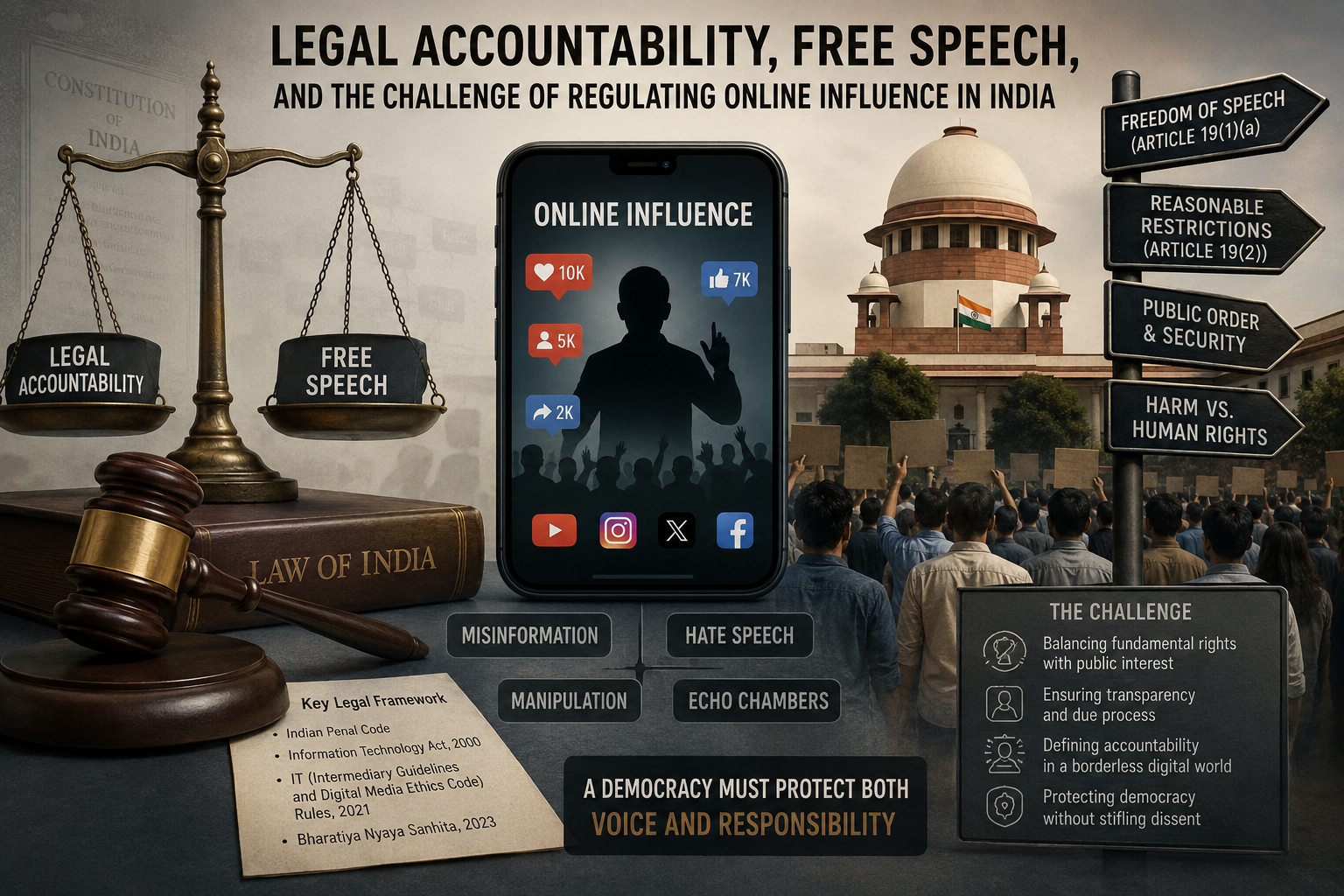
Introduction:
The digital revolution has fundamentally transformed how information is created, distributed, and consumed. Social media platforms have turned ordinary individuals into public influencers with the power to shape opinions, markets, elections, lifestyles, and even legal narratives. Today, influencers are not merely entertainers or content creators; they are opinion leaders, advertisers, political commentators, financial advisors, and social mobilizers.
Platforms such as "Instagram","Meta social media platform"] "YouTube","Google video-sharing platform"] "Facebook","Meta social networking platform"]and "X","Social media platform formerly Twitter"] have enabled individuals to reach millions of people within seconds. This digital influence has created new economic opportunities and democratized public participation. However, it has also produced one of the most pressing legal and social challenges of the modern era: the rapid spread of misleading information.
False claims, manipulated content, deepfakes, fake news, deceptive advertising, and unverified medical or financial advice now circulate online at unprecedented speed. Influencers with large followings can significantly impact public behaviour, often without institutional oversight or professional accountability.
In recent years, India has witnessed several controversies involving misinformation spread through social media platforms. Misleading investment advice, fake health remedies, manipulated political narratives, communal rumours, and undisclosed paid promotions have raised serious concerns regarding public safety, consumer protection, democratic integrity, and constitutional freedoms.
The rise of artificial intelligence and algorithm-driven content amplification has intensified these risks. Viral misinformation can now spread faster than factual reporting, creating panic, economic harm, reputational damage, and social unrest.
This raises an important legal question:
To what extent should digital influencers be held legally responsible for spreading misleading information?
The answer is complex because it involves a difficult balance between:
Freedom of speech and expression
Consumer protection
Platform accountability
Public interest
Democratic values
Technological innovation
India’s legal system is still evolving to address these digital realities. Existing laws governing defamation, advertising standards, cybercrime, intermediary liability, consumer rights, and misinformation were largely developed before the explosion of influencer culture.
This blog critically examines the rise of digital influence, the legal consequences of online misinformation, the regulatory challenges facing India, the constitutional implications of content regulation, and the urgent need for a modern legal framework capable of balancing accountability with digital freedom.
🌐 Understanding Digital Influence in the Modern Era:
Digital influence refers to the ability of individuals or entities to shape public opinion and behaviour through online platforms.
Influencers operate across various categories, including:
Lifestyle and fashion
Fitness and health
Politics and public affairs
Finance and investment
Technology and education
Entertainment and gaming
Law and legal awareness
Unlike traditional media organizations, influencers often function without formal editorial structures or professional verification systems.
Their influence is driven by:
Personal branding
Audience trust
Emotional connection
Algorithmic visibility
Viral engagement
Many followers perceive influencers as more relatable and trustworthy than mainstream institutions.
This trust creates enormous persuasive power.
For example:
A financial influencer may affect investment decisions.
A health influencer may influence medical choices.
A political influencer may shape electoral perceptions.
A legal influencer may affect public understanding of laws.
As digital influence expands, the distinction between personal opinion and professional responsibility becomes increasingly blurred.
🚨 The Rise of Misleading Information Online:
Misleading information is not a new phenomenon. However, social media has dramatically accelerated its reach and impact.
Online misinformation may include:
Fake news
Manipulated videos
Deepfakes
Misleading advertisements
False health claims
Rumours and communal propaganda
Financial scams
Political disinformation
Edited or out-of-context content
Unlike traditional media, digital platforms reward engagement rather than accuracy.
Algorithms often amplify:
Sensational content
Emotional reactions
Polarizing narratives
Viral misinformation
As a result, misleading information can spread rapidly before fact-checking mechanisms intervene.
This creates serious risks for:
Public order
Democratic processes
Consumer safety
Public health
National security
The COVID-19 pandemic demonstrated how dangerous digital misinformation can become. False medical claims, fake cures, vaccine rumours, and conspiracy theories spread widely online, sometimes causing direct harm.
Similarly, misinformation relating to communal tensions, elections, and financial investments has created significant legal and social concerns in India.
💰 Influencer Culture and Commercialization:
The influencer economy is now a major commercial industry.
Brands collaborate with influencers to promote:
Products
Services
Financial schemes
Online applications
Educational platforms
Health supplements
Sponsored content often appears in the form of:
Paid promotions
Affiliate marketing
Product reviews
Testimonials
Live sessions
Viral challenges
However, many influencers fail to disclose commercial partnerships transparently.
This raises consumer protection concerns.
Followers may believe they are receiving genuine opinions rather than paid advertising.
Misleading promotions may involve:
Unrealistic investment returns
Unsafe products
Fake educational promises
Gambling applications
Health misinformation
Fraudulent business schemes
Young audiences are especially vulnerable because influencer marketing often appears authentic and relatable.
The commercialization of digital influence has therefore transformed misinformation into a significant legal and economic issue.
📚 Legal Framework Governing Misinformation in India:
India currently does not have a single comprehensive law specifically regulating influencer misinformation.
Instead, multiple legal frameworks apply depending on the nature of the content.
💻 Information Technology Act, 2000
The Information Technology Act remains India’s primary cyber law legislation.
Certain provisions may apply to misleading digital content.
Section 66D
Punishes cheating through online impersonation.
This may apply to:
Fake influencer accounts
Fraudulent schemes
Online scams
Section 67
Addresses publication of obscene material online.
Intermediary Liability
Social media platforms may receive limited legal protection as intermediaries if they comply with due diligence obligations.
However, platforms may lose protection if they knowingly allow unlawful content to continue.
The challenge lies in determining when platforms become responsible for harmful misinformation.
Information Technology Rules and Digital Regulation:
India’s Information Technology Rules introduced obligations regarding online content moderation.
Platforms may be required to:
Remove unlawful content
Establish grievance mechanisms
Respond to government notices
Exercise due diligence
Critics argue that excessive regulation may threaten freedom of speech.
Supporters believe stricter controls are necessary to combat digital harm.
The debate reflects a larger constitutional tension between regulation and liberty.
🛡️ Consumer Protection Laws and Influencer Liability:
The Consumer Protection Act, 2019 significantly expanded protections against misleading advertisements.
Influencers promoting products or services may face legal consequences for false endorsements.
The Central Consumer Protection Authority (CCPA) has issued guidelines requiring influencers to:
Disclose paid partnerships
Avoid deceptive claims
Ensure transparency in advertisements
Failure to comply may result in:
Monetary penalties
Removal orders
Restrictions on endorsements
These guidelines are particularly important in sectors such as:
Health products
Financial advice
Educational services
Gambling applications
The law increasingly recognizes that influencers are not merely casual speakers but commercial actors capable of affecting consumer behaviour.
🧾 Defamation and Reputational Harm:
Misleading online statements may also create defamation liability.
Under Indian law, defamation may be:
Civil
Criminal
Influencers spreading false allegations against individuals or businesses may face legal action.
Digital platforms amplify reputational harm because:
Content spreads rapidly
Viral posts remain permanently accessible
Public outrage escalates quickly
Even inaccurate accusations can cause severe damage.
The challenge for courts is balancing:
Reputation rights
Free speech protections
Public criticism
Journalistic freedom
🗳️ Misinformation and Electoral Integrity:
Digital misinformation has become a major concern during elections.
Political influencers and social media campaigns can shape public perception through:
Manipulated narratives
Fake videos
False statistics
Targeted propaganda
Coordinated disinformation campaigns
Deepfake technology further complicates the issue.
AI-generated speeches and manipulated videos may influence voters before verification occurs.
The Election Commission and courts face growing pressure to regulate online political misinformation without suppressing legitimate political speech.
This is especially difficult in democratic societies where political expression enjoys constitutional protection.
📈 Financial Influencers and Regulatory Challenges
One rapidly growing category involves “finfluencers” — financial influencers who provide investment-related advice online.
Many social media personalities now recommend:
Stocks
Cryptocurrency
Trading strategies
Mutual funds
Financial applications
The problem is that many lack:
Professional qualifications
Regulatory registration
Financial expertise
Misleading financial advice may result in:
Investor losses
Market manipulation
Fraudulent schemes
Regulators have increasingly scrutinized financial influencers for:
Hidden sponsorships
Pump-and-dump schemes
Misrepresentation of returns
This reflects the broader problem of unregulated digital authority.
Large follower counts often create perceived credibility even where expertise is absent.
🏥 Health Misinformation and Public Safety:
Health misinformation represents one of the most dangerous forms of misleading online content.
Influencers may spread:
Fake cures
Anti-vaccine claims
Dangerous diet practices
Unverified medical treatments
Pseudoscientific advice
Such content can directly affect public health.
The COVID-19 pandemic highlighted the consequences of uncontrolled digital misinformation.
False medical advice sometimes discouraged proper treatment or promoted unsafe remedies.
The legal challenge involves determining:
When misinformation becomes punishable harm
Whether intent matters
How platforms should respond
Excessive censorship risks suppressing legitimate debate.
However, unrestricted misinformation may threaten public safety.
🤖 Deepfakes and AI-Generated Misinformation:
Artificial intelligence has dramatically transformed misinformation.
Deepfake technologies can now create:
Fake speeches
Manipulated videos
Voice cloning
Artificial interviews
Synthetic media
These technologies raise serious legal concerns regarding:
Defamation
Privacy
Consent
Electoral manipulation
Fraud
Deepfakes may become increasingly difficult to detect.
This creates a crisis of digital authenticity.
Indian law currently lacks a comprehensive statutory framework specifically governing deepfake misuse.
Future regulation may require:
Mandatory disclosure obligations
AI watermarking systems
Criminal penalties for malicious impersonation
Platform detection responsibilities
📜 Constitutional Dimensions of Regulating Misinformation:
The regulation of digital misinformation inevitably raises constitutional concerns.
Article 19(1)(a): Freedom of Speech and Expression
The Constitution protects free speech as a fundamental democratic right.
Social media platforms have become modern public spaces for:
Political participation
Journalism
Public debate
Social activism
Excessive state control over online speech may threaten democratic freedoms.
At the same time, Article 19(2) permits reasonable restrictions in the interests of:
Public order
Defamation
Morality
Security of the State
Incitement to offences
The central challenge is distinguishing between:
Harmful misinformation
Legitimate dissent
Satire
Opinion
Political criticism
Governments may sometimes misuse misinformation laws to suppress criticism.
Therefore, safeguards against arbitrary censorship are essential.
🏛️ Platform Accountability and Intermediary Liability:
A major global debate concerns the responsibility of social media companies.
Should platforms be treated merely as neutral intermediaries?
Or should they actively monitor harmful misinformation?
Platforms increasingly influence:
Information visibility
Public discourse
Viral trends
Political narratives
Critics argue that algorithms often prioritize engagement over truth.
Supporters of stronger regulation believe platforms should bear greater responsibility.
However, mandatory monitoring raises practical and constitutional concerns:
Risk of over-censorship
Automated moderation errors
Chilling effect on speech
Reduced digital freedom
Balancing accountability with open expression remains one of the most difficult regulatory challenges.
⚠️ Challenges in Enforcing Misinformation Laws:
Even where laws exist, enforcement remains difficult.
1. Speed of Viral Content
Misinformation spreads rapidly.
Legal action often occurs too late.
2. Jurisdictional Issues
Digital platforms operate globally.
Cross-border enforcement is complex.
3. Anonymous Accounts
Fake profiles complicate identification.
4. Defining “Misleading Information”
Determining truth is often controversial.
Political narratives may involve subjective interpretation.
5. Technological Evolution
AI-generated misinformation evolves faster than regulation.
These challenges demonstrate that traditional legal systems struggle to address digital realities.
✅ Ethical Responsibilities of Influencers:
Beyond legal liability, influencers possess significant ethical responsibilities.
Influencers often benefit financially from audience trust.
Therefore, ethical obligations may include:
Verifying information before sharing
Disclosing paid promotions
Avoiding sensational misinformation
Respecting public safety concerns
Correcting false claims promptly
Digital influence carries social power.
With power comes responsibility.
The normalization of misinformation for engagement or profit may weaken public trust in digital communication itself.
🧠 The Psychological Impact of Online Misinformation:
Digital misinformation also affects mental and social behaviour.
Constant exposure to misleading content may produce:
Fear and panic
Social polarization
Distrust in institutions
Radicalization
Emotional manipulation
Algorithms often create “echo chambers” where users encounter only information reinforcing existing beliefs.
This may deepen societal divisions.
Influencers who exploit emotional outrage for visibility may contribute to long-term democratic instability.
🔍 The Role of Fact-Checking and Digital Literacy:
Legal regulation alone cannot solve misinformation.
Public awareness and digital literacy are equally important.
Users must learn to:
Verify sources
Identify manipulated content
Recognize sponsored promotions
Distinguish facts from opinions
Fact-checking organizations increasingly play an important role in combating misinformation.
Educational institutions may also need to introduce digital literacy programs.
The future fight against misinformation will require both legal reform and informed citizenship.
🚀 The Future of Digital Regulation in India:
India will likely witness stronger digital regulation in coming years.
Possible reforms may include:
1. Stricter Influencer Disclosure Rules
Mandatory transparency regarding paid promotions.
2. AI and Deepfake Regulation
Specific laws governing synthetic media.
3. Platform Accountability Standards
Clearer due diligence obligations.
4. Financial Influencer Regulation
Licensing or registration requirements for investment-related advice.
5. Digital Literacy Campaigns
Public education initiatives against misinformation.
6. Stronger Consumer Protection Mechanisms
Improved remedies for misleading endorsements.
However, future regulation must avoid creating excessive censorship powers.
Democratic freedoms must remain protected.
⚖️ Balancing Freedom and Accountability:
The central legal challenge is balancing free expression with social responsibility.
An overly permissive digital environment may encourage:
Fraud
Hate campaigns
Manipulation
Public harm
At the same time, excessive regulation may suppress:
Political dissent
Satire
Investigative journalism
Democratic participation
Therefore, legal responses must remain:
Transparent
Proportionate
Constitutionally consistent
Technologically informed
The solution does not lie in absolute censorship or complete deregulation.
Instead, India requires a nuanced framework that protects both democracy and public interest.
🏗️ The Need for Comprehensive Legal Reform:
India’s existing legal framework remains fragmented.
Different aspects of misinformation are currently governed through:
IT laws
Consumer protection laws
Defamation law
Advertising regulations
Criminal law
A comprehensive digital accountability framework may eventually become necessary.
Such a framework could address:
Influencer responsibility
AI-generated misinformation
Platform obligations
Deepfake liability
Transparency standards
User rights
Importantly, any reform must preserve constitutional freedoms while addressing genuine digital harms.
📌 Conclusion:
Social media influencers today hold significant power to shape public opinion, consumer behaviour, and digital trends. With this influence comes legal and ethical responsibility. Under Indian law, influencers may face liability for spreading misleading information, false advertisements, or harmful content, especially when it affects consumers or public safety. As misinformation and AI-generated content continue to grow online, stronger regulation, transparency, and responsible digital conduct are becoming essential for maintaining trust and accountability in the digital space.
📌 Important Note:
This blog is intended solely for educational and informational purposes.

Leave a Comment
Your email address and mobile number will not be published. Required fields are marked *