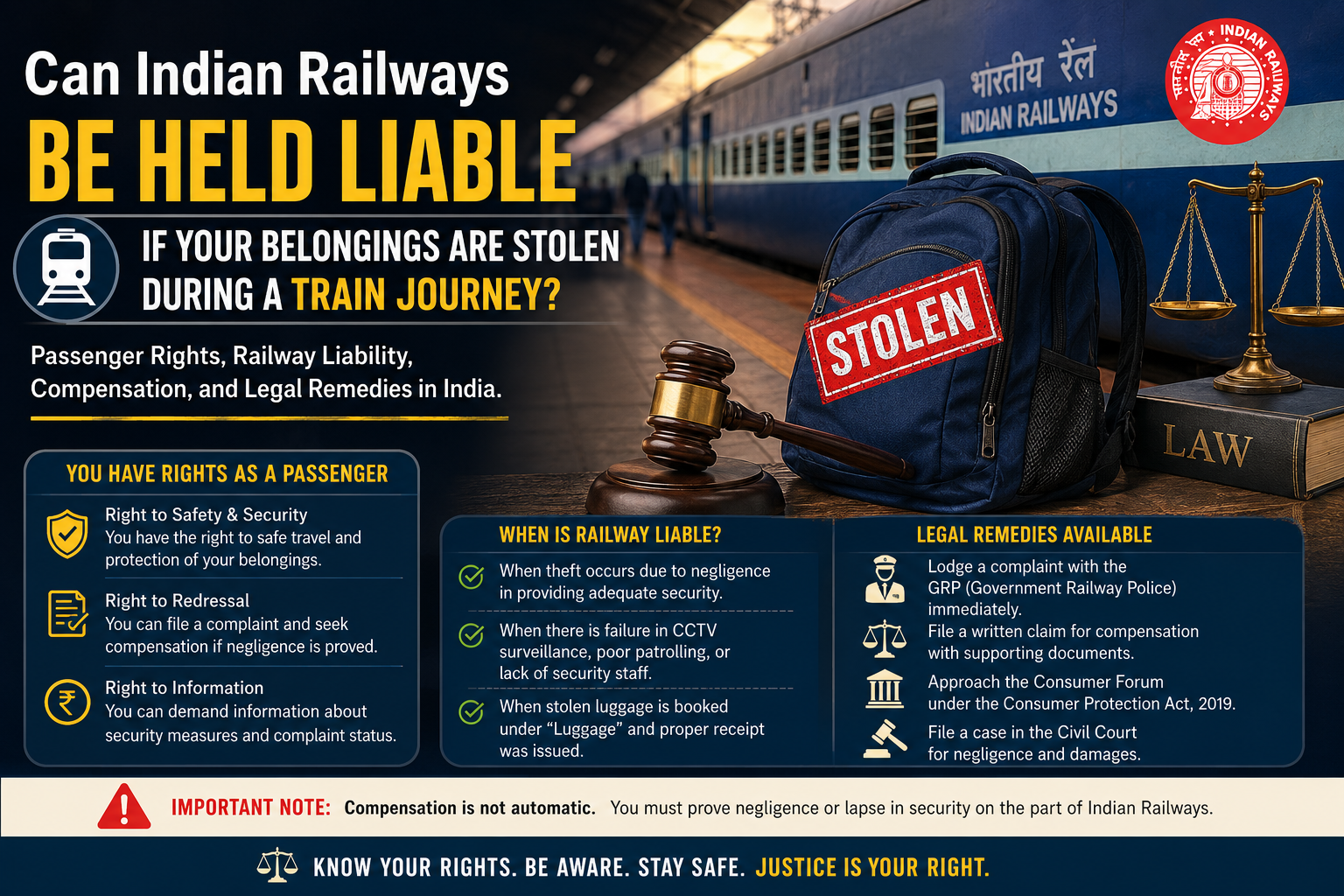
🚆 Introduction
Every day, millions of people travel through the Indian Railways network, making it one of the largest railway systems in the world. For most passengers, train travel is affordable, convenient, and safe. However, incidents of mobile phone theft, luggage theft, purse snatching, and missing baggage continue to occur on trains and at railway stations.
Imagine this situation:
You board a reserved train with your suitcase safely placed beneath your seat. After waking up the next morning, you discover that your luggage has disappeared. Your laptop, important documents, cash, and valuables are gone.
The first question that comes to mind is:
Can Indian Railways be held legally responsible for this loss?
The answer is not always.
Unlike air travel, where airlines often assume responsibility for checked baggage, the legal position in railway travel is different. Whether Indian Railways is liable depends on several factors, including:
⚖️ The nature of the luggage.
🎫 Whether the luggage was booked or carried personally.
🚉 Where the theft occurred.
👮 Whether railway authorities were negligent.
📜 The applicable provisions of railway and consumer laws.
🏛️ Judicial precedents interpreting railway liability.
Many passengers believe that the Railways must automatically compensate every theft victim. In reality, Indian law draws a distinction between personal negligence and railway negligence.
This blog explains the complete legal position, passenger rights, available remedies, compensation mechanisms, and important judicial principles governing theft during train journeys in India.
❓Common Questions Asked by Passengers
Passengers frequently search for answers to questions such as:
❓Can I claim compensation if my luggage is stolen on a train?
❓Is Indian Railways responsible for theft inside reserved coaches?
❓What should I do immediately after discovering a theft?
❓Should I approach the RPF or the GRP?
❓Can I register an FIR while travelling?
❓Will Railways reimburse the value of my stolen belongings?
❓Can I approach the Consumer Commission?
❓Does travel insurance cover railway theft?
❓What if CCTV footage is available?
❓Can railway officials be held liable for negligence?
These are not merely practical concerns—they involve important legal principles relating to duty of care, negligence, statutory liability, criminal law, and consumer protection.
⚖️ Why This Issue Matters
Train theft is not just about losing money or valuables. It may involve:
📱 Mobile phones containing sensitive personal data.
💻 Laptops with confidential work or academic information.
🪪 Identity documents such as Aadhaar, PAN, passport, or driving licence.
💳 Debit and credit cards.
💍 Jewellery and family heirlooms.
💵 Cash and financial instruments.
The consequences can include financial loss, identity theft, disruption of travel, and emotional distress. Therefore, understanding your legal rights is essential.
🎯 Objectives of This Blog
By the end of this guide, you will understand:
✅ Whether Indian Railways is legally liable for stolen belongings.
✅ The distinction between booked luggage and personal baggage.
✅ Passenger rights under Indian law.
✅ The role of the Railway Protection Force (RPF) and Government Railway Police (GRP).
✅ The process for reporting theft and seeking legal remedies.
✅ Circumstances in which compensation may be available.
✅ Important court decisions shaping railway liability.
✅ Practical precautions every passenger should take.
⚖️ The Central Legal Question
The key legal issue is:
Does Indian Railways owe a legal duty to protect every passenger's belongings, and if that duty is breached, can the passenger claim compensation?
Answering this requires an examination of:
🚆 The Railways Act, 1989.
⚖️ The Railway Claims Tribunal Act.
🛡️ The Consumer Protection Act, 2019.
📚 The Bharatiya Nyaya Sanhita (BNS), 2023, relating to theft offences.
🏛️ Judicial decisions of the Supreme Court and High Courts.
These laws collectively determine when liability arises and when it does not.
📌 What Makes This Topic Legally Complex?
Unlike many other transport services, railway liability is not absolute. Courts often examine:
Whether the passenger exercised reasonable care.
Whether railway authorities were negligent.
Whether the theft could have been prevented with proper security measures.
Whether the luggage was officially booked with the Railways.
Whether there was any breach of statutory duty by railway officials.
As a result, two passengers suffering similar losses may receive different legal outcomes depending on the facts of their cases.
⚖️🚆 Legal Framework Governing Railway Liability in India
Before determining whether Indian Railways can be held liable for stolen belongings, it is essential to understand the legal framework that governs the relationship between passengers and the Railways. Unlike common assumptions, there is no single law that automatically makes the Railways responsible for every theft occurring during a train journey. Instead, liability is determined through a combination of statutory provisions, judicial principles, and the facts of each case.
⚖️ 1. The Railways Act, 1989 – The Primary Law
The Railways Act, 1989 is the principal legislation governing the administration, operation, and responsibilities of Indian Railways.
It regulates matters such as:
🚆 Carriage of passengers.
🎒 Transportation of luggage.
📦 Booking of goods and parcels.
⚖️ Rights and liabilities of the Railway Administration.
💰 Compensation in specified situations.
However, the Act does not provide that Indian Railways is automatically liable whenever a passenger's personal belongings are stolen during travel.
Instead, liability depends on:
Whether the luggage was officially entrusted to the Railways.
Whether railway authorities were negligent.
Whether the loss occurred due to a breach of statutory duty.
🎒 Personal Luggage vs Booked Luggage
This distinction is one of the most important concepts in railway law.
✅ Personal Luggage
Personal luggage refers to belongings that remain in the passenger's own custody throughout the journey.
Examples include:
🎒 Backpack
👜 Handbag
💻 Laptop bag
📱 Mobile phone
💵 Wallet
💍 Jewellery worn or carried personally
Since these items remain under the passenger's control, the general rule is that the passenger is primarily responsible for their safety.
If such belongings are stolen without any negligence on the part of the Railways, compensation is generally not available.
📦 Booked Luggage
Booked luggage is baggage that has been officially handed over to Indian Railways for transportation after following the prescribed procedure.
Examples include:
Large trunks
Suitcases booked separately
Heavy baggage
Articles transported through the luggage office
Once the Railways officially accept custody of booked luggage, they assume legal responsibilities regarding its safe carriage.
If booked luggage is lost, damaged, or destroyed due to railway negligence, passengers may have a stronger legal basis to seek compensation.
⚖️ 2. Railway Claims Tribunal Act
The Railway Claims Tribunal (RCT) was established to provide a specialised forum for deciding claims against Indian Railways.
The Tribunal deals with matters such as:
📦 Loss of booked luggage.
🚆 Claims relating to goods entrusted to Railways.
💥 Compensation for railway accidents.
⚖️ Certain statutory claims under the Railways Act.
However, theft of personal belongings kept with the passenger does not automatically fall within the Tribunal's jurisdiction unless the law specifically provides for such a claim.
⚖️ 3. Consumer Protection Act, 2019
Passengers purchasing railway tickets are generally regarded as consumers of a service.
Therefore, in appropriate cases, they may approach the Consumer Commission if they can establish:
Deficiency in service.
Negligence.
Failure to provide reasonable safety measures.
Breach of legal duty by railway authorities.
For example:
✅ Failure to lock reserved coaches.
✅ Absence of security despite repeated complaints.
✅ Railway staff ignoring reports of suspicious activity.
✅ Gross negligence leading to theft.
However, merely proving that theft occurred is usually not sufficient. The passenger must also demonstrate that the Railways failed to exercise reasonable care.
⚖️ 4. Bharatiya Nyaya Sanhita (BNS), 2023
When belongings are stolen during a train journey, criminal liability arises under the Bharatiya Nyaya Sanhita (BNS), 2023.
Depending on the facts, offences may include:
👜 Theft.
🤝 Dishonest misappropriation.
👥 Criminal conspiracy.
🛑 Receiving stolen property.
The purpose of criminal proceedings is to identify, prosecute, and punish the offender.
Importantly, criminal liability of the thief is different from the civil liability of Indian Railways. Even if the thief is prosecuted, the Railways are not automatically required to compensate the passenger.
👮 Role of Railway Protection Force (RPF)
The Railway Protection Force (RPF) plays an important role in protecting railway property and assisting passengers.
Its functions include:
🚆 Security patrols.
👮 Preventing crimes on railway premises.
🔍 Assisting passengers after theft.
📞 Coordinating with other agencies.
However, criminal investigation is generally conducted by the Government Railway Police (GRP), which has powers to register FIRs and investigate offences committed on trains and railway stations.
👮 Government Railway Police (GRP)
The GRP is responsible for:
📝 Registering FIRs.
🔎 Investigating theft cases.
👥 Arresting accused persons.
📂 Filing charge sheets before the court.
Therefore, if your belongings are stolen during a train journey, the GRP is usually the primary investigating authority.
⚖️ The Principle of Negligence
The most important legal principle governing railway liability is negligence.
Negligence means a failure to exercise the level of care that a reasonable authority would have exercised under similar circumstances.
Examples of possible railway negligence include:
🚪 Coach doors left unlocked despite known risks.
👮 Absence of security in vulnerable areas.
⚠️ Failure to respond to repeated complaints.
🚨 Ignoring information regarding suspicious persons.
If such negligence directly contributes to theft, the Railways may be held liable depending on the evidence and applicable law.
⚖️ Is Railway Liability Automatic?
No.
Indian law does not impose automatic liability on Indian Railways simply because a theft occurred.
Courts generally examine:
Did the passenger take reasonable precautions?
Was the luggage personally carried or officially booked?
Was there negligence by railway authorities?
Did railway staff fail to perform their legal duties?
Can the passenger establish a causal link between the negligence and the loss?
Only after considering these factors will a court or tribunal determine whether compensation is justified.
⚖️🚆 When Can Indian Railways Be Held Legally Liable for Stolen Belongings?
The most common misconception among passengers is that Indian Railways must compensate them whenever their belongings are stolen during a train journey. Legally, this is not always true.
The Railways may be held liable only in specific circumstances, particularly where there is a legal duty, a breach of that duty, and a direct connection between the breach and the passenger's loss.
⚖️ The Three Legal Tests
Before fixing liability, courts generally examine three questions:
1️⃣ Did Indian Railways owe a legal duty to the passenger?
Yes. Indian Railways has a duty to provide a reasonably safe journey, maintain order on railway premises, and take appropriate security measures. However, this duty does not mean that the Railways act as an insurer for every item carried by passengers.
2️⃣ Was there negligence by the Railways?
Negligence may arise if railway authorities fail to exercise reasonable care that could have prevented the theft.
Examples include:
🚪 Coach doors or compartments left unsecured where security measures were expected.
👮 Failure to deploy security personnel in vulnerable areas despite known risks.
🚨 Ignoring repeated complaints about suspicious persons or theft attempts.
💡 Failure to provide basic safety measures where required by law or established practice.
3️⃣ Did the negligence directly cause the loss?
Even if negligence is established, the passenger must show that the negligence contributed to or caused the theft.
For example, if railway staff ignored repeated warnings about thieves moving through a coach and a passenger's luggage was subsequently stolen, the failure to act may become a significant factor in determining liability.
✅ Situations Where Indian Railways May Be Held Liable
📦 1. Loss of Booked Luggage
When luggage has been officially booked and accepted by the Railways for transportation, the Railways assume responsibility for its custody.
If such luggage is lost, damaged, or stolen due to negligence while in railway custody, a passenger may have a valid claim for compensation, subject to the applicable legal provisions and evidence.
👮 2. Negligence by Railway Officials
Liability may arise if railway officials fail to perform their duties with reasonable care.
Illustrative situations include:
Ignoring reports of suspicious activity.
Failing to respond after passengers alert staff about a theft in progress.
Serious lapses in security arrangements where preventive action was reasonably expected.
🚆 3. Theft Resulting from Security Lapses
If it is established that the theft occurred because of a significant failure in railway security—rather than solely due to the passenger's own conduct—a court may consider whether the Railways breached their duty of care.
Each case will depend on its specific facts and available evidence.
⚠️ 4. Deficiency in Service
Under consumer law, if a passenger can prove that the Railways provided a deficient service that directly led to the loss, a Consumer Commission may examine the claim.
Examples may include:
Failure to address repeated security complaints.
Lack of reasonable assistance after a reported theft.
Other proven lapses amounting to a deficiency in service.
The outcome depends on the evidence presented in the particular case.
❌ Situations Where Indian Railways Are Generally Not Liable
🎒 Personal Belongings Kept in the Passenger's Own Custody
If a passenger keeps valuables with them and they are stolen without any proven negligence by the Railways, compensation is generally not available merely because the theft occurred during the journey.
Examples include:
📱 Mobile phone stolen while left unattended.
💻 Laptop bag left unattended on the seat.
👛 Wallet misplaced or stolen due to lack of personal care.
😴 Passenger's Own Negligence
Courts may deny compensation where the loss is primarily attributable to the passenger's own negligence.
Examples include:
Leaving luggage unattended while getting off the train.
Sleeping with valuables openly exposed.
Handing baggage to an unknown person without verification.
Leaving coach doors or baggage unsecured when reasonable precautions could have been taken.
💵 Carrying High-Value Items Without Adequate Precautions
Passengers carrying substantial amounts of cash, expensive jewellery, or other valuables are generally expected to take reasonable care. If they fail to do so and no railway negligence is established, the Railways are unlikely to be held liable.
⚖️ Burden of Proof
In most cases, the passenger must establish:
🎫 That they were travelling lawfully.
📦 That the belongings were actually lost or stolen.
📸 The value of the stolen property, as far as possible.
👮 That there was negligence or a deficiency in service by the Railways, where compensation is sought from the Railways.
Evidence such as tickets, booking receipts (for booked luggage), photographs, CCTV footage (if available), witness statements, and the FIR can strengthen a claim.
📌 Illustrative Examples
Example 1 – Likely No Railway Liability
A passenger leaves a mobile phone on the seat while stepping out at a station. On returning, the phone is missing. There is no evidence of negligence by railway staff.
Possible outcome: Criminal action may be taken against the thief if identified, but compensation from the Railways is generally unlikely.
Example 2 – Potential Railway Liability
A passenger's officially booked luggage goes missing while in railway custody, and evidence indicates negligence in handling or safeguarding it.
Possible outcome: The passenger may have grounds to seek compensation under the applicable legal framework.
Example 3 – Security Complaint Ignored
Passengers repeatedly inform railway staff that suspicious persons are moving through a reserved coach and attempting to steal luggage. No preventive action is taken, and theft subsequently occurs.
Possible outcome: Depending on the evidence, a court or consumer forum may examine whether there was a breach of the Railways' duty of reasonable care.
🚆⚖️ Passenger Rights, Immediate Steps After Theft, RPF, GRP, FIR & Legal Remedies
If your belongings are stolen during a train journey, the first few hours are crucial. Many passengers panic or wait until they reach their destination, which may make recovery and investigation more difficult.
Knowing your legal rights and acting promptly can significantly improve the chances of recovering your property and preserving evidence.
⚖️ Passenger Rights After Theft
Every railway passenger has certain legal rights, including:
🎫 The right to report the theft immediately.
👮 The right to seek assistance from railway authorities.
📝 The right to lodge an FIR through the appropriate police authority.
📄 The right to receive an acknowledgement or copy of the complaint/FIR, as applicable.
⚖️ The right to pursue legal remedies if there is evidence of railway negligence or deficiency in service.
These rights are available regardless of the class of travel, although the facts of each case will determine the legal outcome.
🚨 Step 1 – Inform Railway Staff Immediately
As soon as you discover the theft:
Inform the Train Ticket Examiner (TTE) or Train Manager/Guard.
Tell the coach attendant (if available).
Request that the incident be recorded and seek assistance in contacting the appropriate authorities.
Early reporting helps create a record of the incident and may assist the investigation.
👮 Step 2 – Contact the Railway Protection Force (RPF)
The Railway Protection Force (RPF) assists passengers and helps maintain security on railway premises.
The RPF can:
Help record your complaint.
Coordinate with the Government Railway Police (GRP).
Assist in tracing the stolen property where possible.
Guide you on the next procedural steps.
However, the RPF generally does not investigate criminal offences in the same manner as the police. Investigation is ordinarily handled by the GRP.
👮 Step 3 – Approach the Government Railway Police (GRP)
The Government Railway Police (GRP) is responsible for:
Registering FIRs.
Investigating theft cases.
Collecting evidence.
Identifying and arresting accused persons.
Filing the final report before the criminal court.
If the theft occurred on a train or at a railway station, report it to the GRP as soon as possible.
📝 Step 4 – File an FIR
An FIR (First Information Report) is an important document in cases of theft.
While filing the FIR, provide accurate details such as:
🚆 Train number and name.
🎫 PNR and coach/berth number.
⏰ Date and approximate time of the theft.
📍 Place where the theft was noticed or is believed to have occurred.
📦 Description of the stolen articles.
💰 Approximate value of the items.
👥 Details of any witnesses, if available.
A clear and complete FIR can help the investigation and support any subsequent legal claim.
🌍 What Is a Zero FIR?
A Zero FIR allows a person to report a cognizable offence at a police station that may not have territorial jurisdiction over the incident. The FIR can later be transferred to the police station having the appropriate jurisdiction.
This is particularly helpful if:
You discover the theft after the train has crossed into another district or State.
You are unable to report the matter at the exact place where the offence occurred.
📞 Railway Helpline and Online Complaint Mechanisms
Passengers may also seek assistance through official railway grievance and emergency channels.
Useful options include:
📞 Railway Helpline 139 for assistance and guidance.
📱 RailMadad for lodging service-related complaints and requesting support.
These mechanisms can help alert railway authorities promptly, but they do not replace an FIR in a criminal theft case.
📸 Preserve Evidence
Evidence is often the deciding factor in theft-related disputes.
Where possible, preserve:
🎫 Your train ticket or e-ticket.
📦 Luggage booking receipt (if applicable).
📱 Photographs of the luggage or belongings.
🧾 Purchase bills or invoices for valuable items.
📄 Copy of the FIR or complaint.
📞 Records of calls or complaints made to railway authorities.
👥 Contact details of any witnesses.
Strong evidence may assist both the criminal investigation and any future compensation claim.
⚖️ Can You Claim Compensation Immediately?
Not necessarily.
The registration of an FIR does not automatically entitle a passenger to compensation from Indian Railways.
Compensation, where legally available, generally depends on factors such as:
Whether the Railways had custody of the luggage.
Whether there was negligence or deficiency in service.
The evidence available to support the claim.
The applicable legal provisions and judicial principles.
🚫 Common Mistakes to Avoid
Many passengers unintentionally weaken their own cases by:
❌ Delaying the complaint until days later.
❌ Failing to obtain a copy or acknowledgement of the complaint/FIR.
❌ Throwing away luggage receipts or purchase invoices.
❌ Giving inconsistent statements about the incident.
❌ Assuming that an online complaint alone is sufficient in every case.
Prompt reporting and proper documentation are essential.
💡 Practical Safety Tips
Although no precaution can eliminate all risks, passengers should consider:
🔒 Locking bags with sturdy locks.
🔗 Securing luggage with chains where appropriate.
💎 Keeping jewellery, cash, and important documents on their person rather than in unattended bags.
👀 Remaining alert, especially during night journeys and major station halts.
🚫 Avoiding handing baggage to unknown persons.
📱 Keeping digital copies of important documents separately.
These measures may reduce the risk of theft and also demonstrate that reasonable care was taken.
📌 Key Takeaways
✅ Report the theft immediately.
✅ Inform railway staff without delay.
✅ Contact the RPF for assistance and the GRP for investigation.
✅ File an FIR (or Zero FIR, where appropriate).
✅ Preserve all available evidence, including tickets, receipts, and complaint records.
✅ An FIR initiates the criminal process but does not, by itself, establish Railway liability or guarantee compensation.
💰 Can You Claim Compensation from Indian Railways?
This is the most frequently asked question by passengers.
The short answer is: Yes—but only in limited circumstances.
Indian Railways is not automatically liable every time a passenger's belongings are stolen. Compensation depends on:
⚖️ Whether the Railways owed a legal duty in the particular situation.
🚨 Whether there was negligence or deficiency in service.
📦 Whether the luggage was officially booked and in the custody of the Railways.
📑 Whether the passenger can prove the loss with credible evidence.
Therefore, the mere fact that a theft occurred during a train journey does not automatically entitle a passenger to compensation.
⚖️ Legal Remedies Available to Passengers
Depending on the facts of the case, a passenger may pursue one or more of the following remedies:
1️⃣ Criminal Proceedings
The first remedy is criminal action against the offender.
After an FIR is registered, the GRP investigates the case. If the accused is identified, prosecution may follow under the Bharatiya Nyaya Sanhita (BNS), 2023 for offences such as theft or receiving stolen property.
The objective of criminal proceedings is to punish the offender and, where possible, recover the stolen property.
2️⃣ Consumer Protection Remedy
If a passenger believes that the theft resulted from deficiency in service or negligence by the Railways, they may consider approaching the appropriate Consumer Commission under the Consumer Protection Act, 2019.
Examples may include:
Failure to provide reasonable security despite known risks.
Ignoring repeated complaints about suspicious activity.
Other proven lapses amounting to a deficiency in service.
The passenger must establish both the deficiency and its connection with the loss.
3️⃣ Railway Claims
Where luggage was officially booked and entrusted to the Railways, claims may be maintainable under the relevant provisions governing railway liability and the jurisdiction of the Railway Claims Tribunal, depending on the nature of the claim and applicable law.
🏛️ Important Judicial Principles
Indian courts have consistently emphasized certain principles while deciding cases involving railway liability:
✅ Railways are not insurers of every passenger's personal belongings.
✅ Liability generally depends on proof of negligence or breach of duty.
✅ A passenger also has a responsibility to take reasonable care of their own luggage.
✅ Claims are decided on the basis of the specific facts and evidence of each case.
These principles have guided courts in balancing passenger rights with the statutory responsibilities of the Railways.
📚 Illustrative Judicial Approach
Courts typically examine questions such as:
Was the luggage in the passenger's own custody or officially entrusted to the Railways?
Were reasonable security measures provided?
Did railway staff respond appropriately after receiving information about the incident?
Was there any deficiency in service?
Did the passenger exercise reasonable care?
There is no universal rule making the Railways liable in every theft case.
❓ Frequently Asked Questions (FAQs)
Q1. If my mobile phone is stolen while I am sleeping, will Indian Railways compensate me?
Not automatically. Compensation would depend on whether railway negligence or another legally recognized basis for liability can be established.
Q2. Can I file an FIR after reaching my destination?
Yes. You should report the incident as soon as possible. Depending on the circumstances, a Zero FIR may also be an available option.
Q3. Is the RPF responsible for investigating theft?
The RPF primarily assists with railway security and passenger support. Criminal investigation is generally conducted by the Government Railway Police (GRP).
Q4. Can I approach the Consumer Commission?
If you can establish deficiency in service or negligence by the Railways, you may have a remedy under the Consumer Protection Act, 2019, subject to the facts of your case.
Q5. Does a confirmed ticket guarantee compensation for stolen belongings?
No. A confirmed reservation does not by itself create an automatic right to compensation for theft.
Q6. Should I keep purchase bills for expensive items?
Yes. Bills, invoices, warranty cards, photographs, and other documents may help establish ownership and value if a claim becomes necessary.
🚆 Practical Checklist for Passengers
Before travelling:
✅ Lock your luggage.
✅ Use chains where appropriate.
✅ Keep valuables with you.
✅ Save copies of important documents.
✅ Note your coach and berth details.
If theft occurs:
✅ Inform railway staff immediately.
✅ Contact the RPF for assistance.
✅ Lodge an FIR with the GRP (or a Zero FIR, where applicable).
✅ Preserve all evidence, including tickets, receipts, and photographs.
📌 Key Takeaways
⚖️ Indian Railways is not automatically liable for theft of passengers' belongings.
🎒 Personal luggage and booked luggage are treated differently under the law.
👮 Theft should be reported promptly to the RPF and the GRP.
📝 Filing an FIR is a crucial first step in the criminal process.
💰 Compensation depends on negligence, custody of the luggage, applicable legal provisions, and the evidence available.
🏛️ Each case is decided on its own facts.
✍️ Conclusion
Theft during a train journey does not automatically make Indian Railways liable. Compensation depends on the facts, evidence, and whether there was negligence by the Railways. Passengers should report the incident immediately, file an FIR, and preserve all relevant documents to protect their legal rights.
⚠️ Legal Disclaimer
This article is intended solely for educational and informational purposes.

Leave a Comment
Your email address and mobile number will not be published. Required fields are marked *