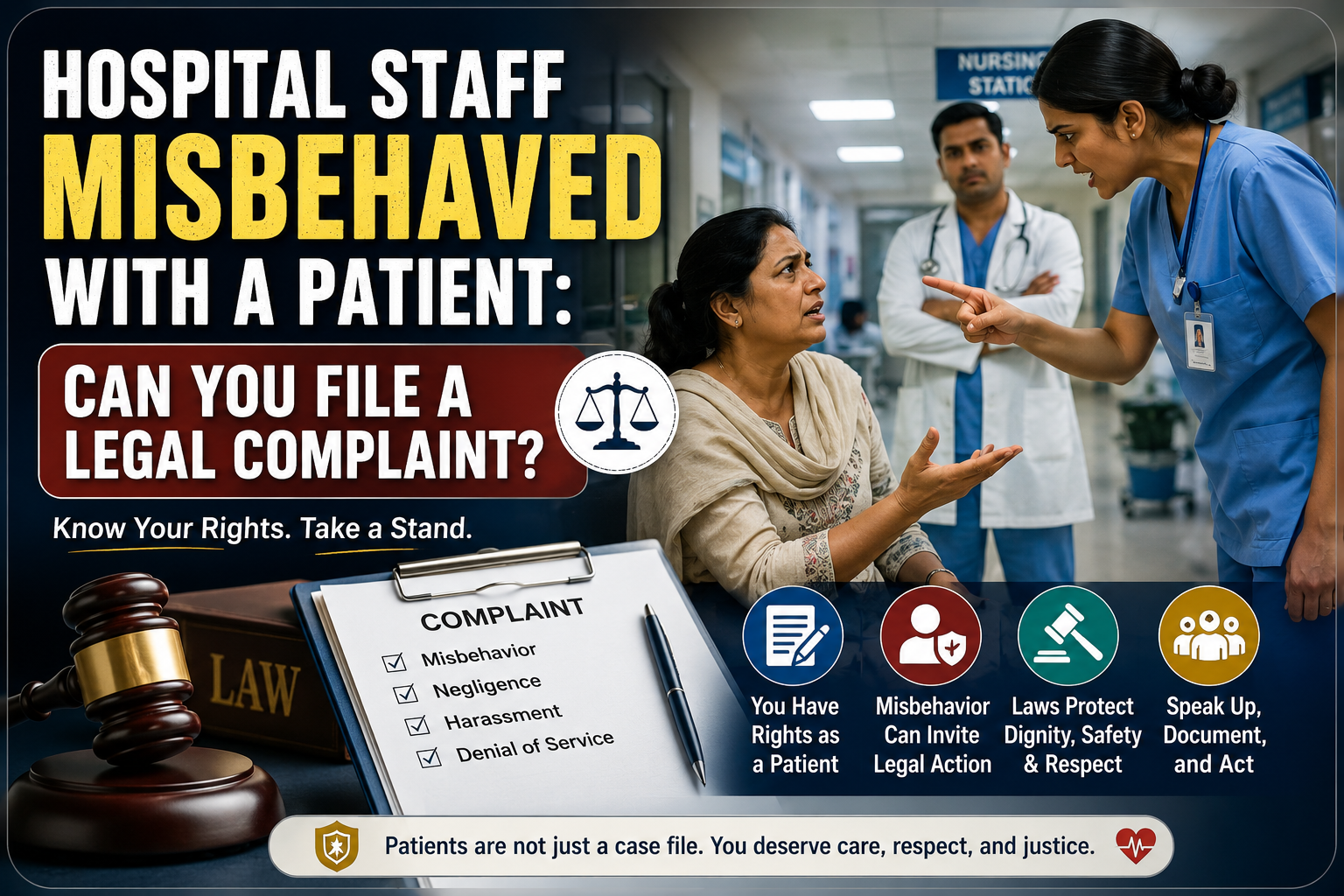
A Practical Legal Guide to Complaints, Patient Rights, Evidence and Remedies in India
Going to a hospital is rarely a comfortable experience. A patient may already be dealing with pain, anxiety, uncertainty, financial pressure, or concern about a family member. In such a situation, the last thing anyone expects is to be shouted at, insulted, humiliated, threatened, ignored, or treated disrespectfully by hospital staff.
But what can a patient actually do when this happens?
Can you complain against the receptionist who spoke rudely?
Can you take action if a security guard misbehaved?
What if a nurse behaved disrespectfully?
What if the hospital administration refuses to listen?
Can the police be approached?
Can compensation be claimed?
Is every instance of rude behaviour a criminal offence?
The answer is not always the same.
Indian law does not treat every unpleasant interaction as a criminal offence. At the same time, a patient is not expected to tolerate unlawful conduct merely because it occurs inside a hospital.
The appropriate remedy depends upon what exactly happened, who was involved, whether there was a deficiency in service, whether a professional duty was breached, whether a specific criminal offence was committed, and what evidence is available.
This article explains the issue from a practical, ground-level perspective.
🔎 The Basic Question: Can You Legally Complain About Hospital Staff Misbehaviour?
Yes, you can make a complaint.
However, there is an important distinction between:
- an internal grievance;
- a consumer complaint;
- a professional misconduct complaint;
- an administrative complaint; and
- a criminal complaint.
For example, if a receptionist speaks rudely to you, the first practical remedy may be to complain to the hospital administration or grievance officer.
But if a hospital employee threatens you, assaults you, causes intentional harm, or engages in another act that satisfies the ingredients of a criminal offence, the matter may go beyond an ordinary hospital grievance.
Therefore, the first question should not be:
“Which section should I file?”
Instead, ask:
“What exactly happened, and what legal category does that conduct fall into?”
That approach helps prevent both underreaction and overreaction.
🏥 What Counts as “Misbehaviour” by Hospital Staff?
The expression “misbehaviour” is very broad.
It may include conduct such as:
- shouting at a patient;
- using insulting or abusive language;
- deliberately humiliating a patient;
- refusing to answer reasonable questions;
- behaving aggressively;
- threatening a patient or attendant;
- deliberately creating unnecessary obstacles;
- refusing to provide an explanation for a bill;
- discriminating against a patient;
- physically pushing or assaulting someone;
- making inappropriate remarks;
- harassing a patient;
- refusing to deal with a genuine grievance.
But not every one of these situations automatically constitutes a criminal offence.
For example:
A receptionist says, “Please wait. The doctor is currently busy.”
This may be inconvenient, but it is not necessarily unlawful.
On the other hand:
A staff member deliberately threatens a patient with physical harm if the patient makes a complaint.
That can raise a substantially different legal issue.
The exact words, conduct, intention, circumstances and consequences matter.
⚖️ Rudeness vs Legal Wrong: Why the Difference Matters
One of the biggest mistakes people make is assuming that every rude interaction is automatically a criminal offence.
It is not.
Suppose a patient asks:
“Why has this charge been added to my hospital bill?”
The billing employee responds:
“I don't have time to explain everything. Pay the bill or leave.”
This may be discourteous and unprofessional.
The patient can certainly raise a grievance.
But whether it amounts to a specific criminal offence is another question.
Now consider a different situation:
“If you complain about me, I will hurt you.”
Here, the conduct may potentially attract criminal-law consequences depending on the exact facts.
Similarly, if an employee physically assaults a patient, the matter can become much more serious.
Therefore:
Poor service → grievance mechanism
Service deficiency → potentially consumer remedy
Professional misconduct → relevant professional authority
Threat/assault/other offence → potentially police/criminal remedy
This distinction should remain central throughout the complaint process.
👩⚕️ Who Can Be Considered “Hospital Staff”?
Hospital staff is not limited to doctors.
A patient may interact with:
- 👨⚕️ doctors;
- 👩⚕️ nurses;
- 🧑💼 receptionists;
- 💳 billing employees;
- 🛡️ security guards;
- 🧪 laboratory technicians;
- 💊 pharmacy staff;
- 🧹 housekeeping personnel;
- 🚑 ambulance staff;
- administrative employees;
- patient-care coordinators;
- attendants.
The appropriate complaint mechanism can differ depending upon who committed the alleged misconduct.
For instance, a complaint concerning the professional conduct of a registered medical practitioner may involve a different regulatory route from a complaint against a private security guard working at the hospital.
So, before filing a complaint, identify the person and their role as accurately as possible.
🧑⚖️ Do Patients Have a Right to Be Treated With Dignity?
Yes.
A patient does not surrender their basic dignity by entering a hospital.
The healthcare relationship involves trust and dependence. A patient may be:
- physically weak;
- elderly;
- disabled;
- anxious;
- financially vulnerable;
- unable to understand medical terminology;
- dependent upon family members;
- undergoing painful treatment.
This makes respectful communication particularly important.
Patient-rights frameworks and healthcare standards emphasize respectful and appropriate treatment.
However, the existence of a patient right does not mean that every violation automatically gives rise to a criminal prosecution.
The legal remedy must be matched to the conduct.
📋 First Step: Complain to the Hospital
For an ordinary incident of staff misbehaviour, the most practical first step is usually a written complaint to the hospital administration.
Do not rely only on a verbal complaint.
You can approach:
- hospital administrator;
- medical superintendent;
- patient relations department;
- grievance officer;
- nursing superintendent;
- billing manager;
- department head;
- hospital management.
If the hospital has an official grievance mechanism, use it.
Why?
Because a written complaint creates a record.
Suppose you verbally complain on Monday and the hospital later says:
“Nobody ever complained.”
You may have difficulty proving otherwise.
A written complaint creates evidence of:
- when you complained;
- what you complained about;
- what remedy you requested;
- whether the hospital responded.
That is far more useful.
📹 Preserve CCTV Evidence
Many hospitals have CCTV cameras installed around:
- reception;
- billing counters;
- entrances;
- corridors;
- emergency areas;
- waiting rooms.
If the incident happened in such an area, CCTV footage may potentially help establish what happened.
However, CCTV footage may not be stored permanently.
Therefore, one of the most useful things a complainant can do is request preservation of the relevant footage.
Example:
“I request that the CCTV footage covering the reception/billing area between 4:15 PM and 4:45 PM on 27 August 2026 be preserved in connection with my complaint.”
This is better than merely saying:
“Give me CCTV.”
Why?
Because CCTV may contain other patients and visitors, raising privacy considerations.
The immediate objective should be preservation of potentially relevant evidence.
📱 What Other Evidence Can You Preserve?
A complaint becomes much stronger when supported by objective material.
Useful evidence may include:
🧾 Hospital bills
Keep:
- admission bill;
- discharge bill;
- pharmacy bill;
- diagnostic bill;
- payment receipt.
📅 Appointment records
Preserve:
- appointment confirmation;
- registration slip;
- patient ID;
- token;
- online booking record.
💬 Messages
Keep relevant:
- SMS;
- WhatsApp conversations;
- emails;
- hospital-app communications.
👥 Witnesses
If another person witnessed the incident, note their identity and contact information where appropriate and with their consent.
🎥 Video/audio
If you possess relevant recordings, preserve the original material and avoid misleading editing.
📸 Photographs
Photographs may be relevant in appropriate cases.
🧾 Why Documentation Matters So Much
Imagine two patients.
Patient A says:
“The staff behaved badly.”
Patient B says:
“On 27 August at 5:10 PM, at the second-floor billing counter, the employee wearing an ID card marked ‘Billing Executive’ shouted at me, refused to explain a ₹1,500 charge, and threatened to call security when I asked for the supervisor. Two people standing near Counter No. 2 witnessed the incident. CCTV cameras were installed above the counter.”
Which complaint is easier to investigate?
Obviously, the second.
Legal principle for practical complaints:
Facts > allegations
Documents > assumptions
Specificity > exaggeration
🚨 What If the Staff Member Threatened You?
Threatening behaviour should be treated more seriously than ordinary rudeness.
Under the Bharatiya Nyaya Sanhita, 2023 (BNS), criminal intimidation is recognized as an offence where the statutory requirements are satisfied.
For example, suppose an employee tells a patient:
«“If you report this to the hospital administration, I will harm you.”»
The patient should preserve:
- messages;
- recordings where lawfully obtained;
- witnesses;
- CCTV information;
- details of the exact words used.
The patient may also approach the police where the facts disclose a cognizable or otherwise actionable criminal offence.
Important:
Do not automatically label every unpleasant statement as “criminal intimidation.”
The exact legal ingredients must be satisfied.
✋ What If Hospital Staff Physically Pushes or Hits a Patient?
That is substantially more serious.
Suppose a security guard:
- pushes a patient;
- slaps an attendant;
- hits someone;
- physically assaults a person.
The matter may potentially involve criminal liability.
The patient should:
1. move away from immediate danger;
2. seek medical attention if injured;
3. preserve medical documentation;
4. identify witnesses;
5. request preservation of CCTV;
6. make a written complaint;
7. approach the police where appropriate.
Do not respond with violence.
A person who is assaulted should not create a second dispute by physically retaliating unless acting within the boundaries of lawful self-defence.
💰 What If the Problem Is Related to Billing?
Not every hospital grievance is about physical or verbal abuse.
Billing disputes are extremely common.
Suppose a patient notices:
“Why is there a ₹5,000 service charge on my bill?”
The employee refuses to explain and behaves aggressively.
There are actually two separate issues:
Issue 1: Staff conduct
The patient can complain about rude or inappropriate behaviour.
Issue 2: Billing dispute
The patient can request an explanation and, where legally appropriate, pursue a consumer/service grievance.
Separating the two issues can make the complaint much clearer.
💳 Hidden Charges: Can You Challenge Them?
If a hospital bill contains unexplained or disputed charges, the patient can ask for:
- itemized bill;
- explanation of charges;
- applicable tariff;
- payment receipt;
- relevant documentation.
If the dispute concerns an actionable deficiency in service or consumer-law violation, the patient may consider an appropriate remedy under the Consumer Protection Act, 2019, subject to the facts and applicable law.
Again, the important point is:
An unexplained charge should be documented and challenged through the appropriate mechanism rather than converted automatically into a criminal allegation.
💊 What If the Hospital Pharmacy Charges More Than the MRP?
This is another practical grievance.
Suppose a medicine has an MRP of ₹100 but the patient is asked to pay ₹150.
The patient should:
1. retain the medicine packaging;
2. retain the bill;
3. ask for an explanation;
4. document the response;
5. use the appropriate consumer/regulatory complaint mechanism if the charge is unlawful.
A small billing dispute can therefore become a useful example of how consumer rights work at ground level.
📄 What If the Hospital Refuses to Give Medical Documents?
Patients and their attendants may require:
- reports;
- prescriptions;
- discharge summary;
- investigation reports;
- bills;
- treatment-related documents.
If the hospital refuses to provide records that the patient is legally entitled to receive, the patient can make a written request and preserve proof of refusal.
The appropriate remedy depends upon:
- type of record;
- type of hospital;
- applicable regulations;
- nature of the dispute.
This can be addressed separately from a complaint about rude behaviour.
👨⚕️ What If the Misbehaviour Is by a Doctor?
This requires additional care.
If the complaint concerns:
- rude professional conduct;
- unethical behaviour;
- professional misconduct;
- inappropriate communication;
- treatment-related professional issues;
the relevant medical regulatory framework may become relevant.
The complaint route can potentially involve the hospital and, where appropriate, the concerned medical regulatory authority.
But a patient should distinguish between:
“The doctor was rude.”
and
“The doctor committed professional misconduct.”
The latter requires facts capable of supporting the allegation.
👩⚕️ What If a Nurse Misbehaves?
The patient can complain to the hospital's nursing administration or management.
Depending upon the nature of the conduct and the professional status of the person involved, the appropriate nursing regulatory mechanism may also be relevant.
Again, identify:
- nurse's name;
- ward;
- date;
- shift;
- exact conduct;
- witnesses;
- evidence.
🛡️ What If the Security Guard Misbehaves?
Security personnel often work under a hospital or an outsourced security agency.
Suppose a guard:
refuses entry to an unauthorized visitor.
That may be completely legitimate.
But suppose the guard:
abuses the visitor, threatens them, or physically assaults them.
That is different.
The complaint should be addressed to:
- hospital security department;
- hospital administration;
- security supervisor;
- concerned agency, where applicable.
If criminal conduct is alleged, police action may also be appropriate.
🗣️ What If Staff Says “Don't Ask Questions”?
A patient has a legitimate interest in understanding matters relating to their treatment and hospital services.
If staff refuses to explain something, the patient can ask for:
“Please connect me with the concerned supervisor or department.”
This is often more effective than continuing an argument with the individual employee.
🧑💼 What If the Hospital Refuses to Take Your Complaint?
This is where documentation becomes important.
If a hospital refuses to accept a written complaint, consider sending it through an official channel such as:
- hospital email;
- official grievance portal;
- complaint form;
- registered post, where appropriate.
Keep proof.
For example:
📧 email sent → save sent-mail copy
📝 online complaint → save complaint number
📮 registered post → save postal receipt
This creates a documented trail.
📩 What If the Hospital Does Not Respond?
Suppose you submit a complaint and receive no response.
You can send a reminder.
If the hospital continues to ignore the complaint, escalation may be considered.
The correct external authority depends upon the nature of the grievance.
🏛️ Where Can You Escalate a Hospital Complaint?
There is no single authority for every hospital complaint.
The appropriate forum depends on the issue.
🏥 Hospital Administration
Usually the first step for:
- rude staff;
- poor communication;
- internal service grievances;
- billing-counter behaviour;
- security misconduct.
⚖️ Consumer Commission
Potentially relevant where the matter falls within consumer law and involves an actionable deficiency in service or other consumer-law issue.
👨⚕️ Medical Regulatory Authority
Potentially relevant to professional misconduct by a registered medical practitioner.
👮 Police
Potentially appropriate where the facts disclose a criminal offence such as assault, criminal intimidation, or another offence.
🏛️ Other Statutory Authorities
Specific laws may provide additional mechanisms for issues involving:
- disability;
- discrimination;
- pharmacy;
- public healthcare administration;
- other regulated services.
🚔 When Should You Consider Going to the Police?
A police complaint becomes particularly relevant when the alleged conduct involves potential criminality.
Examples may include:
🚨 physical assault;
🚨 serious threats;
🚨 criminal intimidation;
🚨 intentional damage to property;
🚨 certain forms of harassment;
🚨 other conduct satisfying the ingredients of a criminal offence.
But police should not be treated as the default forum for every complaint about poor manners.
Simple example:
“Receptionist didn't smile and spoke curtly.”
Usually an internal grievance.
“Receptionist threatened to physically harm me if I complained.”
Potential criminal-law issue.
“Security guard punched me.”
Potential criminal-law issue.
The legal classification depends on facts.
📱 Can You Use WhatsApp Messages as Evidence?
Potentially, yes.
Suppose you complain to the hospital administrator through WhatsApp and receive a response.
Those electronic communications may become relevant evidence.
Preserve:
- complete conversation;
- original device;
- timestamps;
- relevant attachments;
- surrounding messages.
Do not rely only on a cropped screenshot when the original communication is available.
The Bharatiya Sakshya Adhiniyam, 2023 (BSA) governs electronic evidence and its admissibility requirements.
Therefore, digital evidence should be preserved carefully.
🎥 Can You Record the Incident on Your Phone?
This is a legally sensitive area.
Patients increasingly use smartphones to document disputes.
However, one should not assume that:
“Every recording is automatically illegal.”
Nor should one assume:
“Every secret recording is automatically admissible.”
Questions concerning privacy, manner of recording, authenticity, relevance and admissibility can arise.
Therefore, if a recording exists:
- preserve the original;
- do not manipulate it;
- do not circulate it unnecessarily;
- avoid exposing unrelated patients' confidential information.
For serious matters, legal advice can help determine how the recording should be used.
⚖️ Can You Claim Compensation?
Possibly, but compensation is not automatic.
The availability of compensation depends upon:
legal basis of the claim;
deficiency in service, if applicable;
actual loss or legally recognized harm;
evidence;
forum;
circumstances of the case.
For simple discourtesy, compensation may not necessarily be available.
However, if the conduct forms part of an actionable deficiency in service or causes legally recognizable harm, compensation may potentially be sought through the appropriate forum.
💭 What About “Mental Harassment”?
Many complaints use the phrase:
“I suffered mental harassment.”
That phrase alone does not establish a legal claim.
Instead, explain:
what happened;
how long it continued;
whether it affected treatment;
whether there was humiliation;
whether there was financial loss;
whether there was physical injury;
whether there is documentary evidence.
Courts and consumer forums examine the actual facts rather than merely accepting labels.
🌟 The Golden Rule: Choose the Remedy According to the Conduct
A common misunderstanding is:
“Something went wrong in a hospital, therefore I should file a criminal case.”
That is not necessarily correct.
The law provides different mechanisms for different problems.
If the problem is:
Rudeness → grievance
Poor service → grievance/consumer remedy where applicable
Professional misconduct → professional regulator
Discrimination → appropriate statutory mechanism
Threat → potentially criminal remedy
Assault → potentially criminal remedy
Medical negligence → specialized legal analysis
The correct remedy depends on the facts.
🏁 Conclusion: You Don't Have to Stay Silent—But Choose the Right Legal Remedy
Being a patient does not mean that you have to silently tolerate disrespectful or unlawful behaviour.
If hospital staff misbehaves, the patient can raise a complaint and seek an appropriate remedy.
But the strongest legal approach is not to immediately assume that every unpleasant interaction is a criminal offence.
Instead:
Identify the conduct.
Document the facts.
Preserve the evidence.
Complain in writing.
Ask the hospital to investigate.
Escalate to the appropriate authority if necessary.
And where the conduct crosses the line into threats, assault, discrimination, professional misconduct, or another legally actionable wrong, stronger legal remedies may become available.
Ultimately, the question is not simply:
“Was the hospital staff rude?”
The more legally useful question is:
“What exactly did the staff member do, what evidence do I have, and which legal mechanism is appropriate for that conduct?”
📌 Disclaimer
This article is intended for general legal awareness and educational purposes.

Leave a Comment
Your email address and mobile number will not be published. Required fields are marked *