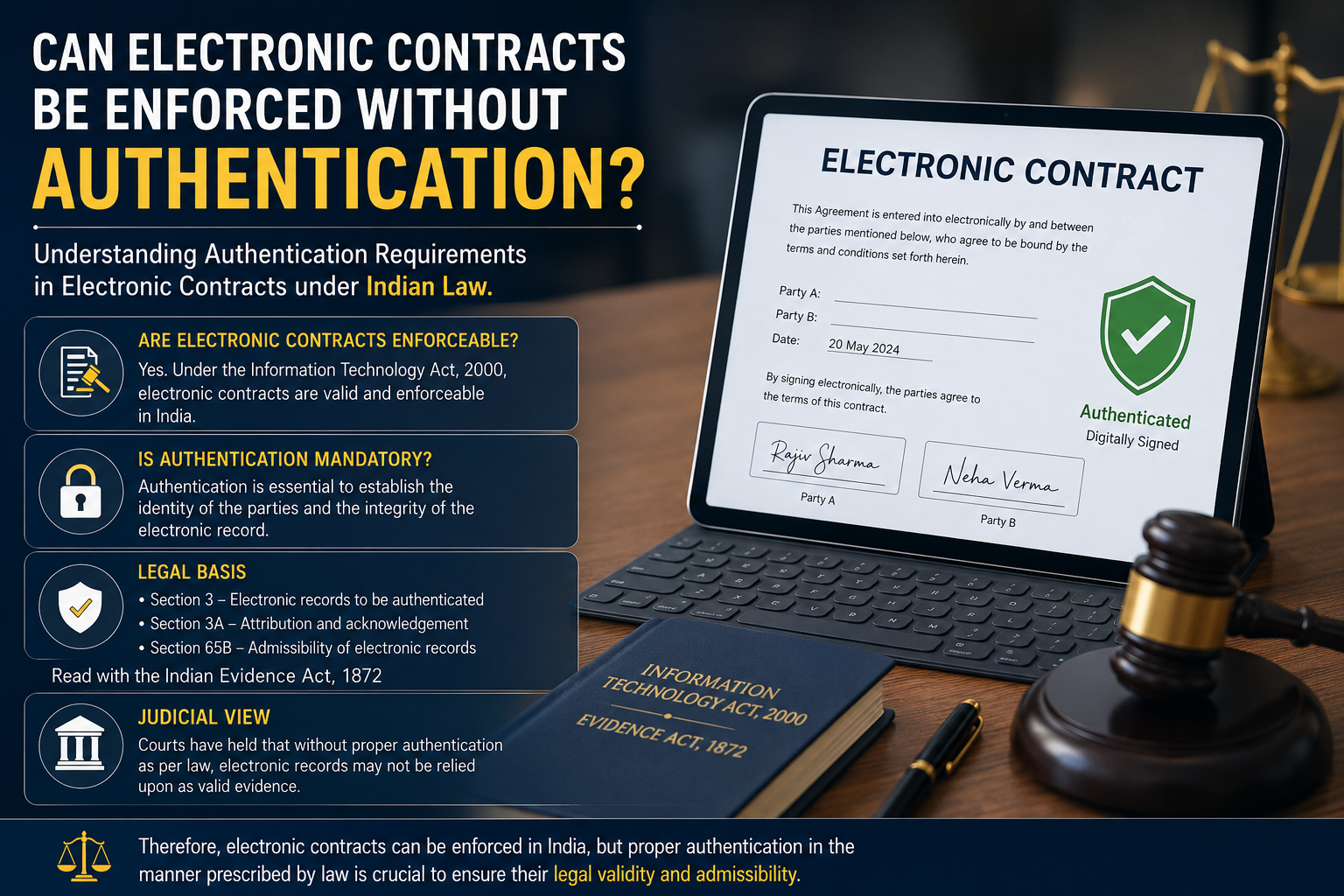
🔹1. Introduction
In the digital era, contracts are no longer limited to paper, ink, and physical signatures. From clicking “I Agree” on websites to signing agreements through email exchanges, WhatsApp chats, and e-sign platforms, electronic contracts have become the backbone of modern commercial transactions in India.
However, a critical legal question arises:
Can electronic contracts be enforced in India even if they are not authenticated?
This question becomes especially important because authentication (such as digital signatures, OTP verification, or e-signatures) is often seen as the “proof” of validity in electronic transactions. But under Indian law, the answer is more nuanced.
The short legal position is:
Yes, electronic contracts can be enforceable in India even without formal authentication, provided they satisfy the essential elements of a valid contract under the Indian Contract Act, 1872 and are not barred by law.
This blog provides a deep legal analysis of enforceability, authentication, statutory framework, judicial interpretation, and practical implications.
🔹2. Meaning of Electronic Contracts
An electronic contract (e-contract) is any agreement formed, signed, or executed through digital or electronic means.
Examples include:
Clickwrap agreements (“I Agree” buttons)
Browsewrap agreements (website terms of use)
Email agreements
WhatsApp / SMS agreements
E-signature-based contracts
Online service subscriptions
Key feature:
The contract exists in digital form instead of physical paper form, but legally it remains a contract under the Indian Contract Act, 1872.
🔹3. Legal Framework Governing Electronic Contracts in India
Electronic contracts in India are governed by a combination of laws:
(A) Indian Contract Act, 1872
This is the primary law governing all contracts, including electronic ones.
It lays down:
Offer and acceptance
Lawful consideration
Intention to create legal relationship
Free consent
Capacity of parties
Lawful object
👉 Importantly, the Act is technology-neutral, meaning it does not require physical form or manual signature.
(B) Information Technology Act, 2000
The IT Act, 2000 is the backbone of electronic transactions in India.
Key provisions:
Section 10A – Validity of electronic contracts
Contracts formed through electronic means shall not be deemed unenforceable solely because electronic means were used.
This is the strongest legal recognition of e-contracts in India.
Section 3 & 3A – Digital signatures & electronic signatures
These provisions define:
Digital signatures
Electronic signature authentication methods
But importantly, they are not mandatory for all contracts.
(C) Bharatiya Sakshya Adhiniyam, 2023 (BSA)
Replacing the Indian Evidence Act, this law governs:
Admissibility of electronic records
Presumption of authenticity of electronic evidence
It provides legal recognition to:
Emails
Server logs
Digital documents
Electronic communications
🔹4. What is Authentication in Electronic Contracts?
Authentication means:
Verification of identity of the person entering into a contract.
It can be done through:
Digital Signature Certificates (DSC)
Aadhaar-based e-sign
OTP verification
Biometrics
Email verification
Purpose of authentication:
To prove identity
To prevent fraud
To strengthen evidentiary value in court
But here is the crucial point:
Authentication strengthens a contract but is not always required for its validity.
🔹5.AUTHENTICATION REQUIREMENTS IN ELECTRONIC CONTRACTS
Authentication is the most crucial practical element in electronic contracting because it bridges the gap between mere digital communication and a legally reliable contract. While the formation of a contract under the Indian Contract Act, 1872 does not strictly require authentication, in the digital environment authentication becomes the backbone of identity verification, consent validation, and enforceability in court.
In simple terms:
Authentication does not create a contract, but it makes a contract trustworthy, provable, and enforceable in legal proceedings.
📌 1. Identity Verification of Parties (Core Requirement)
One of the biggest challenges in electronic contracts is confirming who exactly is behind the screen. Unlike traditional contracts where parties sign in person, digital contracts rely on electronic systems to verify identity.
Common methods include:
OTP verification on registered mobile numbers
Email verification links
KYC-based onboarding (PAN, Aadhaar, passport, etc.)
User ID/password systems with secure login credentials
👉 Legal importance: This step ensures that the acceptance of contract terms can be traced to a specific, identifiable individual or legal entity, reducing disputes like “I never agreed to this contract.”
📌 2. Digital Signature Mechanisms (Strongest Legal Authentication Tool)
Digital signatures are one of the most legally recognized forms of authentication under the Information Technology Act, 2000.
They include:
Digital Signature Certificate (DSC)
Aadhaar-based e-sign services
Certified digital signature providers licensed under Indian law
👉 Why it matters: A digital signature:
verifies identity of signer
ensures integrity of document
prevents unauthorized alteration
It works on cryptographic principles, meaning even a small change in the document invalidates the signature.
📌 3. Consent Validation Mechanisms (Click-Based Authentication)
In modern electronic contracts, consent is often given through actions rather than physical signatures.
Examples:
“I Agree” button click
Checkbox acceptance of Terms & Conditions
Scroll-wrap agreements (scrolling implies acceptance)
App-based subscription confirmations
👉 Legal significance: Courts examine whether consent was:
clear
informed
voluntary
If the system properly records consent with time stamps and logs, it becomes strong evidence of acceptance.
📌 4. Electronic Record Integrity and Tamper Protection
Once an electronic contract is created, ensuring it is not altered becomes extremely important.
Integrity is maintained through:
Hashing algorithms (document fingerprinting)
Encryption techniques
Secure cloud storage systems
Version control logs
👉 Legal relevance: Under the Indian Evidence Act, 1872, courts require electronic records to be reliable and tamper-proof before admitting them as evidence.
If integrity is compromised, the evidentiary value of the contract weakens significantly.
📌 5. Time Stamping and Transaction Logging
Time and date play a critical role in resolving disputes in electronic contracts.
Systems usually record:
Exact time of acceptance
IP address of user
Device details (mobile, laptop, browser)
Server logs of transaction
👉 Importance in disputes: Time-stamped records help establish:
when the contract was formed
sequence of acceptance
whether modification occurred later
This becomes especially important in financial, employment, and commercial agreements.
📌 6. Secure Communication Channels
The platform used to form the contract must ensure secure transmission of data.
Common security measures:
HTTPS encryption
SSL/TLS protocols
Secure API communication
Encrypted email systems
👉 Why this matters: If communication is not secure, there is a risk of:
data interception
manipulation of terms
unauthorized access
Secure channels strengthen both validity and trustworthiness of electronic contracts.
📌 7. Audit Trails and System Logs (Digital Footprint Evidence)
Audit trails are one of the strongest forms of electronic authentication evidence.
They include:
IP address tracking
login/logout history
device fingerprinting
action logs (clicks, approvals, edits)
👉 Legal importance: Audit trails help courts reconstruct the entire contract formation process step-by-step.
In disputes, they act as digital witnesses showing:
who accessed the contract
when it was accepted
from which device/location it was executed
📌 8. Multi-Factor Authentication (MFA) Systems
Advanced electronic contracts often use layered authentication methods such as:
OTP + password
biometric + PIN
email + mobile verification
👉 Why it is important: It reduces risks of:
identity theft
unauthorized access
fraudulent acceptance
The stronger the authentication layers, the higher the legal reliability of the contract.
📌 9. Role of Platform or Intermediary Verification
In many electronic contracts (e-commerce, fintech, SaaS platforms), the platform itself plays a role in authentication.
They ensure:
verified user accounts
compliance checks
automated consent capture systems
secure storage of contract records
👉 This adds an additional layer of trust beyond the parties themselves.
⚖️ Legal Significance of Authentication Requirements
Although not explicitly a requirement for contract formation under the Indian Contract Act, 1872, authentication becomes essential for:
proving identity of parties
establishing genuine consent
ensuring evidentiary admissibility under the Indian Evidence Act, 1872
preventing fraud and misrepresentation
strengthening enforceability in courts
💡 Final Insight
Authentication in electronic contracts is not about “creating” validity, but about protecting validity in real-world legal disputes.
🔹6. Core Legal Question: Is Authentication Required for Enforceability?
Short Answer:
❌ No, authentication is not mandatory for enforceability in all cases.
Legal reasoning:
Under Indian Contract Act, 1872:
No provision requires signature or authentication for contract validity.
Even oral contracts are valid.
Therefore:
If an oral contract is valid, a non-authenticated electronic contract can also be valid.
🔹7. Conditions for a Valid Electronic Contract (Without Authentication)
Even without authentication, an electronic contract is enforceable if it satisfies:
1. Offer and Acceptance
Example:
Email offering services
Acceptance via reply email or message
2. Lawful Consideration
Something of value must be exchanged.
3. Intention to Create Legal Relations
Business or commercial intent must be clear.
4. Free Consent
No coercion, fraud, or misrepresentation.
5. Capacity of Parties
Parties must be legally competent.
6. Lawful Object
Purpose must not be illegal.
👉 If these conditions are satisfied, authentication is not a legal necessity for validity.
🔹8. Role of Section 10A of IT Act: Game Changer
Section 10A states:
“Where a contract is expressed in electronic form, such contract shall not be deemed to be unenforceable solely on the ground that electronic form or electronic means were used.”
Interpretation:
This provision confirms:
Electronic form ≠ invalid contract
No requirement of physical signature
No mandatory authentication condition for validity
👉 Therefore, lack of authentication alone cannot invalidate an e-contract.
🔹9. Authentication vs Enforceability: Key Legal Difference
Basis Authentication Enforceability
Meaning Verification of identity Legal enforceability in court
Requirement Optional in many contracts Depends on Contract Act essentials
Purpose Evidence strengthening Legal binding effect
Absence effect Weak evidence Not necessarily invalid
Legal role Procedural safeguard Substantive legal right
Key Insight:
Authentication is a proof mechanism, not a validity condition.
🔹10. Judicial Approach in India
Indian courts have consistently upheld electronic contracts.
1. Recognition of electronic agreements
Courts have accepted:
Email contracts
Online agreements
Digital transactions
2. Principle followed:
Substance over form
If parties clearly intended to contract, courts enforce it even without formal authentication.
3. WhatsApp and Email as evidence
Courts have increasingly treated:
WhatsApp chats as evidence of agreement
Emails as proof of contractual consent
However:
Authentication affects weight of evidence, not existence of contract.
🔹11. Enforceability Without Authentication: Practical Scenarios
Scenario 1: Email Agreement (No Digital Signature)
Party A offers services via email
Party B replies “Confirmed”
✔ Enforceable contract
❌ No authentication required
Scenario 2: WhatsApp Deal
Price negotiated via messages
Final acceptance recorded in chat
✔ Valid contract
⚠ Authentication not necessary but proof may be disputed
Scenario 3: Clickwrap Agreement
User clicks “I Agree”
No identity verification beyond basic login
✔ Enforceable under IT Act Section 10A
Scenario 4: Unverified Online Transaction
Purchase made without OTP or signature
Payment completed
✔ Contract exists based on conduct
🔹12. When Authentication Becomes Important
Although not mandatory, authentication becomes crucial in:
1. Dispute cases
To prove:
Identity of parties
Consent validity
2. High-value contracts
Banks, financial institutions require strong authentication.
3. Fraud prevention
To avoid impersonation or fake consent claims.
4. Statutorily required contracts
Some contracts require written or signed form (e.g., certain property transfers).
🔹13. Exceptions: When Electronic Contracts May Not Be Valid
Under Indian law, some documents cannot be executed electronically, such as:
Negotiable instruments (except electronic cheques in certain cases)
Trust deeds (in some interpretations)
Certain property-related documents
Wills (generally excluded from e-contract framework)
In such cases, authentication alone is not enough—form itself matters.
🔹14. Evidentiary Value Without Authentication
Under the Bharatiya Sakshya Adhiniyam, 2023:
Electronic records are admissible if:
Properly generated
Not tampered with
Can be verified through metadata/logs
Without authentication:
Contract is still admissible
But burden of proof increases
👉 Courts may require:
Email headers
Server logs
Device IP tracking
Witness testimony
🔹15. Challenges of Non-Authenticated Electronic Contracts
1. Identity disputes
Parties may deny involvement.
2. Tampering risk
Digital messages can be edited or fabricated.
3. Jurisdiction issues
Online contracts often involve cross-border elements.
4. Proof burden
More reliance on circumstantial electronic evidence.
🔹16. Advantages of Allowing Non-Authenticated E-Contracts
1. Ease of doing business
No procedural barriers.
2. Faster transactions
Instant agreement formation.
3. Flexibility
Suitable for startups and SMEs.
4. Technology neutrality
Law adapts to innovation.
🔹17. Policy Perspective
Indian legal system follows a balanced approach:
Promotes digital commerce
Ensures legal enforceability
Avoids excessive procedural burden
Yet maintains evidentiary safeguards
👉 Authentication is encouraged, not imposed universally.
🔹18. Key Legal Principle (Most Important Takeaway)
An electronic contract does not become invalid merely because it lacks authentication. What matters is whether there is clear consent and fulfillment of essential contractual elements.
🔹19. FAQs
Q1. Is a WhatsApp agreement legally valid in India?
Yes, if offer, acceptance, and intention are clear.
Q2. Can an unsigned email be a contract?
Yes, if contractual elements are satisfied.
Q3. Is digital signature mandatory for e-contracts?
No, except where specifically required by law.
Q4. Can courts reject an unauthenticated e-contract?
Not solely for lack of authentication.
Q5. What is the biggest risk in non-authenticated contracts?
Difficulty in proving identity and consent.
🔹20. Conclusion
Electronic contracts represent the evolution of traditional contract law in the digital age. Indian law, through the Indian Contract Act, 1872 and the Information Technology Act, 2000, strongly supports the validity of electronic agreements.
Authentication, while highly useful and often recommended, is not a mandatory requirement for enforceability in most cases. Instead, it functions as a tool of proof and security rather than a condition of validity.
Thus, the legal position in India can be summarized as:
✔ Electronic contracts are valid
✔ Authentication strengthens evidence
❌ But absence of authentication does not automatically make them unenforceable
The law ultimately prioritizes intent, consent, and substance over technical formalities.
⚠️ Disclaimer
This article is intended for general informational and academic purposes only and does not constitute legal advice.

Leave a Comment
Your email address and mobile number will not be published. Required fields are marked *