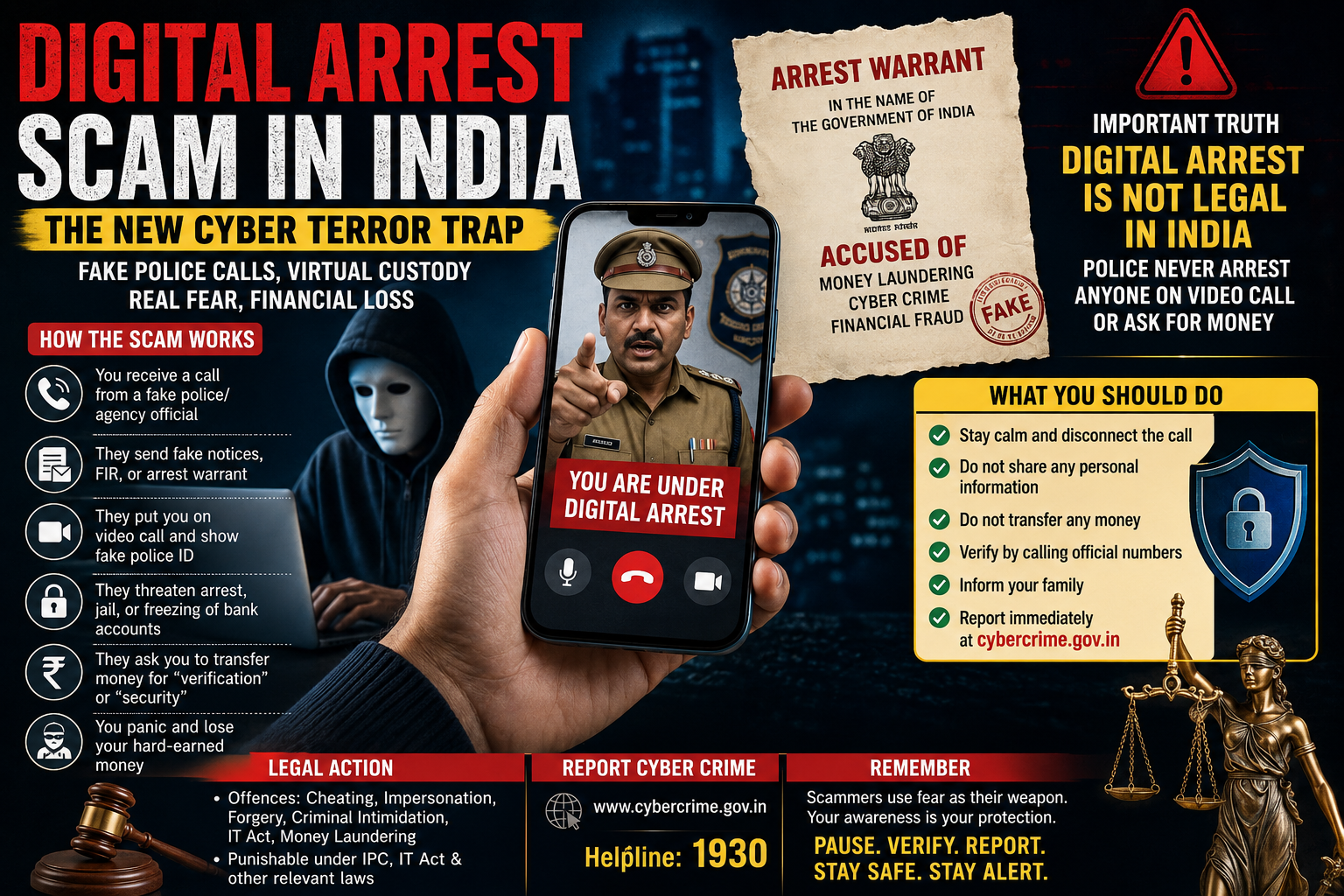
Fake Police Calls, Virtual Custody & The New Cyber Terror Threat Destroying Lives Across India
“You are under digital arrest…”
A single video call.
A fake police uniform.
A forged arrest warrant.
A terrified citizen.
And within hours — life savings disappear.
India is witnessing the rapid rise of one of the most psychologically dangerous cyber frauds in modern times: the Digital Arrest Scam.
Unlike ordinary scams, digital arrest fraud does not merely target money. It weaponizes fear, law enforcement imagery, fake authority, and psychological pressure to mentally imprison victims through screens.
Thousands of educated professionals, senior citizens, students, businessmen, and even government employees have reportedly fallen victim to these scams. Many victims continue to remain silent due to shame, fear, or confusion.
This is no longer merely a cybercrime issue.
It is becoming a serious legal, psychological, constitutional, and public safety concern.
This article provides a complete legal and practical analysis of digital arrest scams in India, including:
- How the scam works
- Whether “digital arrest” has any legal validity
- Cyber law implications
- Police powers vs fake threats
- Constitutional rights of citizens
- Banking and cyber freeze issues
- Latest fraud patterns
- Preventive strategy
- Legal remedies for victims
⚖️ 1. What Is a “Digital Arrest” Scam?
A digital arrest scam is a cyber fraud technique where criminals impersonate:
- Police officers
- CBI officers
- ED officials
- Cyber crime officers
- Customs officers
- Telecom authorities
- RBI officials
Victims are contacted through:
- Video calls
- Skype
- Telegram
- Fake police letters
- Forged warrants
- Spoofed caller IDs
The scammers falsely claim that:
- your Aadhaar was misused,
- your SIM card is linked to crime,
- a parcel contains illegal items,
- money laundering investigation is ongoing,
- arrest warrant has been issued,
- bank accounts will be frozen immediately.
Victims are then psychologically isolated and instructed not to contact anyone.
This illegal coercive process is commonly called “digital arrest.”
🚔 2. The Most Important Legal Truth: Digital Arrest Has No Legal Recognition
Indian law does not recognize any concept called:
“Digital Arrest”
There is:
❌ No lawful online custody system
❌ No legal video-call detention
❌ No legal WhatsApp arrest
❌ No remote interrogation confinement by random officials
Under Indian criminal procedure, lawful arrest must follow legal safeguards.
Real police powers are governed by:
- Constitution of India
- Code of Criminal Procedure, 1973 / updated procedural laws
- statutory arrest safeguards
- judicial precedents
No genuine officer will ask citizens to remain continuously on video call under “digital custody.”
🧠 3. Why This Scam Is So Dangerous
Unlike traditional frauds, digital arrest scams combine:
- Fear psychology
- Legal intimidation
- Identity theft
- Fake authority
- Isolation tactics
- Financial panic
Victims are often told:
- “You cannot disconnect.”
- “You are under surveillance.”
- “National security matter.”
- “Your family will be arrested.”
- “Do not contact lawyer.”
- “Funds must be verified immediately.”
This creates mental panic severe enough to override rational thinking.
📞 4. How the Scam Usually Begins
Common Entry Points
🔹 Fake Telecom Alert
“Your mobile number will be disconnected.”
🔹 Fake Courier/Parcel Issue
“Illegal parcel sent under your identity.”
🔹 Fake Money Laundering Allegation
“Your bank account linked to criminal transactions.”
🔹 Aadhaar Misuse Threat
“Your Aadhaar used for illegal activities.”
🔹 Fake Court or Police Notice
Forged PDF documents are sent.
🎭 5. The Fake Police Setup: Why People Believe It
Scammers now create highly convincing setups:
- Fake uniforms
- Fake police stations in background
- Government logos
- Forged arrest warrants
- Fake Supreme Court seals
- Deepfake-style authority presentation
Many victims panic because the environment appears “official.”
⚠️ 6. Can Real Police Arrest Through Video Call?
Short Answer: No.
Real arrest procedures involve lawful physical process and legal safeguards.
Under constitutional protections:
- grounds of arrest must be informed,
- legal rights exist,
- procedural compliance is required.
A random video call demanding money is a major red flag.
🛡️ 7. Constitutional Rights of Citizens
Even during lawful criminal investigation, citizens possess constitutional protections under the Constitution of India.
Important safeguards include:
🔹 Article 20(3)
Protection against self-incrimination.
🔹 Article 21
Right to life and personal liberty.
🔹 Article 22
Protection against arbitrary arrest.
No fake “digital detention” can override constitutional rights.
💰 8. The Financial Trap: “Verification Transfer” Fraud
This is where victims lose money.
Scammers often say:
- “Funds must be verified.”
- “Transfer to secure RBI account.”
- “Temporary security deposit.”
- “Audit verification.”
Victims then transfer lakhs of rupees believing they are cooperating with investigation.
In reality:
👉 It is direct fraud.
No lawful authority asks citizens to transfer money privately for investigation verification.
🏦 9. Bank Account Freeze Panic
Scammers often threaten:
- account freeze,
- PAN blocking,
- Aadhaar suspension,
- passport cancellation.
This fear pushes victims into hurried compliance.
Real legal freezing processes follow lawful procedure—not emotional video-call pressure.
📂 10. Fake Documents Used in Digital Arrest Scams
Scammers commonly circulate forged:
- FIR copies
- Arrest warrants
- Supreme Court notices
- ED summons
- Cyber crime notices
- RBI directives
- Money laundering notices
Most victims never verify authenticity before panicking.
⚖️ 11. Relevant Indian Laws Against Such Fraud
Digital arrest scams may involve offences relating to:
- cheating,
- impersonation,
- forgery,
- identity theft,
- cyber fraud,
- criminal intimidation,
- extortion,
- electronic deception.
Cybercrime and financial fraud provisions may apply depending on facts.
📱 12. Technology Behind These Scams
Modern scammers use:
- Caller ID spoofing
- AI voice imitation
- Fake government templates
- Encrypted apps
- International routing
- Screen-sharing manipulation
Some fraud networks operate across borders.
👨⚖️ 13. Why Educated People Also Become Victims
Many victims are:
- doctors
- advocates
- engineers
- businessmen
- retired officers
- professors
Why?
Because fear bypasses intelligence.
When people hear words like:
- CBI
- ED
- money laundering
- terrorism
- arrest warrant
panic overrides analysis.
🚨 14. Senior Citizens: The Most Vulnerable Targets
Elderly victims are often specifically targeted because:
- they fear police action more,
- may not understand cyber systems fully,
- often trust official-looking communication.
Families must educate senior citizens urgently.
📢 15. How Real Police Actually Work
Real police generally:
✅ issue lawful notice where required
✅ follow procedural safeguards
✅ record formal process
✅ allow legal representation
✅ do not demand secret transfers
Real investigations are structured—not theatrical.
❌ 16. Biggest Mistakes Victims Make
🔴 Staying on continuous video call
🔴 Sharing OTPs
🔴 Sharing screen access
🔴 Sending Aadhaar/PAN blindly
🔴 Transferring money for “verification”
🔴 Avoiding family or lawyer consultation
🔴 Acting in panic
🧾 17. What To Do Immediately If You Receive Such Call
✅ Step 1: Disconnect Immediately
Do not stay under pressure.
✅ Step 2: Never Transfer Money
No matter what threats are made.
✅ Step 3: Verify Independently
Call official numbers yourself.
✅ Step 4: Inform Family
Isolation helps scammers.
✅ Step 5: Report Cyber Crime
Use official cybercrime reporting mechanisms.
📞 18. Cybercrime Complaint Process in India
Victims may:
- contact cyber helplines,
- report online fraud,
- approach local cyber police station,
- inform bank immediately.
Fast reporting improves recovery chances.
🏛️ 19. Banking Response: Why Immediate Reporting Matters
If fraud transfer occurred:
- immediate bank complaint is crucial,
- transaction trail matters,
- delay may reduce recovery chances.
Speed becomes extremely important.
⚖️ 20. Can Victims Recover Money?
Sometimes yes. Sometimes partially. Sometimes recovery becomes difficult.
Outcome depends on:
- reporting speed,
- transaction routing,
- mule account tracing,
- bank coordination,
- cyber investigation progress.
Early action dramatically improves prospects.
🧠 21. Psychological Warfare: The Real Core of the Scam
Digital arrest scams are fundamentally psychological operations.
Scammers intentionally create:
- fear,
- urgency,
- confusion,
- shame,
- isolation,
- authority pressure.
The victim is mentally manipulated before financial fraud occurs.
🌍 22. Why Digital Arrest Scams Are Growing Rapidly
Reasons include:
- rise of online banking,
- fear of law enforcement,
- low cyber awareness,
- leaked personal data,
- sophisticated fraud technology,
- social media misinformation.
📜 23. Can Police Legally Threaten Citizens Like This?
No lawful authority can arbitrarily:
- isolate you digitally,
- force continuous video monitoring,
- demand confidential transfers,
- prohibit legal consultation unlawfully.
Citizens possess legal safeguards.
👨👩👧 24. Family Awareness Is the Strongest Defence
Many frauds succeed because victims feel embarrassed or afraid to inform others.
The simplest protection is:
“Pause. Disconnect. Verify. Discuss.”
📱 25. Social Media’s Role in Both Fraud & Awareness
Ironically, social media spreads:
- scam fear,
- misinformation,
- fake notices,
- but also awareness.
Responsible legal awareness is urgently needed.
🚔 26. The Future Threat: AI-Powered Digital Arrest Scams
Experts fear future scams may use:
- deepfake police videos,
- cloned voices,
- AI-generated warrants,
- realistic virtual courtrooms.
Cyber fraud is becoming more technologically sophisticated.
🏛️ 27. What the Government and Banks Must Improve
Needed reforms include:
- stronger cyber awareness campaigns,
- faster account tracing,
- better fraud response systems,
- public legal education,
- stricter telecom verification,
- AI fraud detection systems.
❤️ 28. Behind Every Scam Is Human Trauma
Victims often suffer:
- financial loss,
- panic attacks,
- depression,
- shame,
- family stress,
- trust breakdown.
Cyber fraud is not “just online crime.”
It deeply affects real lives.
🏁 29. Final Verdict: Fear Is the Real Weapon
The biggest truth about digital arrest scams is simple:
Scammers do not first steal money.
They first steal calmness.
Indian law does not recognize “digital arrest.”
No genuine officer will demand secret transfers or keep citizens under illegal virtual custody.
The strongest defence is:
- awareness,
- verification,
- legal understanding,
- calm decision-making.
Fear creates victims.
Knowledge creates protection.
❓ Frequently Asked Questions (FAQ)
Is digital arrest legal in India?
No. There is no legal concept called digital arrest.
Can police ask for money verification transfer?
No lawful authority asks citizens to privately transfer money for investigation verification.
What should I do if I receive such call?
Disconnect, verify independently, inform family, and report cybercrime immediately.
Can money be recovered?
Possibly, especially if reported quickly.
Are fake notices common in such scams?
Yes. Forged police, court, ED, and RBI notices are frequently used.
📌 Disclaimer
This article is for public legal awareness and educational purposes only. Specific cybercrime situations may involve different legal and factual circumstances. For case-specific advice, consult qualified legal professionals or appropriate authorities.

Leave a Comment
Your email address and mobile number will not be published. Required fields are marked *