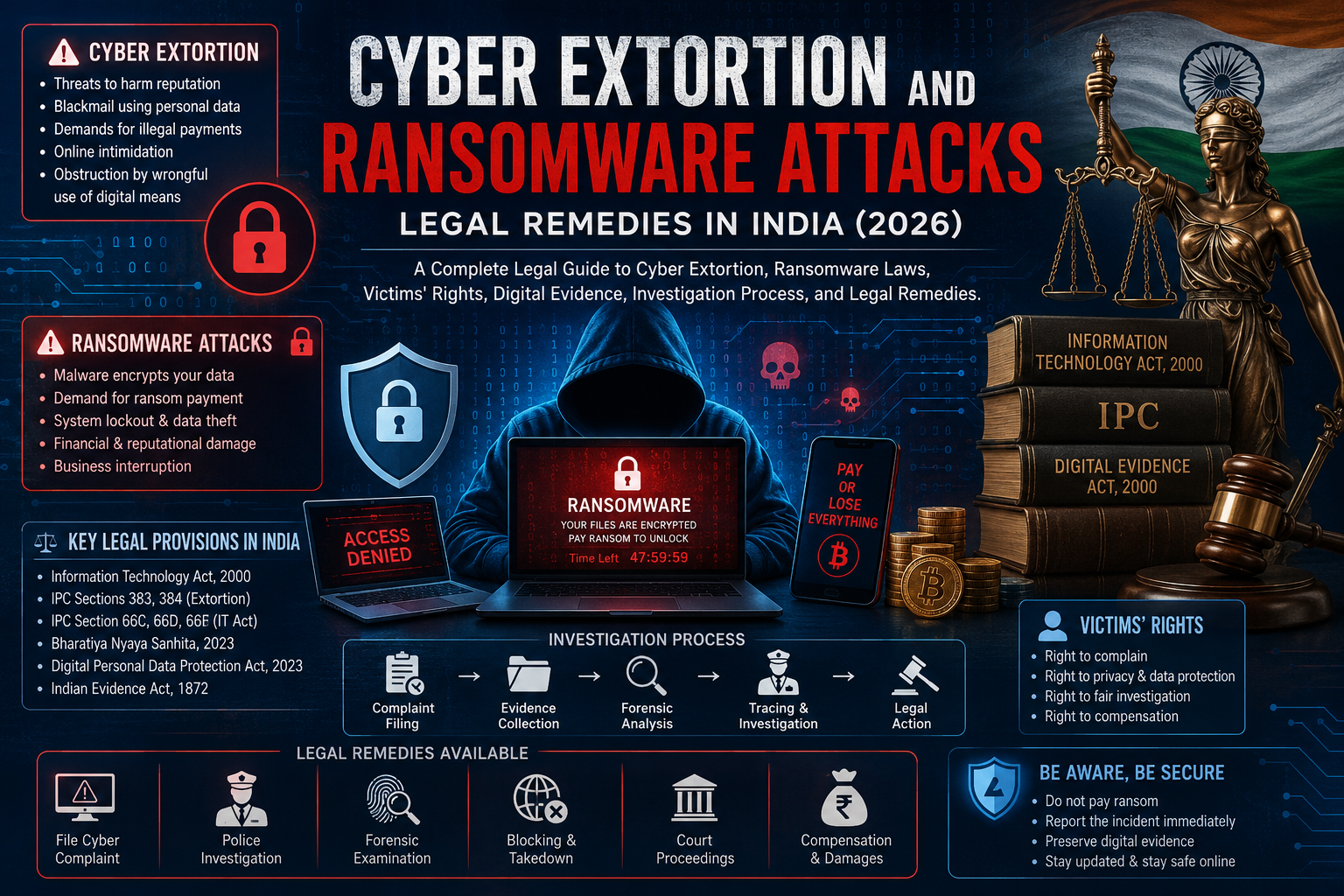
⚖️💻Cyber Extortion and Ransomware Attacks: Legal Remedies in India (2026): A Complete Legal Guide to Cyber Extortion, Ransomware Laws, Victims' Rights, Digital Evidence, Investigation Process, and Legal Remedies :
“Your computer has been locked. Pay ₹10,00,000 in Bitcoin within 48 hours, or your data will be permanently deleted.”
Imagine opening your office laptop one morning and seeing this message. Every important file—business records, customer information, financial documents, contracts, and confidential emails—has suddenly become inaccessible. Within minutes, your business operations come to a halt.
This is not a fictional scenario. It is the reality of ransomware attacks, one of the fastest-growing forms of cybercrime worldwide.
Cyber extortion has become a significant legal, financial, and national security concern in India. Hospitals, banks, educational institutions, multinational corporations, startups, government departments, and even individual users have increasingly become targets of sophisticated cybercriminals.
Unlike traditional extortion, cyber extortion allows criminals to operate anonymously across international borders, making investigation and prosecution considerably more complex. As India's digital economy expands rapidly, ransomware attacks have evolved from isolated incidents into organized criminal enterprises involving highly skilled hacker groups.
This article provides a comprehensive legal analysis of cyber extortion and ransomware attacks in India, the applicable legal framework, rights of victims, responsibilities of organizations, investigative mechanisms, judicial perspectives, and practical preventive measures.
🌐 Understanding Cyber Extortion
Cyber extortion refers to a criminal activity where an individual or organization is threatened through digital means to obtain money, confidential information, cryptocurrency, intellectual property, or other valuable assets.
Unlike conventional extortion, cyber extortion does not require physical presence. Criminals exploit vulnerabilities in computer systems, networks, cloud infrastructure, or digital devices to force victims into making payments or complying with unlawful demands.
Cyber extortion can involve:
🔒 Encrypting confidential files
📂 Stealing sensitive business data
💣 Threatening to leak confidential information
💰 Demanding cryptocurrency payments
🌍 Launching Distributed Denial-of-Service (DDoS) attacks
📧 Blackmail through hacked emails
📱 Threatening exposure of personal photographs or videos
The objective is psychological pressure. Victims often feel compelled to pay because they fear financial losses, reputational damage, legal consequences, or operational disruption.
🔐 What is Ransomware?
Ransomware is malicious software (malware) specifically designed to block access to a computer system or encrypt valuable data until a ransom is paid.
Once ransomware infects a device, it may:
Encrypt files
Lock the operating system
Disable backups
Spread across connected networks
Delete recovery points
Display ransom instructions
Most attackers demand payment through cryptocurrencies because such transactions are relatively difficult to trace.
Modern ransomware groups often combine encryption with data theft. They first steal confidential information and then encrypt the victim's systems. Even if backups are available, the attackers threaten to publish stolen data unless payment is made.
This strategy is commonly referred to as double extortion.
⚖️ Cyber Extortion vs. Ransomware
Although these terms are often used interchangeably, they are not identical.
Cyber Extortion
Ransomware
A broader criminal activity involving digital threats
A specific type of malware
May or may not involve encryption
Primarily encrypts or locks systems
Includes threats to leak information
Focuses on blocking access to data
Can involve DDoS attacks, email blackmail, data theft
Mainly involves malicious software
Ransomware is one form of cyber extortion
Cyber extortion includes ransomware
Therefore, every ransomware attack involving ransom demands constitutes cyber extortion, but not every cyber extortion incident necessarily involves ransomware.
📜 Evolution of Ransomware
Ransomware has evolved significantly over the past three decades.
🕰️ Early Stage
The earliest ransomware attacks were relatively unsophisticated. Victims were asked to send payments by mail or bank transfer.
💻 Modern Era
With advances in encryption technology and cryptocurrencies, ransomware has become far more dangerous.
Modern attacks involve:
Military-grade encryption
Anonymous cryptocurrency payments
Professional hacker groups
International criminal syndicates
Automated attack tools
Artificial Intelligence-assisted attacks
Today, ransomware has become a billion-dollar criminal industry.
🚨 How Does a Ransomware Attack Work?
A typical ransomware attack follows several stages.
Step 1️⃣ Initial Entry
Hackers gain access through:
Phishing emails
Fake software updates
Malicious attachments
Weak passwords
Remote Desktop Protocol (RDP)
Vulnerable servers
Compromised websites
Step 2️⃣ Network Exploration
The attacker silently explores the victim's network.
They identify:
File servers
Backup servers
Administrator accounts
Databases
Cloud storage
Security software
Step 3️⃣ Data Theft
Modern attackers often steal sensitive information before encrypting it.
Examples include:
Customer records
Financial statements
Employee information
Medical records
Intellectual property
Government documents
Step 4️⃣ Encryption
The malware encrypts files using advanced cryptographic algorithms.
Victims suddenly lose access to:
Word documents
PDFs
Images
Databases
Emails
Software applications
Step 5️⃣ Ransom Demand
A ransom note appears on the victim's screen.
Typical demands include:
Bitcoin payment
Deadline for payment
Threat of deleting data
Threat of publishing confidential information
Contact details for negotiation
🦠 Types of Ransomware
Cybercriminals use different forms of ransomware depending on their objectives.
🔒 Crypto Ransomware
Encrypts files while leaving the operating system functional.
Victims cannot access their documents without the decryption key.
💻 Locker Ransomware
Locks the entire computer system.
Users cannot log in to the operating system.
📢 Leakware (Doxware)
Instead of merely encrypting files, attackers threaten to publicly release confidential information.
This has become increasingly common against companies and hospitals.
⚠️ Double Extortion
The attacker:
Steals confidential data
Encrypts the victim's files
Demands payment for both decryption and non-disclosure
🔥 Triple Extortion
The attacker:
Encrypts data
Threatens publication
Contacts customers, suppliers, or business partners demanding additional payments.
This represents one of the most dangerous modern ransomware strategies.
To be continued in Part 2, where the blog will cover:
Common Cyber Extortion Techniques
Why India Is a Major Target
Legal Framework in India (IT Act, BNS, BNSS, BSA, DPDP Act)
Reporting to CERT-In
National Cyber Crime Portal
Investigation Process
Digital Evidence and Admissibility
Victims' Rights and Legal Remedies
Corporate Liability
🎭 Common Cyber Extortion Techniques Used by Criminals
Cybercriminals continuously develop new methods to extort money from individuals, businesses, and government organizations. Understanding these techniques is the first step toward prevention.
1. 📧 Phishing Emails
Phishing remains the most common method of delivering ransomware.
Attackers send emails that appear to come from:
Banks
Government departments
Delivery companies
HR departments
Clients
Income Tax authorities
The email often contains a malicious attachment or a fake login page. Once opened, malware is silently installed.
2. 💻 Remote Desktop Protocol (RDP) Attacks
Many organizations allow employees to work remotely using Remote Desktop Protocol.
Hackers exploit:
Weak passwords
Stolen credentials
Unpatched RDP services
After gaining access, they move across the network, disable security tools, steal data, and deploy ransomware.
3. 🌐 Fake Software Updates
Cybercriminals create fake update notifications for:
Browsers
PDF readers
Antivirus software
Video players
Instead of an update, victims unknowingly install ransomware.
4. ☁️ Cloud Account Compromise
Businesses increasingly rely on cloud storage.
Attackers may:
Steal cloud credentials
Delete backups
Download confidential files
Encrypt synchronized folders
Demand ransom to prevent public disclosure
5. 📱 Social Engineering
Sometimes criminals don't rely on technical vulnerabilities at all.
Instead, they manipulate human behavior by pretending to be:
IT support staff
Company executives
Government officers
Bank officials
Employees may unknowingly reveal passwords or install malware.
6. 💾 Supply Chain Attacks
Instead of attacking the target directly, criminals compromise:
Software vendors
IT service providers
Managed security providers
Cloud partners
A single compromised supplier may expose hundreds of organizations simultaneously.
🇮🇳 Why Has India Become a Major Target?
India's rapid digital transformation has brought immense benefits—but it has also increased cyber risks.
Several factors contribute to India's vulnerability:
📈 Rapid Digitalization
Government services, banking, healthcare, education, and businesses increasingly operate online.
More digital infrastructure means a larger attack surface.
💳 Growth of Digital Payments
UPI, internet banking, fintech platforms, and e-commerce have created new opportunities for cybercriminals.
🏢 Large Number of SMEs
Many small and medium enterprises have limited cybersecurity budgets and inadequate protection, making them attractive targets.
👨💻 Shortage of Cybersecurity Professionals
Despite significant improvements, many organizations still face shortages of trained cybersecurity experts.
🌍 Cross-Border Nature of Cybercrime
Many ransomware gangs operate outside India, making investigation and prosecution challenging due to jurisdictional issues.
⚖️ Legal Framework Governing Cyber Extortion and Ransomware in India
India does not have a single law exclusively dedicated to ransomware. Instead, several statutes collectively address cyber extortion, unauthorized access, digital evidence, and criminal liability.
📜 Information Technology Act, 2000
The Information Technology Act, 2000 is India's primary cyber law.
It provides legal recognition to electronic records and also penalizes various cyber offences.
Depending on the facts of a case, ransomware attacks may involve provisions relating to:
Unauthorized access to computer systems
Damage to computer resources
Introduction of malware
Identity theft
Cheating by personation using computer resources
Breach of confidentiality and privacy
The Act also empowers authorities to investigate cyber offences and provides a framework for adjudication and compensation in appropriate cases.
⚖️ Bharatiya Nyaya Sanhita, 2023 (BNS)
Although ransomware is a cyber offence, many acts committed by attackers also constitute traditional criminal offences under the Bharatiya Nyaya Sanhita, 2023.
Depending on the circumstances, offences may include:
Extortion
Criminal intimidation
Cheating
Forgery (if false digital documents are created)
Criminal breach of trust
Mischief causing damage
Theft of confidential information
Criminal conspiracy
Organized crime, where applicable
Thus, cyber extortion often results in prosecution under both the IT Act and the BNS.
🛡️ Bharatiya Nagarik Suraksha Sanhita, 2023 (BNSS)
The BNSS governs the procedural aspects of criminal investigations.
In ransomware cases, it deals with:
Registration of FIR
Search and seizure
Digital device seizure
Arrest procedures
Investigation powers
Filing of charge sheets
Trial procedure
It ensures that investigations follow due process while preserving digital evidence.
📂 Bharatiya Sakshya Adhiniyam, 2023 (BSA)
Digital evidence plays a central role in ransomware investigations.
The Bharatiya Sakshya Adhiniyam recognizes electronic records as evidence, subject to legal requirements.
Examples include:
Emails
Server logs
CCTV footage
WhatsApp chats
Hard disk images
Cloud records
Metadata
Network logs
Cryptocurrency transaction records
Proper collection, preservation, and authentication of such evidence are essential for admissibility before courts.
🔒 Digital Personal Data Protection Act, 2023
If personal data is compromised during a ransomware attack, organizations may also face obligations under the Digital Personal Data Protection Act, 2023.
Organizations are expected to:
Implement reasonable security safeguards.
Respond appropriately to personal data breaches.
Notify affected individuals and authorities where legally required.
Protect personal data from unauthorized access and disclosure.
Failure to comply may attract regulatory consequences in addition to criminal investigations against the attackers.
🚔 Where Should Victims Report a Ransomware Attack?
Victims should act immediately. Delay may result in loss of evidence or further compromise.
Important reporting channels include:
🚨 Local Police Station
💻 State Cyber Crime Police Station
🌐 National Cyber Crime Reporting Portal
🛡️ CERT-In (Indian Computer Emergency Response Team)
Prompt reporting enables authorities to initiate investigation, preserve evidence, and issue advisories where necessary.
🚫 Should Victims Pay the Ransom?
This is one of the most common legal and practical questions.
There is no general legal rule in India requiring victims to pay a ransom, and payment does not guarantee:
Recovery of encrypted files.
Deletion of stolen data.
Prevention of future attacks.
Immunity from another extortion attempt.
Cybersecurity experts generally advise prioritizing:
Reporting the incident.
Preserving evidence.
Isolating infected systems.
Restoring from secure backups where possible.
Seeking professional legal and cybersecurity assistance.
🔍 Investigation Process in Ransomware Cases
A ransomware attack is not merely an IT issue—it is a criminal investigation that requires technical expertise and adherence to legal procedures. Once a complaint is received, law enforcement agencies work with cyber forensic experts to identify the attackers, preserve digital evidence, and assess the extent of the breach.
Step 1️⃣ Incident Reporting
The victim should report the incident as soon as possible to the appropriate authorities. Delayed reporting may result in loss of crucial digital evidence.
Step 2️⃣ Securing the System
Before attempting recovery, the affected systems should be isolated from the network to prevent the malware from spreading further. Organizations should avoid deleting files or reinstalling operating systems until forensic experts have examined the affected devices.
Step 3️⃣ Collection of Digital Evidence
Investigators may collect:
💻 Hard drives and laptops
📱 Mobile devices
🌐 Server logs
☁️ Cloud records
📧 Email communications
🔐 Firewall and network logs
💳 Cryptocurrency transaction details
📸 Screenshots of ransom notes
Maintaining the integrity of this evidence is essential for its admissibility before a court.
Step 4️⃣ Cyber Forensic Examination
Digital forensic experts analyze the evidence to determine:
The method of entry.
The type of ransomware used.
Whether data was stolen before encryption.
The timeline of the attack.
Indicators of compromise.
Possible identity or location of the attackers.
Step 5️⃣ Legal Proceedings
If sufficient evidence is gathered, the investigating agency may file a charge sheet before the competent court. During the trial, electronic evidence is examined in accordance with the applicable procedural and evidentiary laws.
📂 Digital Evidence: The Backbone of Cybercrime Prosecution
Unlike conventional crimes, cyber extortion cases depend heavily on electronic evidence.
Examples include:
Email headers
Login records
IP address logs
Server access logs
CCTV footage
Browser history
System metadata
Cloud storage logs
Backup records
Cryptocurrency wallet information
Improper handling of digital evidence can weaken the prosecution's case, making professional forensic support crucial.
👤 Rights of Victims
Victims of ransomware attacks have several important rights under Indian law, depending on the facts of the case.
They generally have the right to:
🚔 Lodge a complaint with law enforcement.
📑 Seek investigation of the offence.
🛡️ Have their digital evidence preserved.
⚖️ Pursue criminal action against offenders.
💰 Seek compensation where permitted by law.
🤝 Receive assistance from cybersecurity professionals and legal counsel.
Businesses may also have contractual rights against third-party service providers if negligence contributed to the incident.
🏢 Corporate Liability
Organizations are expected to take reasonable cybersecurity measures to protect sensitive information.
Failure to implement adequate safeguards may lead to:
Regulatory scrutiny.
Contractual disputes.
Civil claims from affected customers.
Reputational damage.
Financial losses.
Business interruption.
For sectors such as banking, healthcare, and critical infrastructure, cybersecurity obligations are often more stringent due to the sensitive nature of the data they handle.
🌍 International Challenges
Cyber extortion is often transnational. Attackers may operate from another country while targeting victims in India.
This creates challenges such as:
Jurisdictional conflicts.
Extradition issues.
Cross-border evidence collection.
Anonymous cryptocurrency transactions.
Use of encrypted communication platforms.
International cooperation between law enforcement agencies is therefore essential to combat organized cybercrime.
⚖️ Judicial Perspective
Although Indian courts have not developed a large body of case law specifically on ransomware, they have consistently recognized the importance of:
Protecting digital evidence.
Preventing cyber fraud.
Safeguarding privacy.
Ensuring fair investigation.
Adapting legal principles to evolving technology.
Judicial decisions relating to electronic records and cyber offences continue to shape the legal response to emerging digital crimes.
🛡️ Preventive Measures
Prevention remains the most effective defence against ransomware.
Individuals and organizations should:
✅ Use strong, unique passwords.
🔑 Enable multi-factor authentication (MFA).
💾 Maintain regular offline backups.
🔄 Keep software and operating systems updated.
📧 Verify suspicious emails before opening attachments.
🧑🏫 Conduct cybersecurity awareness training for employees.
🔍 Regularly audit networks and security systems.
🛡️ Install reliable endpoint protection and antivirus software.
🚫 Restrict unnecessary administrative privileges.
📊 Prepare an incident response plan.
❓ Frequently Asked Questions (FAQs)
Q1. What is cyber extortion?
Cyber extortion is the use of digital threats to force a person or organization to pay money or provide valuable information.
Q2. What is ransomware?
Ransomware is malware that encrypts or locks a victim's files or systems and demands payment for restoration.
Q3. Is paying a ransom illegal in India?
Indian law does not generally require victims to pay a ransom. However, payment offers no guarantee of data recovery and is generally discouraged from a cybersecurity perspective.
Q4. Can ransomware attackers be prosecuted in India?
Yes. Depending on the facts, they may face prosecution under the Information Technology Act, 2000, the Bharatiya Nyaya Sanhita, 2023, and other applicable laws.
Q5. Can electronic evidence be used in court?
Yes. Electronic records may be admissible when they satisfy the applicable legal requirements.
Q6. What should a victim do immediately after an attack?
Disconnect affected systems, preserve evidence, report the incident to the appropriate authorities, and seek professional legal and cybersecurity assistance.
📝 Conclusion
Cyber extortion and ransomware attacks are rapidly growing cyber threats that demand both strong cybersecurity and effective legal action. By understanding the applicable laws, reporting incidents promptly, preserving digital evidence, and adopting preventive measures, individuals and organizations can better protect themselves and seek appropriate legal remedies in India.
⚠️ Disclaimer
This article is intended solely for educational and informational purposes. It does not constitute legal advice.

Leave a Comment
Your email address and mobile number will not be published. Required fields are marked *