🔹Introduction:
The relationship between labour rights, state power, and constitutional freedoms has always occupied a sensitive space within Indian democracy. Industrial protests and workers’ movements are not merely economic events; they are constitutional expressions connected with dignity, livelihood, equality, and freedom of association. Whenever labour unrest intersects with allegations of excessive police action or custodial abuse, the legal discourse moves beyond industrial law and enters the broader domain of constitutional governance and human rights.
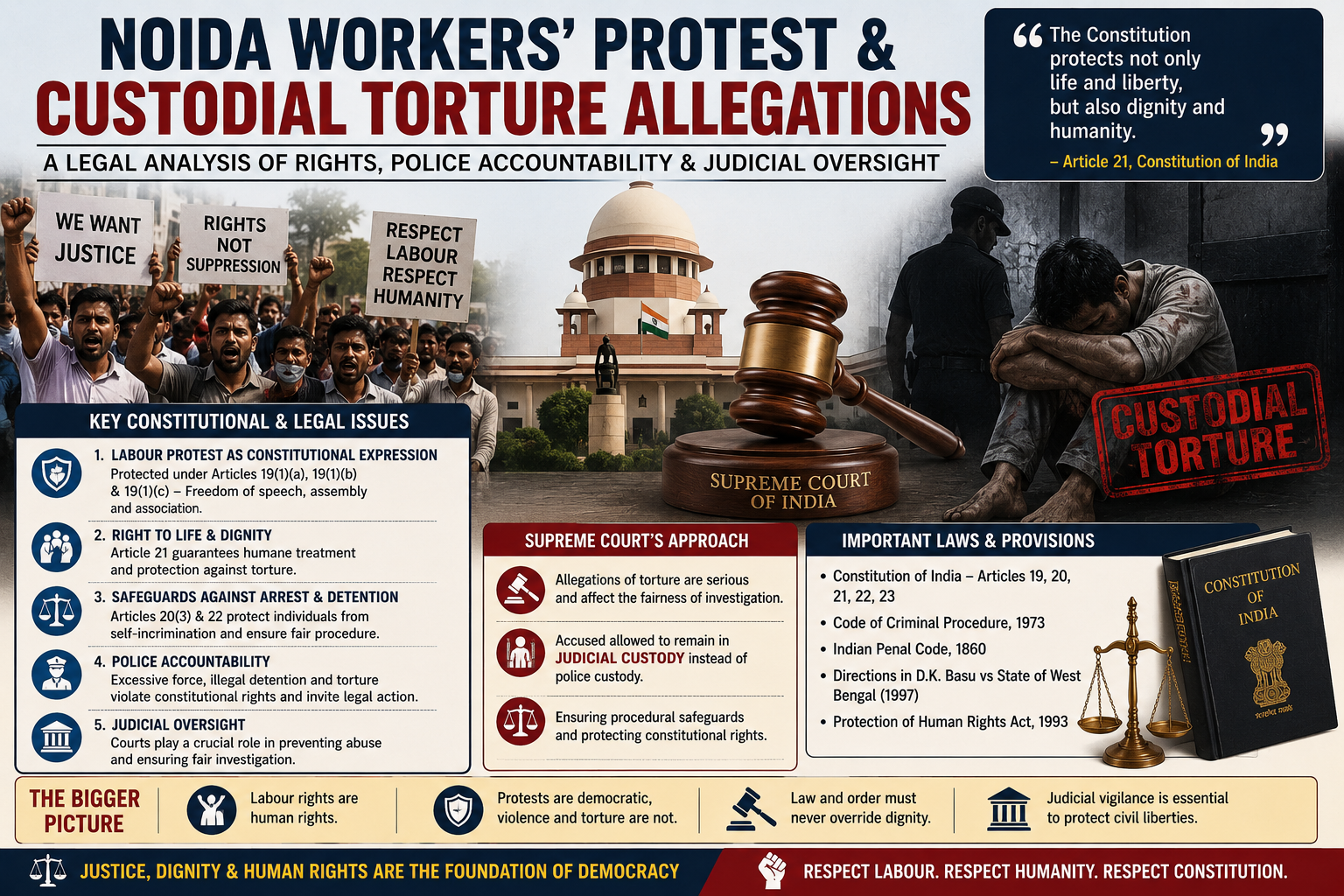
The recent controversy arising from the Noida workers’ protest, where accused persons alleged custodial torture before the Supreme Court, has once again revived debates concerning police accountability, judicial supervision, and the protection of civil liberties during criminal investigations. While the Supreme Court allowed the accused workers to remain in judicial custody rather than granting immediate relief, the matter drew national attention because of the allegations of torture and the Court’s concern regarding procedural safeguards.
The episode is significant not merely because it concerns a labour protest, but because it highlights deeper constitutional questions:
What protections exist against custodial violence in India?
How should courts balance investigative requirements with allegations of torture?
To what extent do labour protests enjoy constitutional protection?
What role does judicial oversight play in preventing abuse of police powers?
The case also demonstrates the continuing tension between law-and-order concerns and the constitutional promise of dignity under Article 21 of the Constitution of India.
This blog examines the legal and constitutional dimensions of the Noida workers’ protest case through the lens of custodial violence jurisprudence, labour rights, criminal procedure safeguards, and judicial accountability.
🔹Understanding the Background of the Noida Workers’ Protest:
Industrial protests in regions such as Noida and Greater Noida are not uncommon. As major manufacturing and industrial hubs, these regions witness recurring disputes relating to wages, working conditions, layoffs, contractual employment, and labour welfare.
The present controversy reportedly emerged after workers associated with a protest movement were arrested following allegations of unlawful assembly, violence, obstruction, or related offences. During subsequent proceedings, some accused persons alleged that they had been subjected to custodial torture and physical abuse while in police custody.
When the matter reached the Supreme Court, the Court reportedly allowed the accused to remain in judicial custody instead of police custody after the allegations were raised. Though the Court did not immediately pronounce upon the truthfulness of the allegations, its intervention reflected judicial caution in situations involving claims of custodial abuse.
The significance of the order lies in the distinction between police custody and judicial custody:
Police custody places the accused under the direct control of investigating authorities.
Judicial custody places the accused under the supervision of the jail administration and ultimately under judicial oversight.
Courts often adopt a cautious approach when allegations of torture or coercion arise during investigation.
🔹Labour Protests as Constitutional Expression:
Labour protests are not merely industrial disputes; they are linked with several constitutional guarantees.
Article 19 and the Right to Protest
The Constitution guarantees:
Freedom of speech and expression under Article 19(1)(a)
Right to assemble peacefully under Article 19(1)(b)
Right to form associations or unions under Article 19(1)©
Trade unions and workers’ collectives derive legitimacy from these constitutional freedoms.
Although the right to strike is not recognised as a fundamental right, peaceful protest and collective bargaining remain constitutionally protected democratic activities.
The Supreme Court has repeatedly recognised that dissent and peaceful assembly are essential components of constitutional democracy.
🔹Labour Rights and Human Dignity:
The Indian constitutional framework also incorporates labour welfare principles through:
Article 21 – Right to life and dignity
Article 23 – Protection against forced labour
Directive Principles under Articles 38, 39, 41, 42, and 43
The judiciary has often interpreted labour protections through the broader framework of human dignity.
In cases involving industrial unrest, therefore, state authorities are expected to maintain public order while simultaneously respecting constitutional freedoms.
🔹Custodial Violence: A Persistent Constitutional Crisis:
Custodial violence remains one of the gravest human rights concerns in India. Despite constitutional guarantees and judicial guidelines, allegations of torture, illegal detention, and custodial deaths continue to emerge across the country.
Constitutional Protection Against Torture
India does not yet have a standalone anti-torture legislation despite international commitments. However, constitutional safeguards against torture emerge from multiple provisions.
Article 21: Right to Life and Personal Liberty
The Supreme Court has expansively interpreted Article 21 to include:
Right to live with dignity
Protection against torture
Fair investigation
Humane treatment during detention
Custodial violence directly violates constitutional dignity.
Article 20(3): Protection Against Self-Incrimination
Forced confessions obtained through coercion or torture violate Article 20(3), which protects individuals from being compelled to testify against themselves.
Article 22: Safeguards During Arrest
Article 22 provides:
Right to be informed of grounds of arrest
Right to consult a lawyer
Production before a magistrate within 24 hours
These protections aim to prevent arbitrary detention and abuse.
🔹Judicial Recognition of Custodial Violence:
The Supreme Court has consistently condemned custodial torture as incompatible with constitutional democracy.
D.K. Basu v. State of West Bengal
This landmark judgment remains the cornerstone of custodial rights jurisprudence in India.
The Court recognised custodial torture as:
“a naked violation of human dignity.”
The judgment laid down mandatory arrest and detention guidelines, including:
Preparation of arrest memo
Medical examination of accused
Informing relatives or friends
Maintenance of custody records
Right to legal consultation
The Court emphasised that state power cannot override constitutional protections.
Joginder Kumar v. State of Uttar Pradesh
The Supreme Court held that arrest should not be routine or mechanical. Police must justify the necessity of arrest.
The Court observed that:
“No arrest can be made merely because it is lawful for the police officer to do so.”
This principle becomes particularly relevant during mass protests where preventive arrests are frequently used.
Nilabati Behera v. State of Orissa
The Court recognised compensation as a constitutional remedy in custodial violence cases.
This judgment reinforced the idea that the State bears responsibility for the safety of persons in custody.
🔹Police Custody vs Judicial Custody: Why the Distinction Matters:
The Supreme Court’s decision to permit the accused workers to remain in judicial custody rather than police custody carries important legal implications.
Police Custody
Under Section 167 of the Code of Criminal Procedure, police custody permits investigators direct access to the accused for interrogation.
However, this stage is also considered highly vulnerable because allegations of:
Coercion
Forced confessions
Physical assault
Psychological pressure
often arise during police interrogation.
Judicial Custody
Judicial custody places the accused in jail under court supervision.
Investigating agencies may still question the accused with permission, but direct custodial control is limited.
When allegations of torture emerge, courts sometimes prefer judicial custody to reduce the possibility of further abuse while permitting investigation to continue.
🔹Supreme Court’s Balancing Exercise:
The Noida workers’ protest case reflects a judicial balancing exercise between competing constitutional interests.
Protection of Investigation
Courts cannot automatically assume all allegations against police are true without inquiry. Criminal investigations must proceed in accordance with law.
The judiciary therefore avoids unnecessarily obstructing investigation unless there is clear illegality.
Protection of Human Rights
At the same time, allegations of custodial torture cannot be ignored because custodial abuse strikes at the heart of constitutional governance.
The Court’s intervention reflects a preventive constitutional approach:
ensuring investigation continues,
while reducing the possibility of custodial abuse.
This approach aligns with the broader constitutional philosophy that procedural fairness is inseparable from justice.
Custodial Torture and International Human Rights Law
India’s constitutional jurisprudence is also influenced by international human rights norms.
United Nations Convention Against Torture
India signed the UN Convention Against Torture in 1997 but has not formally ratified it.
The Convention obligates states to:
criminalise torture,
investigate allegations independently,
provide remedies to victims.
Although not directly enforceable without legislation, Indian courts often rely upon international human rights principles while interpreting constitutional rights.
Labour Movements and Criminalisation
A recurring concern in labour jurisprudence is the increasing criminalisation of industrial protest.
Use of Criminal Law During Labour Unrest
Authorities often invoke provisions relating to:
unlawful assembly,
rioting,
obstruction,
public order disturbances.
While violent conduct cannot be protected, indiscriminate criminalisation of labour protests raises constitutional concerns.
Democratic Value of Labour Dissent
Trade unions historically played an important role in protecting workers from exploitation.
Suppressing peaceful labour movements through excessive police action risks weakening democratic participation within industrial relations.
The Supreme Court has repeatedly emphasised that dissent cannot be treated as anti-state activity merely because it challenges authority.
Judicial Oversight as a Constitutional Safeguard
The judiciary functions as the institutional safeguard between state power and individual liberty.
Magistrate’s Role During Remand
Magistrates are expected to carefully scrutinise:
physical condition of accused persons,
allegations of torture,
legality of arrest,
need for police custody.
Mechanical remand orders undermine constitutional protections.
Constitutional Courts and Human Rights
High Courts and the Supreme Court exercise powers under:
Article 32
Article 226
to protect fundamental rights against custodial abuse.
In cases involving torture allegations, constitutional courts may:
order medical examinations,
transfer investigations,
direct compensation,
order independent inquiry.
🔹The Larger Crisis of Police Accountability in India:
The Noida case also revives the unresolved issue of structural police reform.
Colonial Legacy of Policing
India’s policing framework continues to retain colonial characteristics emphasising:
control,
force,
state authority,
rather than citizen-centric constitutional policing.
Prakash Singh v. Union of India
This landmark judgment directed structural police reforms, including:
independent complaints authorities,
security of tenure,
separation of investigation from law-and-order functions.
Implementation, however, remains incomplete in many states.
🔹Why Custodial Violence Persists:
Several structural factors contribute to continued custodial abuse:
1. Weak Accountability Mechanisms
Internal departmental inquiries often lack independence.
2. Pressure for Quick Results
Investigative agencies face pressure to rapidly solve cases, sometimes leading to coercive interrogation methods.
3. Delayed Trials
Victims of custodial abuse frequently face prolonged litigation.
4. Limited Surveillance and Documentation
Although CCTV installation in police stations has been directed by courts, implementation gaps remain.
The Supreme Court’s Constitutional Messaging
Even interim judicial orders carry constitutional significance.
The Supreme Court’s handling of the Noida workers’ protest matter sends several institutional messages:
Allegations of Torture Must Be Taken Seriously
Courts cannot casually dismiss claims of custodial abuse.
Liberty and Investigation Must Coexist
The justice system must protect both:
effective criminal investigation,
constitutional rights of accused persons.
Judicial Custody Can Function as a Protective Mechanism
Judicial supervision becomes especially important where allegations of abuse arise.
🔹Human Dignity as the Core Constitutional Principle:
At the heart of custodial violence jurisprudence lies the constitutional principle of dignity.
The Supreme Court has repeatedly held that prisoners and accused persons do not lose their fundamental rights merely because they are detained.
In Sunil Batra v. Delhi Administration, the Court recognised that prison walls do not separate inmates from constitutional protections.
The constitutional vision rejects the idea that state power may operate without accountability inside custodial spaces.
🔹Media, Public Perception, and Labour Protests:
Public discourse surrounding labour protests is often shaped by media narratives.
Workers’ agitations are sometimes portrayed exclusively through the lens of disruption or public inconvenience, while underlying labour grievances receive limited attention.
Balanced reporting is therefore crucial to ensure that:
legitimate labour concerns are heard,
allegations of violence are independently examined,
constitutional rights are not overshadowed by sensationalism.
Need for Comprehensive Anti-Torture Legislation
India still lacks a dedicated anti-torture statute.
Several commissions and experts have recommended legislative reform.
A robust anti-torture law should include:
clear definition of torture,
independent investigation mechanism,
witness protection,
compensation framework,
criminal liability for custodial abuse.
Such legislation would strengthen both constitutional governance and public trust in law enforcement.
🔹Balancing Public Order and Constitutional Liberty:
The State unquestionably possesses authority to maintain law and order. Violent protests cannot receive constitutional immunity.
However, constitutional democracy requires proportionality.
The State’s response to labour unrest must remain:
lawful,
necessary,
proportionate,
accountable.
The Supreme Court has repeatedly emphasised that constitutional freedoms cannot be sacrificed in the name of administrative convenience.
Comparative Constitutional Perspective
Many democratic jurisdictions recognise custodial safeguards as essential to the rule of law.
United Kingdom
The UK incorporates procedural safeguards through:
custody monitoring,
legal aid access,
independent complaints bodies.
United States
American jurisprudence developed protections against coercive interrogation through constitutional due process principles and the well-known Miranda safeguards.
South Africa
South Africa’s Constitution explicitly prohibits torture and cruel treatment.
Comparative experiences demonstrate that democratic legitimacy depends significantly upon custodial accountability.
🔹The Broader Constitutional Debate:
The Noida workers’ protest matter is not merely about one remand order or one allegation of abuse.
It reflects larger constitutional anxieties concerning:
expansion of police powers,
shrinking civic space,
criminalisation of dissent,
institutional accountability,
labour precarity.
The judiciary’s role becomes especially important in such moments because constitutional courts function as guardians against excesses of state power.
🔹Way Forward:
Meaningful reform requires institutional commitment across multiple levels.
1. Strengthening Custodial Safeguards
Mandatory CCTV compliance
Independent medical examinations
Digitised custody records
Lawyer access during interrogation
2. Police Reform
Implementation of the Prakash Singh v. Union of India directives remains essential.
3. Judicial Vigilance
Magistrates and constitutional courts must continue scrutinising custodial practices carefully.
4. Labour Dialogue Mechanisms
Industrial disputes should be resolved through negotiation and mediation wherever possible to avoid escalation into criminal confrontation.
5. Anti-Torture Legislation
Parliament should enact comprehensive legislation criminalising custodial torture.
🔹Conclusion:
The Supreme Court’s intervention in the Noida workers’ protest case represents an important constitutional moment at the intersection of labour rights, police accountability, and judicial oversight.
By allowing the accused to remain in judicial custody after allegations of torture emerged, the Court appeared to adopt a cautious constitutional approach—one that neither prematurely obstructed investigation nor ignored concerns regarding custodial abuse.
🔹Disclaimer:
This article is intended solely for academic, informational, and legal commentary purposes.

Leave a Comment
Your email address and mobile number will not be published. Required fields are marked *