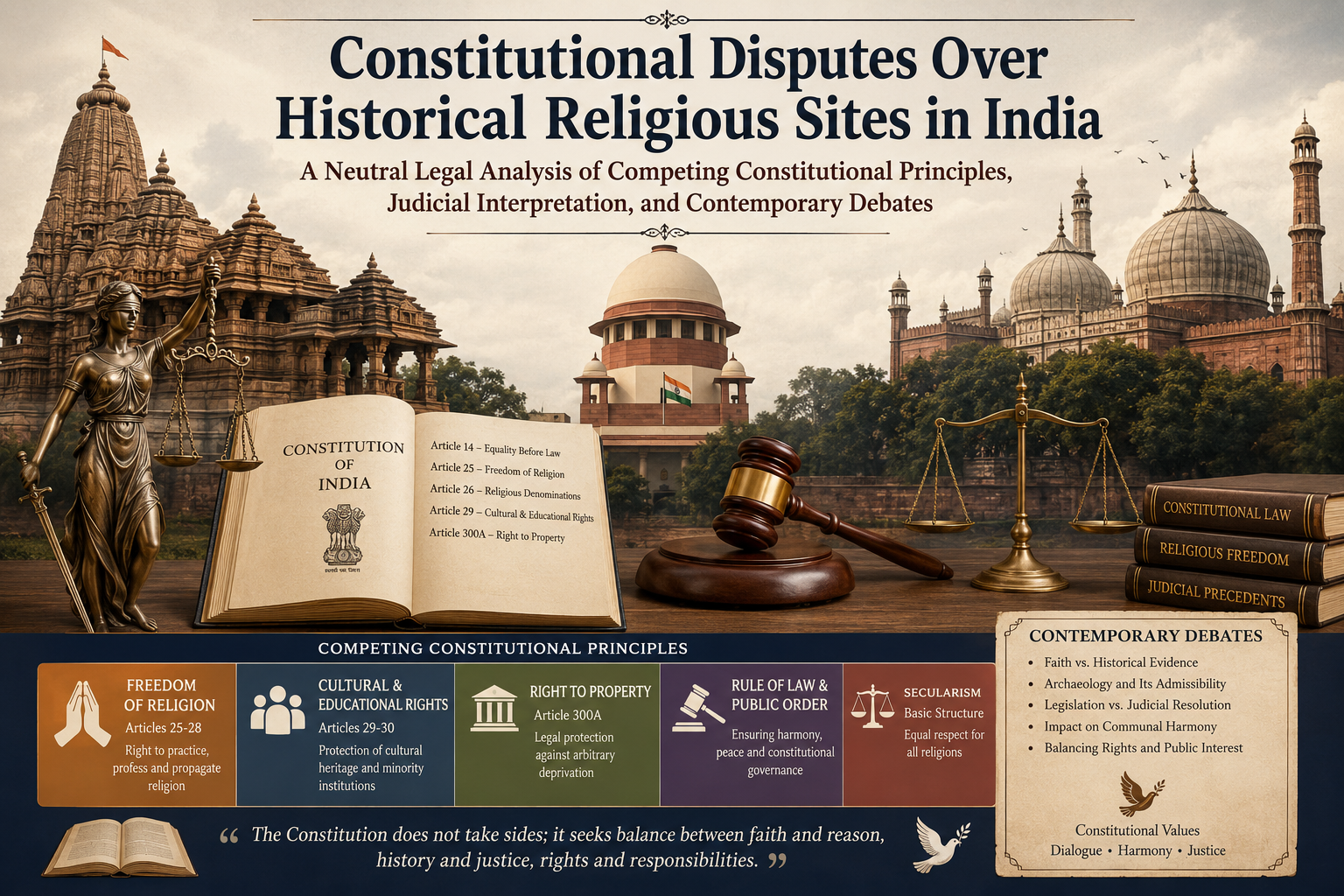
🔹Introduction
India is one of the few civilizations where religion, history, culture, and constitutional governance intersect in remarkably complex ways. Across thousands of years, different kingdoms, communities, and faith traditions have built places of worship that today serve not only as religious centres but also as symbols of India's diverse cultural heritage. Many of these structures possess immense historical, archaeological, architectural, and spiritual significance.
While the overwhelming majority of religious sites coexist peacefully under the protection of law, a limited number of historical places have become subjects of legal disputes concerning ownership, management, worship rights, historical identity, and constitutional protection. These disputes often attract significant public attention because they involve questions extending beyond property law into constitutional values, religious freedom, historical interpretation, and public order.
Constitutional litigation concerning historical religious sites is therefore unlike ordinary civil litigation. Courts are not merely asked to determine ownership or possession; they are required to interpret constitutional provisions, statutory enactments, historical evidence, archaeological findings, and principles of secular governance while safeguarding the rights guaranteed by the Constitution.
The Indian judiciary has consistently emphasized that such disputes must be resolved through the rule of law rather than through public sentiment, political opinion, or extra-legal means. Courts adjudicate on the basis of pleadings, admissible evidence, applicable statutes, and constitutional principles. They do not determine the truth of religious beliefs or evaluate the comparative merit of different faiths.
This article presents a neutral legal analysis of constitutional disputes relating to historical religious sites in India. It does not advocate any political, religious, or ideological position. Instead, it explains the constitutional framework, statutory provisions, judicial interpretation, and competing legal arguments that shape this important area of constitutional law.
🔹Why These Disputes Matter
Historical religious site litigation raises several constitutional questions simultaneously.
For example:
Can historical claims be examined by constitutional courts?
How should religious freedom be balanced with public order?
What is the constitutional significance of secularism?
How should Parliament's legislative choices be respected?
Can archaeological evidence influence judicial decisions?
What role does historical evidence play in constitutional adjudication?
How should competing fundamental rights be reconciled?
Each question requires courts to balance multiple constitutional values rather than giving absolute preference to any single principle.
🔹Understanding Constitutional Litigation
Constitutional litigation refers to legal proceedings in which the interpretation or enforcement of constitutional provisions becomes central to resolving a dispute.
Unlike ordinary civil suits involving contracts or private property alone, constitutional litigation often affects broader public interests. Courts may be required to interpret:
Fundamental Rights
Directive Principles
Constitutional limitations on State power
Legislative competence
Judicial review
Constitutional morality
Rule of law
Basic Structure doctrine
Historical religious site disputes frequently involve several of these constitutional concepts at the same time.
Historical Religious Sites: More Than Places of Worship
A historical religious site may simultaneously represent:
A place of worship
A cultural monument
An archaeological site
A heritage structure
A public institution
A property subject to civil law
A protected monument under statutory law
Consequently, disputes concerning such places often involve several branches of law, including constitutional law, civil law, property law, evidence law, administrative law, and heritage conservation law.
🔹Historical Background
India's long history includes periods of cultural interaction, political change, migration, empire-building, and religious diversity. Across centuries, places of worship have been established, renovated, expanded, damaged, reconstructed, and preserved under different political and social circumstances.
Historical records relating to these sites may be found in:
Archaeological excavations
Ancient inscriptions
Royal grants
Revenue records
Government archives
Travel accounts
Religious literature
Maps
Oral traditions
However, courts do not automatically accept every historical claim. Historical materials must be assessed according to established legal principles governing admissibility, relevance, and evidentiary value.
🔹Constitutional Vision of Religious Freedom
The Constitution of India establishes a democratic republic committed to justice, liberty, equality, and fraternity. Although India is home to numerous religious traditions, the Constitution does not establish an official religion.
Instead, it guarantees equal protection of law to persons belonging to every faith while permitting the State to regulate secular activities associated with religious institutions when constitutionally justified.
This constitutional vision seeks to preserve religious liberty while maintaining public order, social harmony, and constitutional governance.
Article 14: Equality Before Law
Article 14 guarantees equality before the law and equal protection of the laws.
This principle requires:
Equal treatment of similarly situated persons.
Non-arbitrary governmental action.
Fair judicial procedures.
Uniform application of constitutional principles.
Regardless of the religious identity of a disputed site, constitutional adjudication must remain impartial and evidence-based.
Articles 25 and 26: Religious Freedom
Article 25 guarantees every individual the freedom of conscience and the right to freely profess, practice, and propagate religion.
However, this freedom is expressly subject to:
Public order
Morality
Health
Other provisions of Part III of the Constitution
Article 26 grants religious denominations the right to manage their own religious affairs, establish institutions, own property, and administer religious institutions, subject to constitutional limitations.
The Supreme Court has repeatedly clarified that these rights are significant but not absolute. Constitutional balancing becomes necessary whenever competing rights or compelling public interests arise.
Articles 27 and 28
Article 27 generally prohibits compelling any person to pay taxes specifically intended to promote or maintain a particular religion.
Article 28 regulates religious instruction in educational institutions maintained wholly or substantially by the State.
Although these provisions may not directly determine ownership disputes, they reflect the constitutional commitment to neutrality among religions.
Articles 29 and 30
Articles 29 and 30 safeguard cultural and educational rights, particularly those of minorities.
Historical religious institutions sometimes possess educational, linguistic, or cultural significance extending beyond worship alone. Consequently, these provisions may become relevant depending on the facts of a particular case.
Articles 32 and 226
The Constitution empowers citizens to approach constitutional courts for the protection of legal and fundamental rights.
Article 32 empowers the Supreme Court to enforce Fundamental Rights.
Article 226 empowers High Courts to issue writs for enforcement of Fundamental Rights and other legal rights.
These constitutional remedies ensure that disputes concerning religious freedom, equality, or governmental action may be examined through established judicial procedures.
Secularism: The Constitutional Foundation
Secularism is recognised by the Supreme Court as part of the Constitution's Basic Structure.
Indian secularism differs from strict separation models followed in some other jurisdictions. Rather than excluding all interaction between religion and the State, the Indian model permits the State to regulate secular aspects of religious institutions while respecting religious freedom.
For example, the State may legislate concerning:
Administration of religious endowments.
Financial transparency.
Public safety.
Heritage conservation.
Archaeological preservation.
Public order.
This model seeks equal respect for all religions while ensuring that constitutional values remain supreme.
Constitutional Morality
In recent constitutional jurisprudence, the Supreme Court has repeatedly emphasized the importance of constitutional morality.
Constitutional morality requires public institutions to act according to constitutional principles rather than political popularity or majoritarian sentiment.
In disputes concerning historical religious sites, constitutional morality encourages courts to focus on:
Evidence,
Applicable statutes,
Due process,
Equality,
Religious freedom,
Judicial independence.
It discourages adjudication based upon emotion, political pressure, or historical grievance alone.
Rule of Law
The Rule of Law is one of the foundational principles of the Indian Constitution.
It means that:
Every person is subject to law.
Every governmental authority is accountable under law.
Legal disputes must be resolved by courts.
Constitutional procedures must prevail over force or unilateral action.
Accordingly, constitutional disputes concerning historical religious sites are expected to be resolved through judicial institutions and lawful procedures.
🔹Statutory Framework Governing Historical Religious Sites
While the Constitution provides the foundational principles governing religious freedom and equality, Parliament has enacted several statutes that directly or indirectly regulate historical religious sites. These laws guide courts in resolving disputes involving ownership, preservation, management, and worship rights.
The most significant legislations include:
The Places of Worship (Special Provisions) Act, 1991
The Ancient Monuments and Archaeological Sites and Remains Act, 1958 (AMASR Act)
The Archaeological Survey of India (ASI) regulations
Relevant provisions of the Code of Civil Procedure, 1908
The Indian Evidence Act, 1872 (now largely replaced by the Bharatiya Sakshya Adhiniyam, 2023)
State laws governing religious endowments and trusts
Each statute addresses a different aspect of the legal framework.
The Places of Worship (Special Provisions) Act, 1991
The Places of Worship Act, 1991, is one of the most important statutes in this area. It was enacted with the objective of preserving the religious character of places of worship as they existed on 15 August 1947, thereby promoting communal harmony and preventing fresh disputes over historical religious sites.
Key Features
The Act generally provides that:
The religious character of a place of worship as it existed on 15 August 1947 shall be maintained.
Conversion of the religious character of such places is generally prohibited.
Courts are restricted from entertaining certain categories of suits seeking to alter the religious character of covered places, subject to the provisions and exceptions contained in the Act.
The Act contains specific exceptions, including one relating to the Ayodhya dispute, which was expressly excluded from its scope.
The legislation reflects Parliament's attempt to balance historical concerns with the constitutional goal of maintaining public peace and legal certainty.
Constitutional Questions Surrounding the Act
The Act has itself become the subject of constitutional litigation before the Supreme Court. Without commenting on the merits of those pending proceedings, the principal constitutional issues raised include:
Arguments Supporting the Act
Supporters generally contend that:
It reinforces the constitutional value of secularism.
It promotes communal harmony and public order.
It discourages the reopening of numerous historical disputes.
It reflects Parliament's policy choice to preserve legal stability after Independence.
It protects existing religious practices from recurring litigation.
Arguments Challenging the Act
Critics generally argue that:
Certain historical claims should remain open to judicial examination where legally maintainable.
The Act may limit access to judicial remedies in specific circumstances.
Parliament cannot entirely foreclose judicial consideration of disputes involving constitutional rights or title claims.
The constitutional validity of the Act itself should be subject to judicial review.
As these issues are pending before the Supreme Court, their ultimate resolution will depend on future judicial interpretation.
Why the Act Is Constitutionally Significant
The constitutional importance of the Places of Worship Act lies in the fact that it brings multiple constitutional principles into interaction, including:
Secularism
Rule of Law
Legislative competence
Judicial review
Religious freedom
Equality
Public order
Rather than focusing solely on historical events, courts examining the Act must determine whether its provisions are consistent with the Constitution.
The Ancient Monuments and Archaeological Sites and Remains Act, 1958
Another important statute is the Ancient Monuments and Archaeological Sites and Remains Act, 1958 (AMASR Act).
Its primary purpose is to protect monuments and archaeological sites of national importance.
The Act empowers the Government to:
Declare monuments of national importance.
Regulate excavation.
Protect archaeological remains.
Prevent unauthorized construction near protected monuments.
Preserve historically significant structures for future generations.
Where a disputed religious site is also a protected monument, courts may need to consider the requirements of this Act alongside constitutional and civil law principles.
Role of the Archaeological Survey of India (ASI)
The Archaeological Survey of India (ASI) is India's premier archaeological institution.
Its functions include:
Conducting archaeological excavations.
Conserving protected monuments.
Preparing archaeological reports.
Undertaking scientific surveys.
Preserving historical structures.
In certain litigations, courts have directed archaeological investigations where such evidence was considered legally relevant. However, archaeological reports do not automatically determine the outcome of a case. They form one part of the evidentiary record and are evaluated together with documentary evidence, oral testimony, and applicable law.
Role of Archaeological Evidence in Court
Historical disputes often involve competing narratives regarding the origin or history of a site. Courts therefore assess various forms of evidence, which may include:
Archaeological excavation reports.
Inscriptions.
Ancient manuscripts.
Revenue records.
Historical maps.
Government notifications.
Gazette publications.
Expert testimony.
Documentary evidence.
Oral evidence where legally admissible.
Courts examine such material according to established evidentiary principles. No single category of evidence is automatically decisive.
Property Law Principles
Many disputes concerning historical religious sites are also disputes relating to civil property rights.
Important legal questions may include:
Who has legal title?
Who possesses the property?
Is the property public, private, or held in trust?
Is there documentary proof of ownership?
Has continuous possession been established?
Are there statutory limitations on claims?
These issues are governed by ordinary civil law principles in addition to constitutional considerations.
Religious Endowments and Trusts
Numerous historical religious institutions are administered through:
Public trusts.
Religious endowments.
Statutory boards.
Temple management authorities.
Waqf institutions.
Church organizations.
Monastic bodies.
The legal status of these institutions depends upon the governing statute, trust deed, historical records, and judicial precedents. Courts therefore examine institutional rights separately from questions concerning individual worship.
🔹Landmark Judicial Decisions
Indian constitutional jurisprudence concerning historical religious sites has evolved through several important judicial decisions. Each case depends on its own facts, evidence, and legal issues.
The following discussion highlights constitutional principles rather than expressing any view on the merits of particular disputes.
The Ayodhya Judgment (2019)
One of the most significant constitutional decisions in this area is the Supreme Court's judgment in M. Siddiq (D) Thr. LRs v. Mahant Suresh Das (2019).
The dispute involved questions relating to title, historical evidence, possession, archaeological material, and constitutional principles.
The Supreme Court emphasized that the case was decided as a civil title dispute based on evidence and applicable legal principles, rather than on theological preference or comparative religious beliefs.
The Court examined:
Documentary evidence.
Historical records.
Archaeological material.
Oral testimony.
Revenue records.
Applicable property law.
Constitutional principles.
The judgment illustrates that even disputes involving profound religious significance are adjudicated through established legal processes.
Constitutional Significance of the Ayodhya Decision
The decision is frequently studied because it demonstrates several constitutional principles:
Courts decide disputes based on evidence and law.
Historical materials must be legally evaluated rather than assumed to be conclusive.
Religious belief alone does not determine civil title.
Judicial reasoning must remain grounded in constitutional values and legal standards.
The judgment also reaffirmed the importance of maintaining public confidence in constitutional institutions when resolving sensitive disputes.
Pending Constitutional Litigation
Apart from concluded cases, Indian courts continue to hear matters concerning historical religious sites. Some proceedings involve questions about:
The interpretation of statutory provisions.
Maintainability of suits.
Scope of constitutional remedies.
Applicability of the Places of Worship Act.
Procedural issues relating to evidence and surveys.
Since many of these matters remain pending, courts have not reached final conclusions. Any legal analysis should therefore distinguish between decided law and issues awaiting adjudication.
Principles Emerging from Judicial Practice
Although each dispute is fact-specific, certain recurring constitutional principles emerge:
The rule of law must prevail over extra-legal action.
Courts rely on admissible evidence rather than public opinion.
Religious freedom is protected but is subject to constitutional limitations.
Parliament may legislate to address matters affecting public order and communal harmony, subject to constitutional review.
Judicial review remains an essential feature of the Constitution.
These principles collectively guide constitutional adjudication in one of the most sensitive areas of Indian public law.
🔹The Constitutional Debate: Balancing Competing Constitutional Values
Historical religious site disputes present one of the most complex constitutional questions in India because they rarely involve a single legal issue. Instead, they require courts to balance several constitutional principles that may appear to be in tension with one another.
Some of these principles include:
Freedom of religion
Equality before law
Rule of law
Secularism
Judicial review
Protection of cultural heritage
Access to justice
Public order and communal harmony
The challenge before constitutional courts is not to determine which principle is "more important" in the abstract, but to reconcile these principles in the context of the specific facts, evidence, and applicable law of each case.
Competing Constitutional Perspectives
Legal scholars, constitutional experts, and litigants have advanced different constitutional viewpoints regarding disputes over historical religious sites. These viewpoints are presented below to explain the debate, not to endorse either position.
🔹Perspective One: Preserving the Existing Religious Character
One constitutional perspective emphasizes that preserving the existing religious character of historical places of worship promotes constitutional stability and social harmony.
Supporters of this approach generally argue that:
The Constitution seeks to protect peace and fraternity among communities.
Reopening disputes relating to numerous historical events could create prolonged legal uncertainty.
Parliament is constitutionally empowered to enact laws designed to maintain public order and communal harmony.
Courts should ordinarily respect legislative choices unless they clearly violate the Constitution.
Constitutional adjudication should focus on present legal rights rather than attempting to resolve every historical controversy.
From this perspective, preserving the status quo is viewed as a means of strengthening constitutional governance and preventing recurring social conflict.
🔹Perspective Two: Judicial Examination of Historical Claims
Another constitutional perspective emphasizes that access to courts and judicial review are fundamental features of the Constitution.
Supporters of this view generally contend that:
Legitimate legal claims should be capable of judicial examination where permitted by law.
Courts exist to determine disputes based on evidence and constitutional principles.
Historical claims should not automatically be excluded from judicial scrutiny if they raise substantial questions of law.
Constitutional rights, including the right to seek legal remedies, deserve meaningful protection.
Every dispute should be decided according to its own facts rather than through broad assumptions.
According to this perspective, judicial determination through lawful procedures strengthens, rather than weakens, the rule of law.
🔹The Role of Constitutional Courts
The Indian judiciary does not function as a historical commission or theological authority.
Instead, constitutional courts perform several distinct functions:
Interpreting constitutional provisions.
Determining the validity of legislation.
Protecting Fundamental Rights.
Resolving civil disputes.
Reviewing governmental action.
Ensuring compliance with constitutional principles.
In historical religious site litigation, judges therefore focus on legal evidence, statutory interpretation, and constitutional doctrine rather than political or religious preferences.
Judicial Review as a Constitutional Safeguard
Judicial review enables constitutional courts to examine whether legislative or executive action is consistent with the Constitution.
The Supreme Court has repeatedly held that judicial review forms part of the Constitution's Basic Structure.
Accordingly, whenever constitutional questions arise concerning historical religious sites, courts may examine:
Whether legislation complies with the Constitution.
Whether executive decisions are lawful.
Whether Fundamental Rights have been respected.
Whether statutory procedures have been followed.
Judicial review thus serves as a safeguard against arbitrary action while preserving constitutional supremacy.
The Basic Structure Doctrine
The Basic Structure Doctrine, developed by the Supreme Court, prevents constitutional amendments from destroying the essential features of the Constitution.
Important elements include:
Rule of Law
Judicial Review
Democracy
Separation of Powers
Federalism
Secularism
Equality
Constitutional Supremacy
Whenever disputes concerning historical religious sites raise constitutional questions, courts frequently interpret statutes in light of these foundational principles.
🔹Secularism in the Indian Context
Secularism occupies a unique position within Indian constitutional law.
Unlike certain constitutional systems that maintain a strict institutional separation between religion and the State, India's constitutional model permits interaction where necessary to achieve constitutional objectives.
Examples include:
Regulation of temple administration.
Protection of heritage monuments.
Financial oversight of public religious institutions.
Preservation of archaeological sites.
Maintenance of public order.
At the same time, the State must avoid favouring one religion over another in a manner inconsistent with constitutional guarantees.
Thus, Indian secularism is often understood as requiring principled neutrality, equal respect, and constitutional fairness.
🔹Constitutional Morality and Sensitive Litigation
The Supreme Court has increasingly emphasized the importance of constitutional morality in resolving difficult constitutional disputes.
Constitutional morality requires decision-makers to act according to constitutional values rather than transient political or social pressures.
Its practical implications include:
Respect for due process.
Protection of minority rights.
Equal treatment before law.
Independence of the judiciary.
Evidence-based adjudication.
Respect for constitutional limitations.
This principle becomes especially significant where disputes involve questions capable of generating strong public emotions.
Public Order as a Constitutional Consideration
Religious freedom under Article 25 is expressly subject to public order.
This reflects the constitutional recognition that the exercise of religious rights must coexist with societal peace and lawful administration.
Accordingly, governments may impose reasonable restrictions where necessary to:
Prevent violence.
Maintain peace.
Protect life and property.
Ensure orderly administration.
Courts examine whether such restrictions are constitutionally justified and proportionate to the objective sought to be achieved.
Protection of Cultural Heritage
Historical religious sites often possess importance extending beyond religious practice.
Many structures represent:
Architectural achievements.
Archaeological heritage.
Cultural memory.
National history.
Artistic excellence.
The Constitution encourages preservation of India's composite cultural heritage, while statutory laws such as the Ancient Monuments and Archaeological Sites and Remains Act provide specific mechanisms for protecting nationally important monuments.
Consequently, constitutional adjudication sometimes requires balancing religious claims with heritage conservation.
🔹Challenges Before the Judiciary
Courts deciding historical religious site disputes encounter several practical and legal challenges.
These include:
1. Evaluating Historical Evidence
Historical records may be incomplete, contradictory, or centuries old.
Courts must therefore distinguish between historical narratives and legally admissible evidence.
2. Balancing Competing Rights
One dispute may simultaneously involve:
Religious freedom.
Property rights.
Cultural heritage.
Equality.
Public order.
Balancing these interests requires careful constitutional reasoning.
3. Maintaining Judicial Neutrality
Because these disputes often attract intense public attention, courts must ensure that judgments are based exclusively on law and evidence.
Judicial legitimacy depends upon public confidence in impartial decision-making.
4. Legislative Interpretation
Courts frequently interpret statutes enacted decades earlier in light of contemporary constitutional jurisprudence.
This requires harmonizing legislative intent with constitutional principles.
5. Social Impact
Constitutional judgments in sensitive matters may influence not only the parties before the court but also public discourse, governmental policy, and future litigation.
Accordingly, constitutional courts often adopt detailed and carefully reasoned judgments.
Emerging Trends
Several developments are likely to influence future constitutional litigation concerning historical religious sites.
These include:
Increased use of digital archival records.
Scientific archaeological methods.
Advanced mapping technologies.
Greater reliance on documentary evidence.
Digitisation of historical manuscripts.
Expanded public access to judicial records.
Growing constitutional scholarship.
These developments may improve evidentiary analysis while preserving procedural fairness.
🔹Key Takeaways
The legal landscape governing historical religious sites in India can be summarized as follows:
The Constitution protects freedom of religion, but that freedom is subject to public order, morality, health, and other constitutional provisions.
Secularism forms part of the Constitution's Basic Structure and requires the State to maintain principled neutrality while respecting all faiths.
Historical religious site disputes often involve multiple areas of law, including constitutional law, civil law, property law, heritage law, and evidence law.
The Places of Worship (Special Provisions) Act, 1991 is a central statute in this field and continues to be the subject of constitutional litigation.
The Ancient Monuments and Archaeological Sites and Remains Act, 1958 protects monuments of national importance and may apply where heritage conservation is involved.
Courts decide disputes based on evidence, statutory interpretation, and constitutional principles, not on theological preferences or political considerations.
Judicial review, the rule of law, equality, and due process remain fundamental safeguards in constitutional adjudication.
Frequently Asked Questions (FAQs)
1. What is constitutional litigation?
Constitutional litigation refers to court proceedings in which the interpretation, enforcement, or validity of constitutional provisions becomes central to resolving a dispute.
2. Are all disputes relating to religious sites constitutional disputes?
No. Many disputes are ordinary civil matters involving title, possession, management, or trust administration. A dispute becomes constitutional when issues relating to constitutional rights, statutory validity, or constitutional interpretation arise.
3. Can courts decide historical questions?
Courts may examine historical evidence only to the extent necessary to resolve the legal issues before them. Their role is not to write history but to decide legal disputes based on admissible evidence and applicable law.
4. Does religious belief alone determine ownership of a site?
No. Questions relating to ownership or title are generally determined according to the applicable legal principles, documentary evidence, possession, statutory provisions, and judicial precedents.
5. Why is the Places of Worship Act, 1991 important?
The Act seeks to preserve the religious character of places of worship as they existed on 15 August 1947, subject to its provisions and exceptions. It plays a significant role in the constitutional and legal framework governing historical religious site disputes.
6. What role does the Archaeological Survey of India (ASI) play?
The ASI conducts archaeological research, conservation, and scientific studies. Where courts direct archaeological investigations, ASI reports may form part of the evidentiary record, but they are assessed alongside all other admissible evidence.
7. Why are these disputes considered constitutionally significant?
Because they often require courts to balance several constitutional principles simultaneously, including freedom of religion, equality, secularism, public order, judicial review, and the rule of law.
🔹Conclusion
Constitutional disputes over historical religious sites are resolved through the Constitution, the rule of law, and judicial interpretation, not through historical or religious assertions alone. These cases highlight the need to balance religious freedom, secularism, equality, and public order while upholding constitutional values and due process.
🔸Disclaimer
This article is intended solely for educational, informational, and academic purposes.

Leave a Comment
Your email address and mobile number will not be published. Required fields are marked *