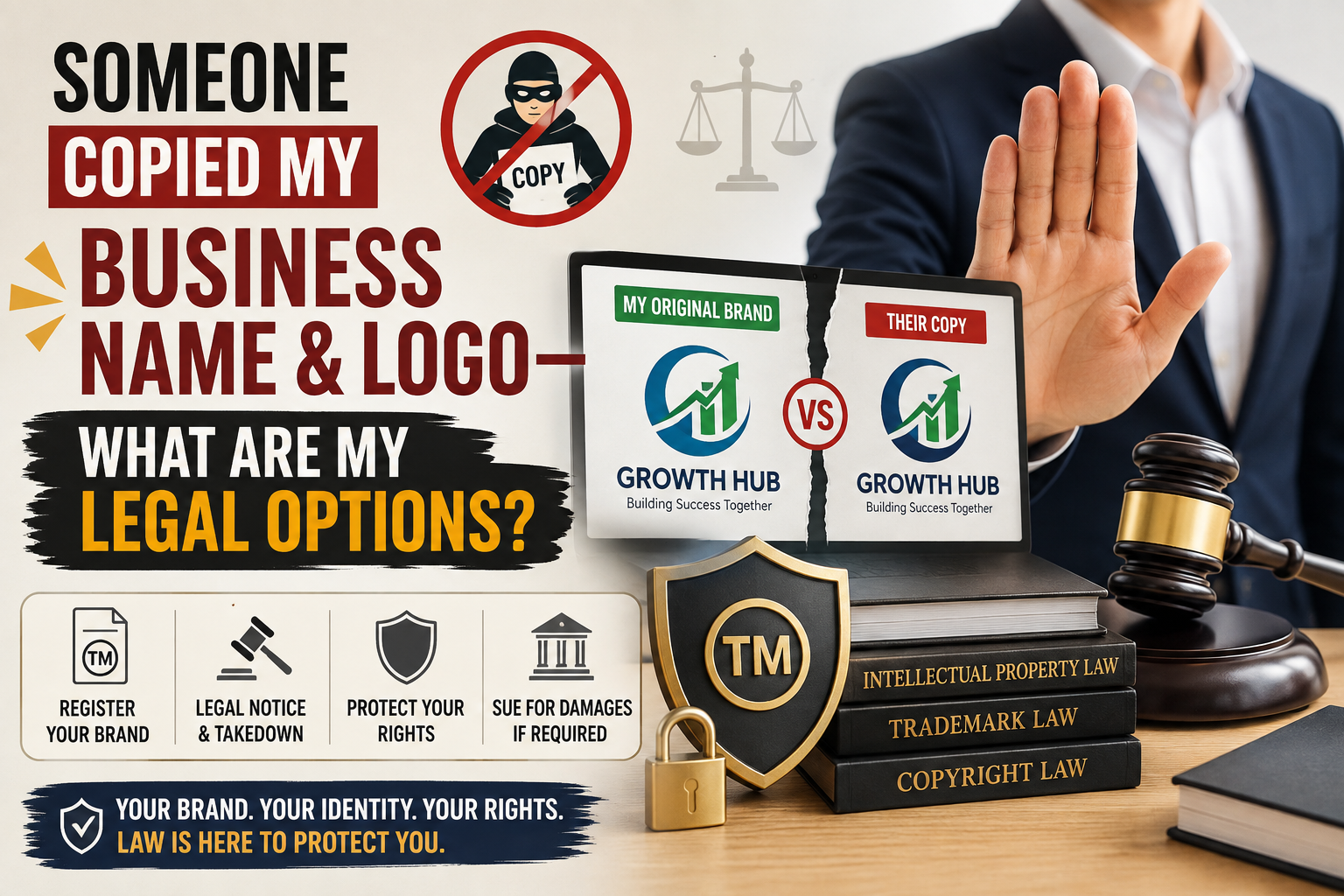
Practical Legal Guide for Business Owners in India
Starting a business involves more than investing money, finding customers, and building a reputation. A business owner also spends considerable time and effort creating a name, logo, brand identity, packaging, website, social-media presence, and goodwill.
But what happens when someone suddenly starts using a name or logo that looks confusingly similar to yours?
You may discover another business using your brand name on Instagram, selling similar products with a similar logo, registering a domain name resembling yours, or even putting a copied logo on its products.
The first reaction is often:
“They copied my business name and logo. What can I legally do?”
The answer depends on what exactly has been copied, whether you have registered your trademark, how similar the competing mark is, the goods or services involved, and whether the other party's use is likely to cause confusion or damage your goodwill.
This article explains the issue from a practical Indian-law perspective so that a new or existing business owner can understand what to do before the dispute becomes more serious. ⚖️
🏪 1. Your Business Name Is More Than Just a Name
When a business becomes known among customers, its name and logo can acquire commercial value.
For example, suppose you start a clothing business called “UrbanLeaf” and spend three years building a customer base.
You create:
a distinctive logo;
Instagram and Facebook pages;
packaging;
visiting cards;
invoices;
a website;
advertisements;
product labels;
customer reviews;
goodwill in the market.
After several years, another person starts selling clothing under the name “Urban Leef”, using a logo almost identical to yours.
Customers may believe:
“Is this the same company?”
That confusion can affect your reputation and sales.
Therefore, protecting your brand identity is an important part of running a business. 🛡️
⚖️ 2. First Question: What Exactly Has Been Copied?
Before deciding on a legal remedy, identify what the other person has actually copied.
It could be:
🔹 Business name
For example:
Your business: “GreenBasket”
Other business: “Green Basket India”
The legal position depends on factors such as the overall similarity, the goods/services, geographical presence, and likelihood of confusion.
🔹 Logo
Someone may reproduce your logo completely or create a logo that is substantially similar.
🔹 Brand name + logo
This can be more serious because the other business may be attempting to create an overall identity resembling yours.
🔹 Packaging
Sometimes the business name itself is not copied, but the competitor copies:
colours;
labels;
packaging layout;
product presentation;
artistic elements.
🔹 Website/domain name
For example:
Your business:
urbanleaf.in
Someone registers:
urbanleafindia.in
or another confusingly similar domain.
🔹 Social-media identity
Another person may create an Instagram page using your business name or a confusingly similar username.
🔹 Product labels
A competitor may put your brand name or logo on goods without permission.
Each situation can involve different legal issues.
📝 3. Trademark Law Is Usually the First Place to Look
For business names and logos, trademark protection is often extremely important.
In India, trademarks are primarily governed by the Trade Marks Act, 1999.
A trademark can include elements such as:
words;
names;
logos;
symbols;
labels;
combinations of words and devices;
and other marks capable of distinguishing one person's goods or services from those of others.
The purpose of trademark protection is essentially to identify the commercial source of goods or services.
So when customers see your distinctive brand, they should be able to associate it with your business.
🛡️ 4. Registered Trademark vs Unregistered Trademark
This is one of the most important distinctions for a business owner.
✅ If Your Trademark Is Registered
A registered trademark generally gives the proprietor stronger statutory protection.
Under the Trade Marks Act, 1999, registration can provide an important basis for taking action against unauthorized use of the registered mark in circumstances covered by the Act.
The owner may potentially pursue remedies including:
injunction;
damages or account of profits;
delivery-up of infringing material;
other appropriate relief.
Registration therefore gives your business a much stronger legal position.
⚠️ What If You Never Registered Your Trademark?
This does not automatically mean that you have no legal remedy.
Indian law recognizes the common-law action of passing off.
Passing off is particularly important where a business has established goodwill and another party represents its goods or services in a way likely to cause confusion or deception.
So an unregistered brand may still have protection in appropriate circumstances.
However, proving such a case can be more complicated than relying upon a registered trademark.
That is why business owners should not wait until a dispute arises before considering trademark registration.
🔍 5. What Is “Passing Off”?
Let's understand this through a simple example.
Suppose you have operated a bakery under the name:
“Sweet Oven”
for several years.
You have:
regular customers;
social-media followers;
advertisements;
positive reviews;
packaging carrying your name;
substantial local goodwill.
Another bakery opens nearby under the name:
“Sweet Ovens”
and uses a similar logo and packaging.
Customers start assuming that the two businesses are connected.
You may potentially have a passing-off claim.
Traditionally, a passing-off action revolves around concepts such as:
1️⃣ Goodwill
You need to show that your business has acquired goodwill or reputation.
2️⃣ Misrepresentation
There must be a representation by the other party that is likely to mislead or confuse consumers.
3️⃣ Damage
The misrepresentation must be capable of causing damage to your goodwill or business interests.
Therefore, simply saying:
“They used a similar name”
may not by itself be enough.
The circumstances matter.
⚔️ 6. Trademark Infringement and Passing Off Are Not the Same
These concepts are often confused.
Trademark infringement
Generally concerns unauthorized use of a registered trademark in circumstances prohibited by the Trade Marks Act.
Passing off
Can protect business goodwill even where the relevant mark is unregistered.
A simple way to remember it:
Registered trademark → infringement protection may be available.
Unregistered trademark → passing off may be available if its requirements are established.
In a real dispute, the legal strategy depends on the evidence and facts.
🚨 7. Someone Copied My Logo—What Should I Do First?
Don't immediately call the other person and threaten them.
First, preserve evidence. 📂
This is one of the most important practical steps.
Take screenshots showing:
the copied logo;
the business name;
website pages;
social-media profiles;
product listings;
advertisements;
packaging;
invoices;
online marketplace listings.
Also preserve:
URLs;
dates;
photographs;
customer messages;
emails;
purchase records;
advertisements.
If possible, maintain a chronological record.
For example:
Date
Evidence
5 August
First discovered copied Instagram page
6 August
Screenshot taken
7 August
Customer confused the two businesses
8 August
Copied product listing found
9 August
Legal consultation
Why does this matter?
Because online content can disappear quickly. 🖥️
📸 8. Take Evidence Before Sending a Legal Notice
This is a common practical mistake.
A business owner discovers infringement and immediately sends a message:
“Remove this immediately or I will sue you.”
The other party then deletes the page.
Later, proving what was actually being used can become more difficult.
Therefore:
Evidence first → legal assessment second → notice/action third.
Take screenshots and preserve relevant material before confrontation wherever reasonably possible.
🔎 9. Check Whether Your Trademark Is Registered
If someone has copied your brand, check your trademark position.
You should determine:
Is the mark registered?
In whose name?
What is the registration number?
Which class is involved?
Is the registration currently valid?
What goods/services are covered?
Is the logo separately protected?
Has the other party filed an application?
The official Indian trademark system should be checked rather than relying solely on assumptions.
A trademark dispute can become complicated when both parties claim rights.
🧾 10. One Business Can Have Multiple Intellectual-Property Rights
A business identity may contain several components.
For example:
Brand name: “FreshRoot”
Logo: 🌿 stylized leaf design
Tagline: “Naturally Better”
Packaging: distinctive artwork
Website: freshroot.in
Different aspects may potentially receive protection under different legal mechanisms.
For example:
Trademark
Can protect distinctive brand identifiers such as names and logos.
Copyright
May potentially protect original artistic works, including certain original logo artwork.
Design law
May become relevant to qualifying product designs.
Domain-name mechanisms
May become relevant in domain disputes.
This is why a copied logo dispute should not automatically be treated as only a “trademark issue.”
🎨 11. Can Copyright Protect Your Logo?
Potentially, yes.
A logo may contain an original artistic work capable of copyright protection.
The exact legal position depends upon the nature of the logo and the circumstances.
For example, suppose you hired a professional designer to create your logo.
Keep:
design drafts;
original files;
invoices;
agreements;
emails;
payment records;
assignment documents.
Why?
Because a dispute may raise a basic question:
Who actually owns the copyright in the artwork?
Simply paying a designer does not mean every possible ownership issue should be ignored.
A written agreement is much safer.
👨🎨 12. What If a Designer Created Your Logo?
This is an extremely practical issue for startups.
Suppose you paid ₹20,000 to a designer to create your company logo.
You assume:
“I paid for it, so obviously I own everything.”
But ownership and contractual rights can depend upon the agreement and applicable law.
Therefore, when commissioning a logo, businesses should consider having a written agreement addressing:
ownership;
assignment;
permitted use;
originality;
third-party material;
warranties;
payment;
source files.
This can prevent disputes later.
📱 13. Someone Copied My Brand on Instagram—What Can I Do?
This is becoming increasingly common.
Imagine:
Your Instagram account:
@freshrootofficial
Someone creates:
@freshrootofficial
They use:
similar logo;
similar bio;
similar product photographs;
similar packaging.
Customers may believe that the account is yours.
Practical steps:
Step 1: Screenshot the profile.
Step 2: Save the username and profile URL.
Step 3: Capture copied posts.
Step 4: Preserve customer messages showing confusion.
Step 5: Report the account through the platform's applicable intellectual-property or impersonation mechanism.
Step 6: Consider a legal notice where appropriate.
Step 7: If serious, consult an intellectual-property lawyer regarding court remedies.
🌐 14. What If Someone Copies Your Website?
Suppose your website is:
www.greenbasket.in�
Another business launches:
www.greenbasketstore.in�
and copies:
your logo;
photographs;
product descriptions;
layout;
business name.
There could be multiple legal issues.
Potentially relevant rights can include:
trademark rights;
copyright;
passing off;
domain-name dispute mechanisms;
contractual issues.
Do not assume that changing one word in a domain automatically makes the use lawful.
The overall circumstances matter.
🛒 15. What If the Copycat Is Selling Products?
This can be more serious.
Suppose your brand is:
“NatureGlow”
and another seller is selling cosmetics using:
“NatureGlo”
with a similar logo.
If customers could reasonably believe that the products originate from, are affiliated with, or are connected to your business, the dispute may warrant urgent legal attention.
This is particularly important when:
products are sold online;
products are counterfeit;
the competing goods are identical or closely related;
your registered trademark is being used;
the conduct is affecting your reputation.
💰 16. Can You Claim Damages?
Potentially, yes.
Depending on the legal claim and facts, a successful claimant may seek monetary relief.
Possible forms can include:
💵 Damages
Compensation for loss caused by unlawful conduct, where legally established.
💰 Account of profits
In appropriate cases, the claimant may seek an accounting of profits made from the wrongful use.
🚫 Injunction
A court may restrain the defendant from continuing the offending conduct.
📦 Delivery-up/destruction
In appropriate cases, the court may grant relief concerning infringing/counterfeit materials.
The availability and scope of each remedy depends upon the specific proceedings and evidence.
🚫 17. The Most Important Remedy: Injunction
For many brand disputes, the immediate objective isn't necessarily money.
It is:
“Stop using my brand.”
An injunction is a court order restraining a person from doing a particular act.
For example, a court may, where justified, restrain a defendant from:
using a disputed trademark;
using a confusingly similar logo;
selling goods under the offending mark;
advertising under the disputed identity.
In urgent cases, lawyers may consider seeking interim relief so that the alleged infringement/passing off does not continue while the dispute is being adjudicated.
⚡ 18. Can You Get an Urgent Court Order?
Potentially, yes.
Suppose a competitor launches a product tomorrow using your registered trademark.
Waiting for years may cause substantial harm.
Depending on the circumstances, a trademark owner may seek interim injunction relief.
Courts generally consider factors relevant to interim relief, such as:
whether there is a serious issue to be tried;
balance of convenience;
potential irreparable injury.
The exact test and application depend on the facts and procedural posture of the case.
📢 19. Should You Send a Legal Notice?
Often, a legal notice can be a practical first formal step, although it is not mandatory in every trademark dispute.
A properly drafted notice may:
identify your rights;
explain the alleged infringement/passing off;
demand cessation;
demand removal of the mark;
demand withdrawal of infringing products;
require preservation of relevant information;
seek undertakings against future use;
address damages/costs where appropriate.
The notice should be based on evidence rather than emotional language.
✉️ 20. What Should a Legal Notice Generally Contain?
A professional notice may address:
1. Your business details
Who owns the brand?
2. Trademark details
If registered:
trademark;
registration number;
class;
proprietor.
3. Your use
Explain when and how the mark has been used.
4. Goodwill
Explain the reputation and commercial presence developed by the business.
5. Defendant's conduct
Identify exactly what the other party is doing.
6. Similarity
Explain why the names/logos are deceptively or confusingly similar, where applicable.
7. Legal rights
Set out the applicable legal grounds.
8. Demands
For example:
stop using the mark;
remove online listings;
discontinue advertising;
surrender/withdraw relevant material where appropriate;
provide an undertaking;
address monetary claims where justified.
9. Consequences
State that appropriate legal proceedings may be initiated if the conduct continues.
🤝 21. What If the Other Person Agrees to Stop?
That's actually a good outcome. 👍
Not every trademark dispute needs to become a long court battle.
If the other party agrees to stop, consider documenting the settlement properly.
Depending on the circumstances, an agreement may address:
cessation of use;
deadline for removal;
disposal/withdrawal of stock;
domain name;
social-media accounts;
future conduct;
confidentiality;
costs;
compensation, if agreed.
Do not rely only on:
“Okay, I'll stop.”
A written undertaking can provide stronger evidence of the agreed terms.
🏷️ 22. What If the Other Person Registered Your Name First?
This can become significantly more complicated.
Imagine:
You have been using the business name informally for years.
But you never registered it.
Later, someone files a trademark application for the same or similar mark.
You discover it only after the application is filed.
Don't assume:
“They registered it, so everything is over.”
The legal position may depend on factors including:
prior use;
nature of the mark;
evidence of goodwill;
circumstances of adoption;
classes;
geographical market;
whether the registration/application is vulnerable to opposition or cancellation;
the parties' respective rights.
This is precisely why early trademark registration matters.
⏳ 23. “I Have Been Using the Name for 5 Years. Is That Enough?”
Not automatically.
Long use can be valuable evidence, especially in passing-off disputes and certain trademark proceedings.
But you need evidence.
Useful documents may include:
old invoices;
GST records;
advertisements;
website archives;
social-media posts;
packaging;
bills;
product photographs;
newspaper advertisements;
customer records;
sales figures;
promotional materials.
The longer and more consistently you can establish commercial use and reputation, the more useful your evidence may become.
📚 24. Keep a Brand-Evidence Folder
Every serious business should maintain a digital folder for its intellectual-property records. 📁
Create subfolders such as:
📂 Trademark
application;
registration certificate;
renewal records;
correspondence.
📂 Logo
original artwork;
source files;
designer agreement;
invoices.
📂 Commercial Use
invoices;
packaging;
advertisements;
brochures;
catalogues.
📂 Online Presence
website screenshots;
social-media pages;
domain records.
📂 Reputation
media coverage;
customer reviews;
awards;
advertisements.
📂 Infringement Evidence
screenshots;
URLs;
product photographs;
customer complaints;
marketplace listings.
This can save significant time if a dispute arises.
🧑⚖️ 25. Should You Go Directly to Court?
Not necessarily.
A practical escalation strategy can be:
Discovery → Evidence → Legal assessment → Notice → Negotiation → Court proceedings if required
However, this isn't a mandatory sequence in every case.
For example, if the infringement is severe and urgent, a lawyer may advise seeking immediate court relief.
The appropriate strategy depends upon:
urgency;
strength of rights;
scale of infringement;
evidence;
defendant's conduct;
potential financial loss;
risk of further damage.
🏛️ 26. What Kind of Court Case Can Be Filed?
Trademark and passing-off disputes are generally civil commercial disputes when they fall within the applicable commercial framework.
Depending on the circumstances, proceedings may involve:
infringement;
passing off;
copyright infringement;
other related claims.
The appropriate court depends upon jurisdiction, pecuniary value, applicable procedural law, and the nature of the dispute.
A lawyer should determine the appropriate forum after examining the facts.
🚓 27. Is Trademark Copying Always a Criminal Offence?
Not every case of business-name similarity is automatically a criminal offence.
This is an important distinction.
A dispute may primarily be a civil intellectual-property dispute.
However, certain conduct involving counterfeit goods, falsification, fraudulent representation, or other unlawful acts may potentially attract criminal provisions depending on the facts.
Therefore, don't assume:
“Someone copied my logo, so I should immediately file an FIR.”
First determine what exactly happened.
If counterfeit products, fraud, forged documents, or other criminal conduct is involved, the legal strategy may be different.
📦 28. What If Counterfeit Products Are Being Sold?
Suppose you manufacture branded shoes.
Someone manufactures cheap shoes and puts your logo on them.
This is more serious than merely having a similar business name.
Potential concerns can include:
trademark infringement;
passing off;
counterfeit goods;
consumer deception;
potential criminal liability depending on conduct and applicable provisions.
In such cases, evidence preservation and prompt legal advice become especially important.
🛍️ 29. What If the Copycat Is Selling on an Online Marketplace?
Online marketplaces create another practical problem.
A copycat may operate from another city while selling throughout India.
Your action may involve:
Preserving the listing.
Recording the seller details.
Saving product photographs.
Preserving order information where lawfully available.
Reporting the listing through the platform's applicable IP process.
Sending a legal notice where appropriate.
Seeking court relief if necessary.
Don't simply report the listing and forget about evidence.
The listing may disappear after the complaint.
🌐 30. What About Domain Names?
Domain names can have significant business value.
Imagine your established business is:
BrightCare
Someone registers:
brightcareindia.com
and uses it to divert customers to a competing business.
Potential legal remedies may depend on the circumstances.
Domain-name disputes can involve:
trademark rights;
passing off;
contractual/domain registration mechanisms;
court proceedings.
Therefore, businesses should secure important domain names early where commercially sensible.
💡 31. Can You Prevent Copying Before It Happens?
Absolutely.
Prevention is generally cheaper than litigation.
Before launching your business:
✅ Choose a distinctive brand name.
✅ Search existing trademarks.
✅ Check domain availability.
✅ Check major social-media handles.
✅ Consider trademark registration.
✅ Secure important domains.
✅ Keep original logo files.
✅ Sign proper agreements with designers.
✅ Maintain proof of first use.
This can significantly reduce future problems.
🔐 32. What Documents Should a New Business Owner Keep?
Maintain:
Business identity
incorporation/registration documents;
GST documents where applicable;
licences.
Brand records
trademark applications;
trademark certificates;
logo files;
brand guidelines.
Commercial records
invoices;
advertisements;
sales records;
packaging.
Digital records
domain registration;
website records;
social-media accounts.
Designer records
contracts;
invoices;
copyright assignments where applicable.
Infringement records
screenshots;
customer complaints;
copied advertisements;
product photographs.
These records can become crucial evidence.
💬 33. Frequently Asked Questions
❓ Can I take legal action if my business name is copied?
Potentially, yes. The remedy depends upon factors such as trademark registration, prior use, goodwill, similarity, goods/services and likelihood of confusion.
❓ What if my trademark is not registered?
You may still have a passing-off remedy if the legal requirements can be established. Registration generally provides an additional statutory framework and stronger protection.
❓ Can someone copy my logo?
They may potentially face legal consequences if their use violates applicable trademark, copyright or other rights. The exact claim depends on the circumstances.
❓ Can I claim compensation?
Potentially. Depending on the proceedings and evidence, a claimant may seek damages or other monetary relief.
❓ Can I force the other business to change its name?
In an appropriate case, a court may restrain use of a disputed mark or grant other relief. The precise remedy depends on the facts.
❓ What if the other person copied my Instagram page?
Preserve evidence, report the account through the platform's applicable mechanism, notify customers if necessary, and consider legal action where appropriate.
❓ What if the other business copied my packaging?
Packaging may involve trademark, copyright, design and passing-off issues depending upon what has been copied.
❓ Should I send a legal notice?
A legal notice can be an effective step in many disputes, but the appropriate strategy depends on the facts. In urgent cases, immediate court relief may also need consideration.
❓ Is trademark registration compulsory?
A business can operate without trademark registration in many circumstances, but registration can provide important legal advantages. A business owner should assess registration early.
❓ What if another person registers my brand first?
The position can become complicated. Prior use, registration, reputation, application history and other facts may become important. Obtain legal advice promptly.
⚠️ Legal Disclaimer
This article is intended for general legal awareness and educational purposes in the Indian context.

Leave a Comment
Your email address and mobile number will not be published. Required fields are marked *